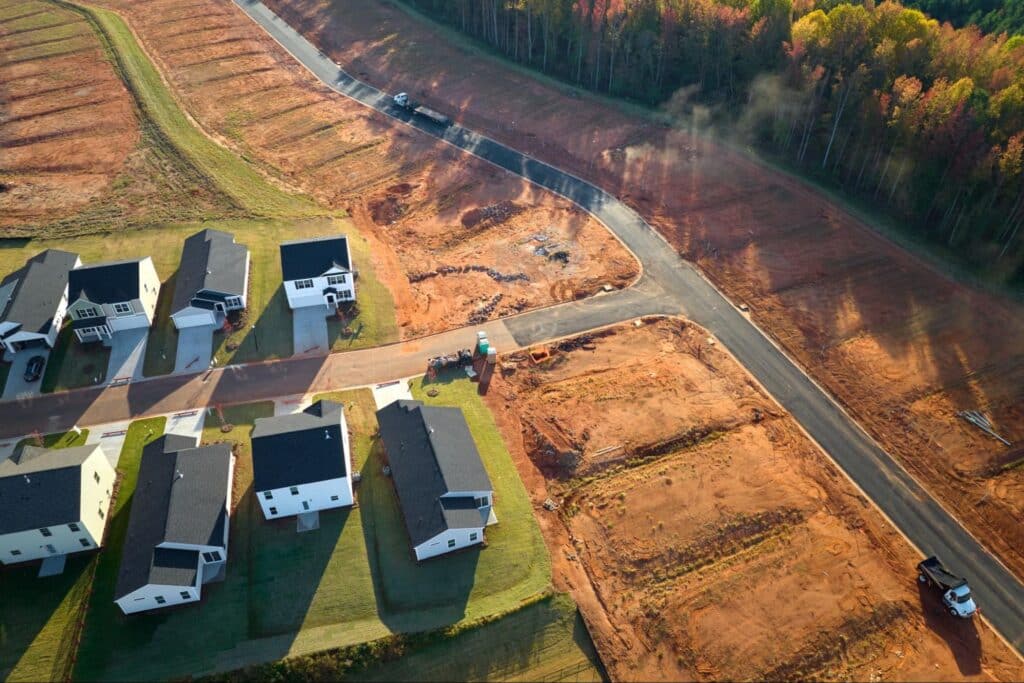
You’ve found a lot, or you’re about to, and one question keeps coming up: how much land do you need to build a house? In Southern Indiana the answer depends less on acreage than on what’s already at the lot. A subdivision lot with sewer and water can be under a fifth of an acre. A rural lot with septic and a private well needs room for separation distances, and the required distance to a well doubles where fast-draining soil sits near the surface.
Key Takeaways
- The land you need is buildable area, not gross acreage: what’s left after setbacks, easements, covenants, and any septic system.
- On a subdivision lot with sewer and water, the plan footprint plus setbacks set the size. Nationally, the median new single-family detached lot sold in 2025 was 8,543 square feet, under one-fifth of an acre.
- On a septic lot, Indiana’s state minimums put the absorption field at least 5 feet from lot lines, 10 feet from buildings, driveways, and patios, and 50 feet from a private well. Counties can be stricter only with state panel approval.
- Field size follows bedrooms and soil, at 150 gallons per day per bedroom divided by the soil loading rate (a jetted tub over 125 gallons counts as a bedroom). The soil evaluation comes before the permit, and the permit before construction.
- A USDA guaranteed loan has no specific limitation on site size or acreage, but land used principally for farming is ineligible.
Why “How Much Land” Really Means “How Much Buildable Land”
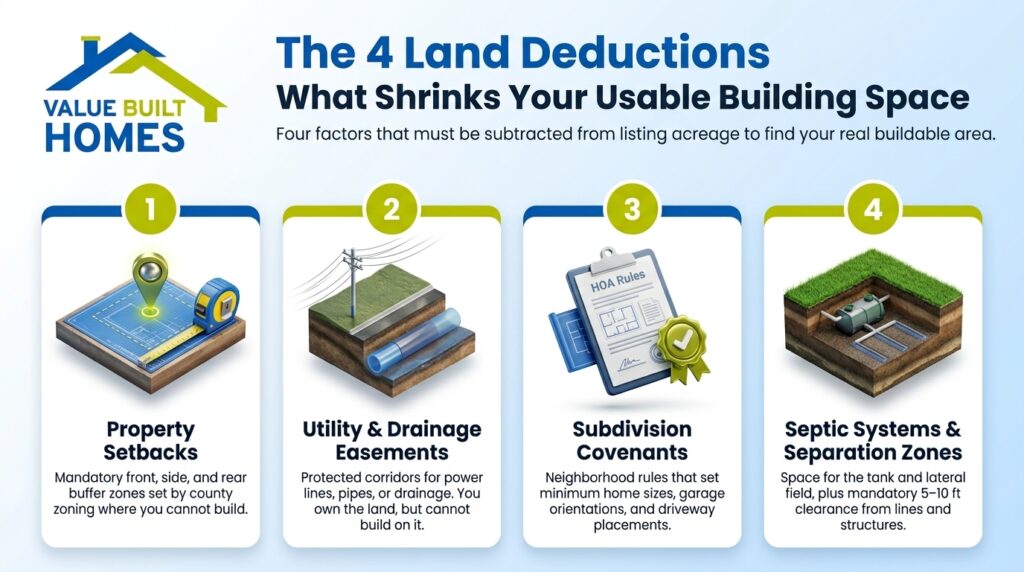
Buildable area is the part of a lot where the house and its systems can legally sit once setbacks, easements, covenants, and any septic system are subtracted. In Southern Indiana that number, not the listing acreage, decides whether a Value Built Homes plan fits.
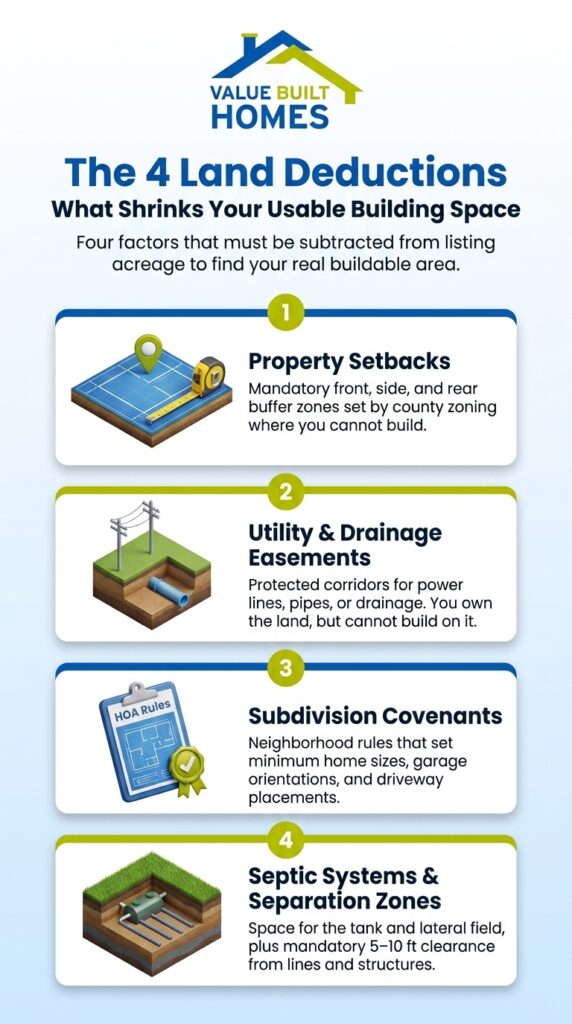
Four things come off the top before you measure for a house:
- Setbacks: how far the house must sit from each property line, per county zoning or the plat.
- Easements: strips reserved for utilities or drainage that you own but can’t build on.
- Covenants: subdivision rules that can set minimum house size, garage placement, or driveway location.
- The septic system, if there’s no sewer: a tank, an absorption field, and the required distances around both.
Still comparing parcels? The guide to choosing the ideal land for your home covers location, shape, and orientation.
Land Needed by Scenario: Sewer, Septic, or Septic Plus a Well
Here is the short answer for Southern Indiana buyers, including Value Built Homes buyers: what actually sets the land you need in each scenario, plus a financing footnote.
| Build scenario | Utilities on the lot | What actually sets the land you need | Source |
|---|---|---|---|
| Subdivision lot with public sewer and water (for example, a Value Built Homes community lot with sewer at the lot) | Sewer and water at the lot | The plan footprint plus the subdivision setbacks and covenants. Nationally the median new detached-home lot sold in 2025 was 8,543 sq ft, under 1/5 acre. A standard sewer connection is included; lots in a subdivision with sewer are covered. | NAHB analysis of Census data; Value Built Homes |
| Rural or unplatted lot with water service but no sewer | Water at the lot, septic required | The plan footprint plus the septic system. In Indiana the absorption field must sit at least 5 ft from lot lines and 10 ft from the house, garage, driveway, and patio; field size follows bedrooms and soil loading rate, so the soil evaluation comes before the permit and the permit comes before construction. Septic is priced separately. | 410 IAC 6-8.3; EPA; IDOH; Value Built Homes |
| Rural lot with septic and a private well | No public water or sewer | Everything in the row above plus 50 ft between the well and the absorption field, doubled where fast-draining layers sit within 34 inches of the surface unless the design overcomes it. This is the scenario where a lot that looks big runs out of buildable area fastest. | 410 IAC 6-8.3; EPA |
| Any of the above with a USDA guaranteed loan | Any | No specific limitation on site size or acreage; the appraiser explains how the site compares to other single family sites in the area. Land used principally for farming is ineligible. | USDA HB-1-3555, Ch. 12 |
Scenario 1: A Subdivision Lot With Public Sewer and Water
On a served lot, the land you need is the plan footprint plus the subdivision’s setbacks and covenants, with no septic field to place.
Of the scenarios in the table, this one needs the least land, which is why Value Built Homes sells build-ready lots in its Southwestern Indiana communities alongside its plans. Before you commit, check the plat’s setbacks, the covenants, and whether your plan still fits with an optional garage.
Scenario 2: A Rural Lot With Septic, With or Without a Well
On a lot without sewer, the septic system sets the land you need, and Indiana’s residential on-site sewage rule sets the minimums. The absorption field must sit at least 5 feet from lot lines and 10 feet from buildings, foundations, garages, patios, driveways, and paved sidewalks. If you also need a private well, add 50 feet between the well and the field.
Those are state minimums; your county health department applies them, and a county can add stricter requirements only through an ordinance approved by the state’s Technical Review Panel. Indiana local health departments issue more than 15,000 permits per year for new systems.
Why Soil Matters More Than Acreage on a Septic Lot
The soil is the treatment system: it accepts, treats, and disperses wastewater as it percolates through. How fast it takes water decides how big the field must be, which is why septic design and size vary with household size, soil type, site slope, lot size, and local regulations, not with acreage alone. Indiana’s rule makes it arithmetic:
- Field area is set by bedrooms and soil. The formula is 150 gallons per day times the number of bedrooms, divided by the soil loading rate. More bedrooms or slower soil means a bigger field.
- Fast-draining layers double the well distance. Where they sit within 34 inches of the surface, the well separation distances are doubled unless the design overcomes the hazard.
The Order of Operations on a Rural Lot
The rule fixes the sequence:
- Soil evaluation first. An on-site evaluation, including a description of the soil profile, is required before any permit is issued.
- Septic permit second. The health officer’s written construction permit is required before construction of the residence starts.
- Then the house. Value Built Homes prices septic separately because the cost varies with home size and ground conditions.
For system detail, see septic systems for new construction in Southern Indiana and well water versus city water. If you already own the parcel, start with the landowner’s guide to building on your own land.

How a Standardized Value Built Homes Plan Fits the Lot
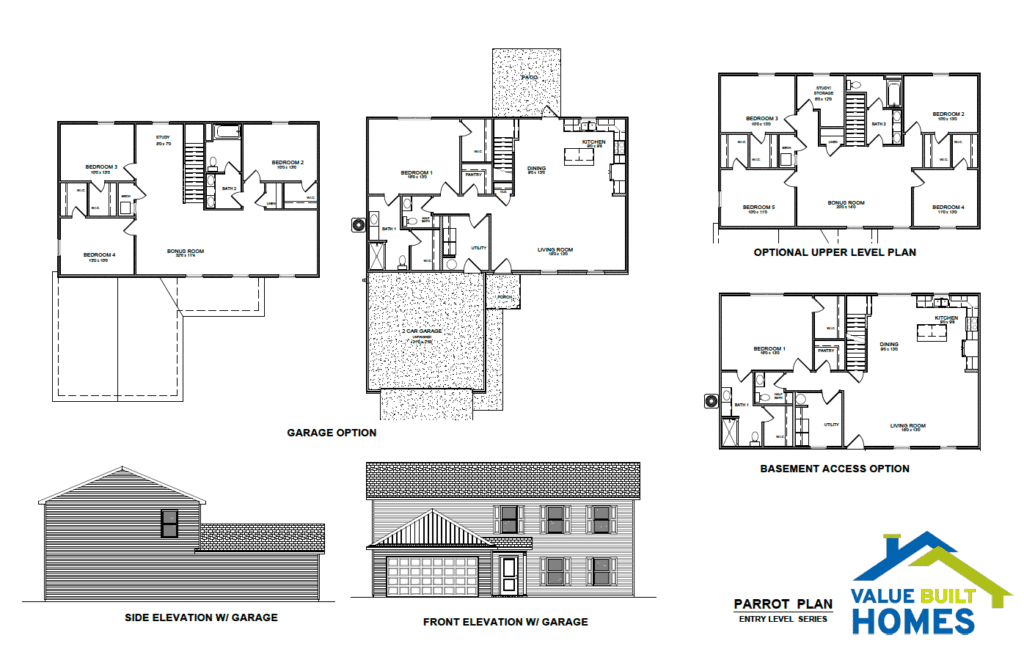
Value Built Homes floor plans range from 2 to 5 bedrooms and 870 to 2,514 square feet. The plan changes the land you need in two ways: the house footprint, and the bedroom count that sizes a septic field. Inclusions follow one rule: part of the standard plan means included; anything else is an optional add-on. Four items change your footprint or septic layout:
- Garage: included when it’s part of the standard plan, otherwise optional. It adds footprint and sits on the 10-foot separation list.
- Porch and patio: included only when the plan’s roofline is built for one; there’s no default porch or patio. Both sit on the 10-foot list.
- Basement: always an optional add-on. It doesn’t widen the footprint, but the foundation is on the 10-foot list too.
- Driveway: a rock construction drive is standard; a finished driveway is an upgrade. Either way it’s on the 10-foot list.
See the full breakdown of what’s included in a new construction home.
Does More Land Cost More to Build On?
It can. Acreage doesn’t change the price of the house, which the plan sets, but it lengthens everything that has to reach the house:
- Driveway: a longer run means more rock for the construction drive and more surface if you upgrade; see the driveway installation cost guide for Indiana buyers.
- Utility runs: water, electric, and a standard sewer connection are in the base price; unusual or long sewer connections are priced separately.
- Site prep: clearing and grading scale with distance and terrain; see the guide to site prep costs to build a house in Indiana.
For the full picture, see the cost to build a house in Indiana guide.
Steps to Take Before You Buy the Land
Do these in order:
- Check zoning with the county area plan commission; lot area and yard requirements are set in each local zoning ordinance.
- Pull the plat and covenants; the rundown of HOA rules and covenants for new construction in Indiana explains how to find them.
- Confirm utilities at the lot: sewer and water, water only, or neither. That picks your row in the table above.
- Order the soil evaluation if septic is needed, and walk the lot; the tips on selecting a lot for new construction cover what to look for.
- Then pick the plan, matching bedrooms to the field and the footprint (with any optional garage or porch) to the buildable area.
Frequently Asked Questions About How Much Land You Need to Build a House in Southern Indiana
Is there a minimum lot size to build a house in Indiana?
There is no single statewide minimum. Indiana lets each local zoning ordinance set total lot area and yard requirements by district, and covenants can add their own; ask your county area plan commission. The state septic rule sets separation distances and a field-size formula, not a lot size.
Do I need an acre of land for a septic system in Indiana?
No acreage is written into the rule. Indiana requires that sufficient area exists on the lot for an appropriately sized system while meeting the separation distances and dispersal area requirements. A smaller lot with good soil can pass; a large lot with soil that fails the evaluation may not.
Does a USDA loan limit how much land I can buy?
Not by size. A USDA guaranteed loan has no specific limitation to the size/acreage of the site; the limit is use, since land used principally for agricultural, farming, or commercial purposes is ineligible. The guide to USDA loans for new home construction in Indiana covers eligibility.
Ready to Match a Plan to Your Lot?
The land question gets easier once you know what’s at the lot. Questions about building in Southern Indiana? Contact the Value Built Homes team to talk through your parcel and which plans fit it.