If you’re weighing a build in Southwestern Indiana, the first question is usually the hardest to answer: what does it actually cost to build a house in Indiana? National calculators throw out wide per-square-foot ranges that rarely match what a home costs here. This guide pairs verified 2025 and 2026 data with what an affordable, standardized build in the tri-state area actually includes, so you can turn a vague average into a real number for your family.
Key Takeaways
- The median new single-family home sold in the U.S. in 2025 cost $417,400, on a median size of 2,194 square feet.
- Construction made up 64.4% of a new home’s sale price in 2024, and the finished lot added another 13.7%.
- In the region that includes Indiana, custom homes ran a median of $186 per square foot in 2024, the third-highest custom-home region. Standardized, production-style homes sit below custom pricing.
- Interior finishes (24.1%) and system rough-ins (19.2%) are the two largest construction stages, so finish choices move the budget most.
- The Midwest was the only U.S. region with rising new-home sales in 2026, up 2.6% year to date, reflecting its lower cost base.
- Value Built Homes builds site-built homes on standardized plans (2 to 5 bedrooms, 870 to 2,514 square feet) and saves most buyers between 20% and 30% compared to building elsewhere.
How Much Does It Cost to Build a House in Indiana?
There’s no single sticker price, but verified data gives real anchors. The median new single-family home sold nationally in 2025 was $417,400 on a median 2,194 square feet, and construction made up 64.4% of a new home’s sale price in 2024, with the finished lot adding 13.7%. Your total comes down to plan size, finishes, and the lot you build on.
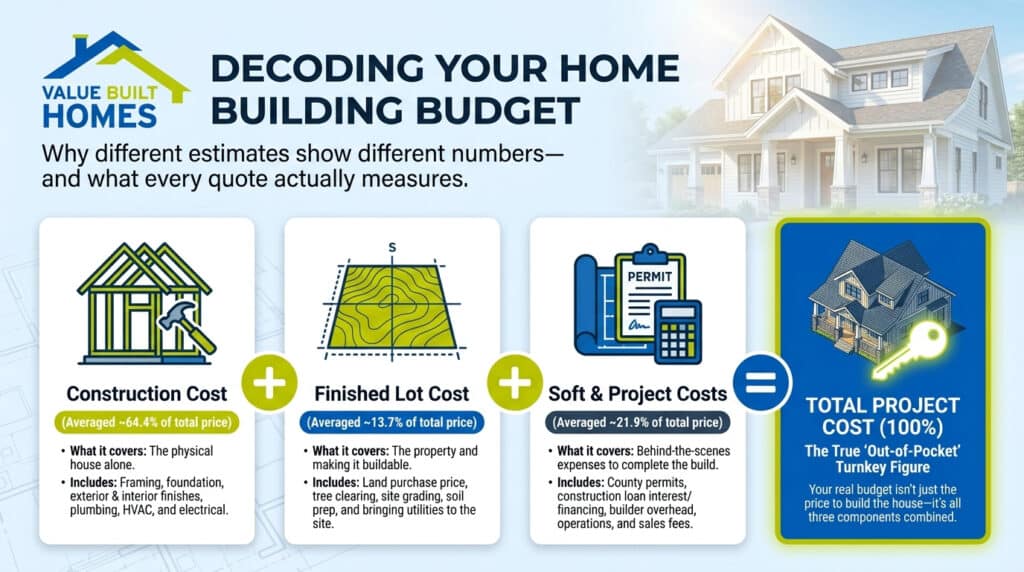
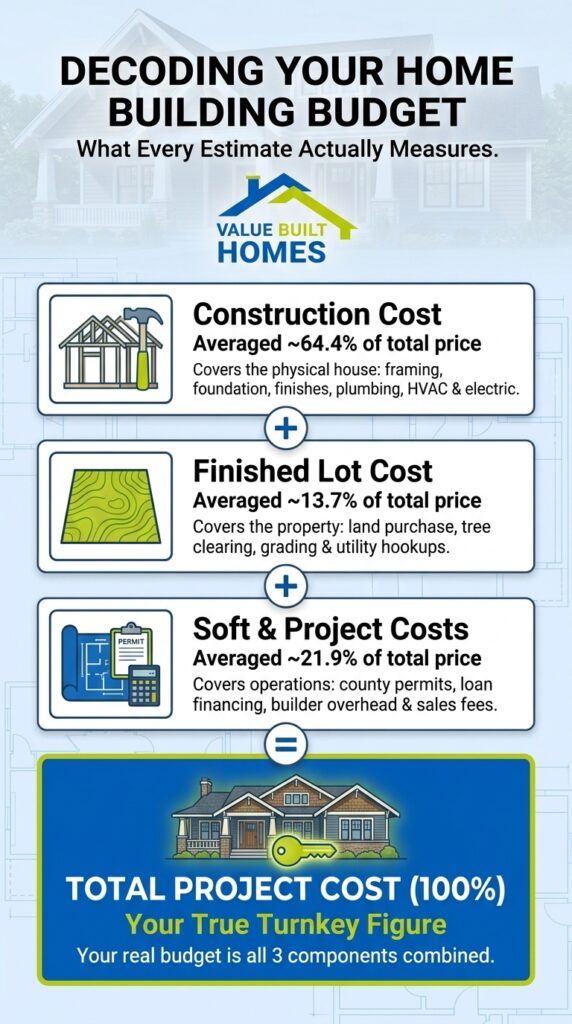
Before you compare any two cost-to-build figures, know which one you’re looking at, because they measure different things:
- Construction cost: the price of the physical home, which was 64.4% of the average new-home sale price in 2024.
- Finished lot: the land plus the work to make it buildable, at 13.7% of the sale price.
- Total project cost: construction plus the lot plus soft costs like overhead, financing, and commissions.
Homes built on standardized, cost-engineered plans are designed to come in below the custom-home benchmarks behind most published averages. Value Built Homes builds affordable, site-built new home construction across Southwestern Indiana and the tri-state area and publishes plan pricing openly. If you want the budgeting side of the picture, the guide to planning a new home construction budget walks through it step by step.
Where Your Construction Dollars Go: A 2026 Cost Breakdown
Most of a construction budget flows into finishes and systems, not the parts buyers expect. In 2024, interior finishes (24.1%) and major system rough-ins like plumbing, HVAC, and electrical (19.2%) were the two largest stages, together more than 40% of construction costs. Framing followed at 16.6%.
Here is where the money goes, using the most recent national cost data from the National Association of Home Builders. The first table breaks construction costs down by stage. The second shows how the full sale price divides up.
| Construction stage | Share of construction cost |
|---|---|
| Interior finishes (cabinets, flooring, paint, fixtures) | 24.1% |
| Major system rough-ins (plumbing, HVAC, electrical) | 19.2% |
| Framing | 16.6% |
| Exterior finishes | 13.4% |
| Foundations | 10.5% |
| Site work | 7.6% |
| Final steps | 6.5% |
| Other | 2.1% |
Source: NAHB Eye on Housing, Cost of Constructing a Home in 2024.
| Component of the sale price | Share of sale price |
|---|---|
| Construction costs | 64.4% |
| Finished lot | 13.7% |
| Builder profit | 11.0% |
| Overhead and general expenses | 5.7% |
| Sales commission | 2.8% |
| Financing costs | 1.5% |
| Marketing | 0.8% |
Source: NAHB Cost of Construction Survey, 2024 and NAHB Eye on Housing.
The two stages most affected by your land, site work and foundations, together account for about 18.1% of construction costs. In Southern Indiana, that is the slice your lot and terrain move the most, which is where local pricing diverges from national averages.
What Is the Cost Per Square Foot to Build a House in Indiana?
Per-square-foot cost depends heavily on whether a home is custom or production-built. Nationally in 2024, custom (contractor-built) homes ran a median of $166 per square foot and spec homes $153. In the East North Central region that includes Indiana, custom homes were higher at $186 per square foot, the third-highest custom-home region.
That $186 figure is custom-home pricing, so it is not the price of every Indiana build. Standardized, production-style homes are built to sit below custom pricing by reusing proven plans and cutting decisions.
Value Built Homes does not quote a single per-square-foot number, because the real figure depends on the plan and finishes you choose. You can browse Value Built Homes’ floor plans to compare 2 to 5 bedroom options from 870 to 2,514 square feet, with plan pricing that generally runs from about $129,900 to $238,500 depending on the plan. From there, the team builds a personalized quote around your plan and lot, so you get a real number for your build instead of a national average.
How Southern Indiana Lots, Site Prep, and Permits Move the Number
Your land is the single biggest local variable. The finished lot made up 13.7% of a new home’s sale price in 2024, and site work plus foundations added about 18.1% of construction costs. In Southern Indiana, lot price, soil conditions, topography, and county permit rules decide where your number lands.
A few factors specific to the tri-state area push site costs up or down:
- Lot price and location: an established lot in a developed subdivision usually costs less to prepare than raw rural land. Compare available lots in Southern Indiana to see how location shifts the starting point.
- Site prep and soil: clearing, grading, and foundation work vary with terrain and soil type. The breakdown of site prep costs to build a house in Indiana covers what to expect.
- County permits: requirements and fees differ across Indiana, Illinois, and Kentucky. The guide to building permits across Southwest Indiana, Southeast Illinois, and West Kentucky explains the local rules.
This is where working with one builder changes the math. A Value Built Homes build covers the foundation, water, and electric as standard, and the same team handles site work, septic, and your driveway rather than leaving you to line up separate vendors. Items that depend on your lot, like septic and a finished driveway, are quoted separately, so they are planned into your total up front instead of surfacing as surprises later.
Site-Built, Modular, and Custom Homes: How the Costs Compare
Site-built (stick-built) homes are constructed entirely on your lot, while modular homes are built in sections at a factory and assembled on site. Custom homes design every element from scratch, which is why they carry the highest per-square-foot cost. That East North Central custom median of $186 per square foot reflects the custom premium.
Site-built and modular homes get compared on price, but a fair comparison only works if both quotes cover the same scope. A Value Built Homes package already includes the foundation, site work, and utilities, which reduces the add-ons that can appear after a base quote. One Value Built Homes homeowner shared that they “ended up spending the same amount for our stick built home as we were going to with the modular company.”
Value Built Homes sits between the extremes: true site-built construction, but on standardized plans that keep pricing closer to production levels than custom. That is the model that trims both cost and the decision fatigue that stretches out custom builds.
Is It Cheaper to Build or Buy a House in Indiana?
Whether it is cheaper to build or buy depends on the market, but the Midwest currently favors building at the affordable end. New-home sales rose 2.6% year to date in the Midwest in 2026, the only U.S. region with growth, and homes priced under $300,000 made up 23% of June 2026 sales, up from 16% a year earlier.
Buying an existing home can be faster and, in some markets, cheaper up front. Building lets you skip another owner’s deferred maintenance and start with new systems, new materials, and a warranty. NAHB’s chief economist noted that the sub-$300,000 price point is “generally only achievable in markets with lower development and construction costs,” which describes Southern Indiana well.
If you would rather weigh new construction against existing options, Value Built Homes also lists move-in-ready homes for sale alongside its build program.
The Costs Buyers Forget: Financing, Allowances, and Overruns
Two costs surprise first-time builders most: construction-loan interest and overruns from allowances and change orders. Financing costs made up 1.5% of a new home’s sale price nationally in 2024, and every change order or upgraded allowance adds to the base price.
Here is how each one works and how a standardized build limits it:
- Construction-loan interest: during the build, you are usually paying interest on the funds drawn to pay for it. Value Built Homes offsets this with Free Construction Financing, covering the construction-loan interest during the build phase.
- Allowances and change orders: budgets run over when finish selections exceed their allowances or plans change mid-build. A fixed-scope standardized plan locks most decisions up front, which limits those surprises.
- What is included versus billed later: knowing what is in the base price protects your budget. Value Built Homes backs its homes with a 2-10 Home Buyers Warranty that covers structural defects for 10 years.
One Value Built Homes homeowner described the turnkey scope simply, saying the team “took care of all the headache items like septic, foundation and water.”
How to Turn These Averages Into a Real Number for Your Build
National averages are a starting point, not a quote. The only way to know your cost is to price a specific plan on a specific lot, and that is a short conversation when the plans are standardized and priced up front. Start with a plan size that fits your family, then factor in your lot and any options. From there, the Value Built Homes team can turn a standardized plan into a personalized quote for your build.
Frequently Asked Questions About Building a House in Indiana
What is the average cost to build a modular home in Indiana?
Modular home pricing varies widely by manufacturer, plan, and how much site work a given quote includes, so a single average can mislead. The most useful comparison is total delivered cost, including foundation, utilities, and finishing, not just the base factory price. Value Built Homes builds site-built (stick-built) homes on standardized plans, not modular.
How much does it cost to build a custom home in Indiana?
Custom homes carry the highest per-square-foot cost because every element is designed from scratch. In the East North Central region that includes Indiana, custom homes ran a median of $186 per square foot in 2024. Standardized plans cost less by reusing proven designs, which is the approach Value Built Homes takes.
Does the cost to build include the lot, septic, and driveway?
Not always, and that is where budgets break. The finished lot alone made up 13.7% of a new home’s sale price in 2024, and site work is often billed separately from the base price. With Value Built Homes, the foundation, water, and electric come standard, and the team also handles site work, septic, and your driveway as part of one coordinated build. Items that vary with your lot, like septic and a finished driveway, are quoted separately, so you see them up front instead of discovering them mid-build.
How long does it take to build a house in Southern Indiana?
Timelines vary with weather, permitting, and plan complexity. Value Built Homes builds its standardized plans in roughly 5 to 7 months, faster than many custom builds because the plans and decisions are set up front. A shorter build also means less construction-loan interest along the way.
Ready to Build in Southern Indiana?
Building a home does not have to start with a scary, unknown number. With standardized plans, transparent pricing, and a coordinated build, you can move from national averages to a real quote quickly. Have questions or ready to price a plan? Contact the Value Built Homes team to get a personalized quote for your build.