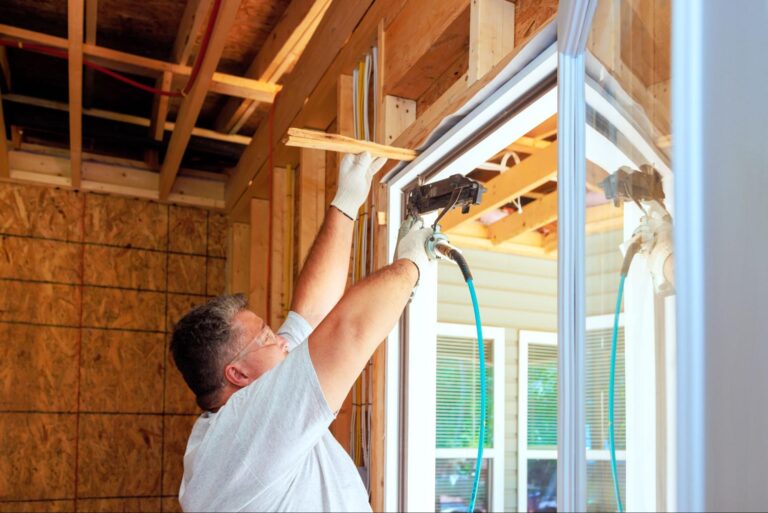
When you build a new home on your own land in the tri-state area, one of the first questions to settle is where your water comes from. The choice between well water vs. city water for new construction shapes your upfront budget, your monthly costs, and who is responsible for keeping the water safe. This guide walks through that decision from a builder’s side of the table, with the Indiana rules, real costs, and local geology that most national comparisons skip.
Key Takeaways
- A private well and a community water connection each fit different lots. Wells suit rural or on-your-own-land parcels beyond a municipal line, while community water fits developed areas and subdivisions with existing mains.
- Drilling a private well costs roughly $5,300 to $9,200 on a national average, and Southern Indiana bedrock can push depth and cost higher. Community water runs about $42 per month on average and varies widely by location.
- Public drinking-water rules do not apply to private wells, so the owner tests the water. Plan to test at least once a year for total coliform bacteria, nitrates, total dissolved solids, and pH.
- Indiana requires a licensed driller, a well record filed within 30 days, at least 25 feet of casing, and at least 50 feet between a new septic system and a domestic well.
- Nitrate is the main water-quality concern on rural, agricultural lots, so test for it every year.
- You can look up real well depth and yield near a specific lot in Indiana’s Water Well Record Database before you buy.
Private Well vs. Community Water: A Quick Comparison for an Indiana New Build
Here is how the two water sources compare on the factors that matter most for a new build in Southwestern Indiana.
| Factor | Private well | Community / city water | Source |
|---|---|---|---|
| Upfront cost | Roughly $5,300 to $9,200 to drill on a national average. Bedrock can raise it. | Generally low. A new build may still need a water main line and tap fee (varies by utility). | Angi |
| Ongoing cost | No water bill. You pay for pump electricity and occasional maintenance. | About $42 per month on average, varies widely by location. | Angi |
| Who tests or monitors | You do. Test at least yearly for coliform, nitrates, TDS, and pH. | The utility. Public systems are regulated and monitored. | EPA; CDC |
| Regulation | Not covered by EPA public-water rules. Indiana driller must be DNR-licensed; well record filed in 30 days. | Regulated public water system. | CDC; DNR |
| Indiana build standards | At least 25 ft of 2-inch casing; at least 50 ft from a new septic system. | Utility sets connection and metering standards. | DNR; Indiana State Dept. of Health |
| Local geology | Often bedrock (fractured limestone or porous sandstone), which affects depth and yield. | Not applicable. | DNR |
| Reliability | Independent of the municipal supply, but the pump needs power. | Utility-managed; large disruptions are uncommon. | Angi |
| Best fit | Rural or on-your-own-land lots beyond a municipal line. | Lots in developed areas and subdivisions with existing mains. | Angi |
Why Do Some Houses Have Well Water and Others City Water?
The difference comes down to location and infrastructure, not preference. Homes in developed areas and platted subdivisions usually tie into an existing community water main. Homes on rural or on-your-own-land parcels beyond that main often rely on a private well, because extending a public line to a distant lot can be costly or impractical.
Two water sources, defined:
- A private well is a cased shaft drilled on your property that draws groundwater to a pump, which pressurizes it for the house. You own the equipment and the water.
- Community or municipal water is a regulated public system that treats, tests, and delivers water to your home through a metered connection, billed monthly.
If you already own a rural parcel or are eyeing one, the water question is part of a bigger site picture. Our guide to building a house on your own land in Southern Indiana covers the wider set of parcel-specific decisions that come with it.
Which Is Better, a Private Well or Community Water?
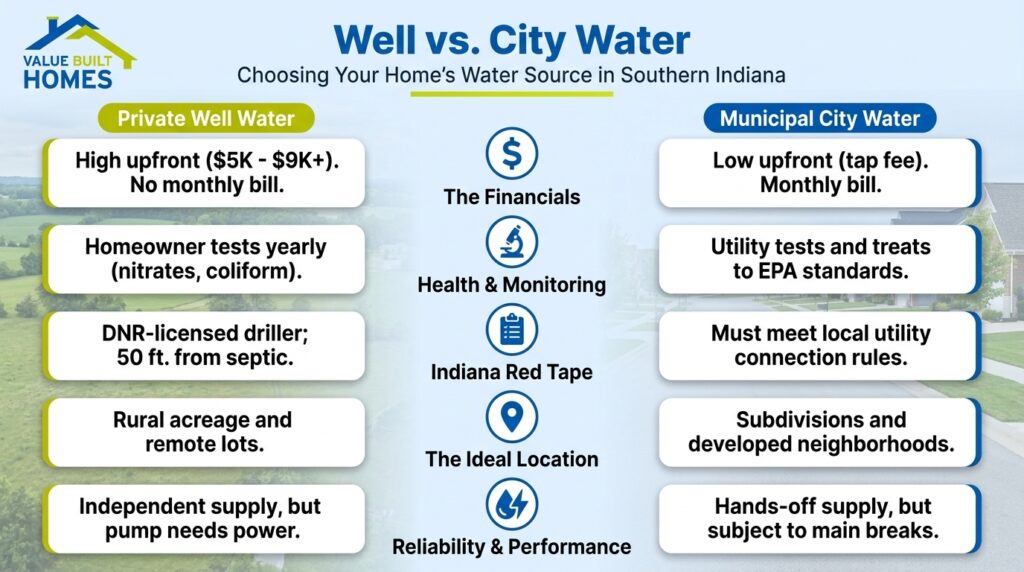
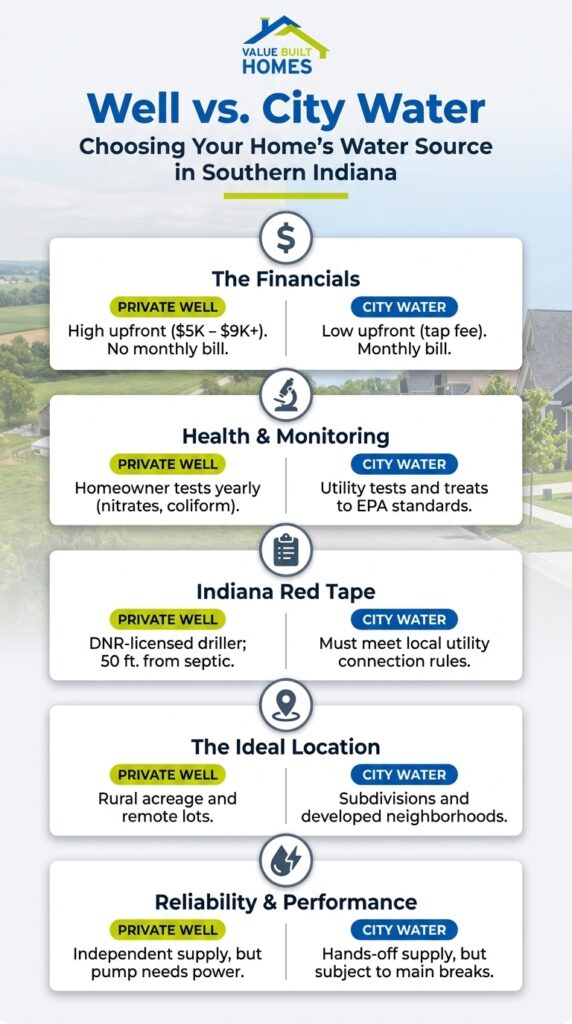
Neither is universally better. The right choice depends on your lot, your budget, and how much independence and upkeep you want. A well gives you an independent supply with no monthly bill but puts testing and maintenance on you. Community water hands monitoring to a regulated utility in exchange for a recurring bill.
Weigh these factors for your situation:
- Cost pattern: A well is a larger upfront cost with little ongoing cost. Community water is little upfront and a steady monthly bill.
- Control versus convenience: A well is yours to manage, from testing to repairs, and does not depend on a utility. Community water hands that upkeep to the utility.
- Location: If a community main already runs to the lot, connecting is usually simpler. If it does not, a well may be the only practical option.
How Much Does It Cost to Drill a Well in Indiana?
Drilling a private well costs roughly $5,300 to $9,200 on a national average, and Southern Indiana’s bedrock can raise both the depth and the price. After that, there is no monthly water bill, though you do pay for the pump’s electricity and occasional maintenance. Community water skips the drilling cost and runs about $42 per month on average, varying widely by location.
The two sources spend your money on different schedules:
- Private well: Most of the cost is upfront, in the drilling and pump. A well commonly lasts 25 to 100 years, so that one-time cost is spread over a long life.
- Community water: Little to no drilling cost, but a new build may still need a water main line and a tap fee that varies by utility. That connection is one piece of your broader utility connection planning.
Does well water save money? Over a long time horizon, skipping the monthly bill can offset the drilling cost, but there is no guaranteed break-even point. Bedrock depth, pump electricity, and annual testing all factor in. For a fuller view of where a well and other site work land in a build budget, see our breakdown of the hidden costs in a new home budget.
Indiana Well Rules Every New Build Should Know
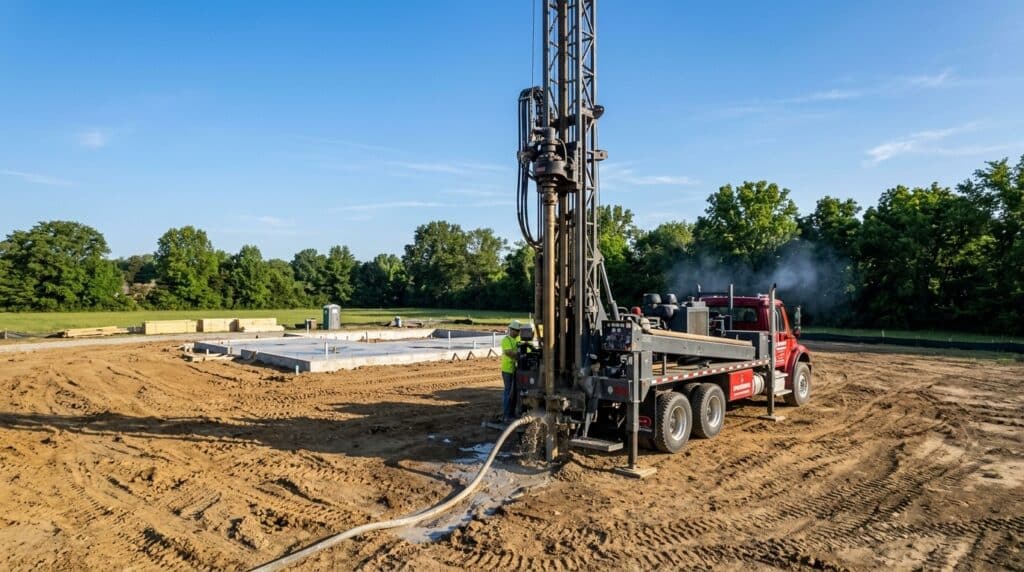
Indiana sets clear rules for new wells. Only a DNR-licensed water well driller may drill one, a well record must be filed within 30 days, the well needs at least 25 feet of casing at least two inches in diameter, and a new septic system must sit at least 50 feet from a domestic well. These are baseline requirements for a legal, safe well, not optional extras.
The essentials for a new Indiana well:
- Licensed driller and filed record: Your driller must hold a DNR license, and a well record (State Form 35680) is filed within 30 days of construction.
- Casing standard: The standard is at least 25 feet of casing, at least two inches in diameter, extending at least a foot above the ground. Where bedrock sits close to the surface, the DNR may allow shorter casing by variance.
- Septic separation: A new septic system has to sit at least 50 feet from a domestic water well.
That last rule ties your water and wastewater decisions together, which is why it pays to plan them side by side. Our guide to septic systems for new construction in Southern Indiana covers the wastewater half of the equation.
How Southern Indiana Geology Affects Your Well
Indiana bedrock wells often draw from fractured limestone or porous sandstone, and that geology affects how deep a driller has to go, how much water the well yields, and what it costs. Where sand-and-gravel aquifers are present instead, wells tend to be more productive at shallower depths.
You can check real numbers for your area rather than guess, which lowers the risk of a bad drilling spot:
- Look up nearby wells: Indiana’s Water Well Record Database holds more than 400,000 well records, so you or your driller can check depth and yield near a specific lot before committing.
- Test the site first: A well-industry expert’s advice is direct. Have a professional evaluate the site before drilling, because starting in the wrong spot still costs you for the dry hole.
Who Tests the Water, and What Should You Test For?
With a private well, testing is your responsibility. The federal rules that protect public water systems do not apply to privately owned wells, so the owner tests at least once a year for total coliform bacteria, nitrates, total dissolved solids, and pH. A community water utility handles that monitoring for you.
A practical testing routine for a private well:
- Annual test: Check for total coliform bacteria, nitrates, total dissolved solids, and pH every year.
- After construction: Test again right after new construction or nearby land disturbance, which can change what reaches the water.
- Nitrate focus: On rural and agricultural land, nitrate from farm runoff, fertilizer, and nearby septic systems is the core concern, so test for it every year.
Is well water healthier than city water? Neither is automatically healthier, and both can be perfectly safe to drink. The difference is oversight: public water is treated and monitored to federal standards, while a private well’s safety depends on your testing and any treatment you add.
What Are the Disadvantages of a Private Well?
The main tradeoffs are responsibility and dependence. You own the testing, maintenance, and repairs, the pump needs electricity to run, and a well can lose yield or face contamination on lots near agriculture. Community water shifts those responsibilities to the utility.
The tradeoffs to plan around:
- You manage the water: Testing, treatment, and repairs are on you, not a utility.
- Power dependence: The pump runs on electricity, so an extended outage can interrupt your supply unless you have a backup.
- Contamination exposure: Lots near farmland face more nitrate and runoff risk, which is why annual testing matters.
- Yield can change: A well can slow down or run low as the water table shifts or the well ages.
What happens if a well runs dry? A well can lose yield if the water table drops or the equipment ages. The usual options are deepening the existing well, drilling a new one, or connecting to a community main if one is now within reach. Checking nearby well records for typical depth and yield before you drill lowers this risk from the start.
Frequently Asked Questions About Well Water and City Water
Is well water safe to drink?
Well water can be perfectly safe to drink, but it is not guaranteed and it is not monitored for you. Because public drinking-water rules do not apply to private wells, you are responsible for testing at least yearly and treating any problems you find. Consistent testing is what keeps a private well safe.
Does a private well add value to a home?
It depends on the location and the buyer. On rural lots where a well is the norm, a properly cased, tested, and well-maintained well is expected and supports the home’s value. Some buyers prefer the hands-off nature of community water, so the resale impact varies by market.
Can I connect to community water later if a main reaches my lot?
Often yes. If a community water line is extended to your area after you build, you can usually connect to it, though you will pay the utility’s connection and tap fees. Confirm availability and cost with the local utility and your build team before counting on a future hookup.
What happens to an old well when a home switches to community water?
An unused well should be sealed by a qualified well contractor rather than left open, so it does not become a path for surface contamination to reach groundwater. Your build team or the county health department can walk you through the local requirements.

Planning Your Water Source with Value Built Homes
Your water source is one piece of a larger site plan that also involves septic, utilities, and the lot itself. Homes in the Value Built Homes subdivisions across Southwestern Indiana come with water service as part of the build. If you are building on your own land beyond a municipal line, the smartest first step is to confirm how water will be handled for your specific parcel.
Ready to plan your water, septic, and utilities together? Contact the Value Built Homes team to talk through your lot. If you are still choosing where to build, browse available lots in Value Built Homes’ communities, or see how Value Built Homes approaches affordable new-home construction and keeps the process simple from start to finish.