Site prep costs to build a house in Indiana can vary wildly from one quote to the next, and most builders don’t spell out which costs are bundled into the home price and which get billed separately. This guide walks through the pre-foundation costs Indiana buyers run into, what state rules require, and how to read a builder’s quote on a true total-cost basis.
Key Takeaways
- Site prep covers everything between buying a lot and pouring a foundation: clearing, grading, soil testing, septic, well or water tap, electric, drainage, driveway, and permits.
- The finished lot represents about 13.7% of the average new home’s sales price nationally, per the most recent NAHB Cost of Construction Survey, with site work and foundations combined adding another 18% of construction cost.
- In Indiana, residential septic systems must be sized at 150 gallons per day per bedroom and evaluated by a Registered Soil Scientist under Rule 410 IAC 6-8.3, and placed at least 50 feet from any domestic water well.
- Value Built Homes’ home package bundles foundation, basement, garage, driveway, septic, water, electric, sidewalks, porches, and patios. Many other builders bill several of those line items separately.
- Subdivisions in Southwestern Indiana typically cost less to prepare than rural acreage because utilities, roads, and drainage are already brought to the lot.
- Most pre-foundation surprises trace back to the wrong question at the lot stage. Confirming soil, septic feasibility, utility access, and permitting before you buy protects the budget.
What Site Prep Actually Means Before the Foundation Goes In
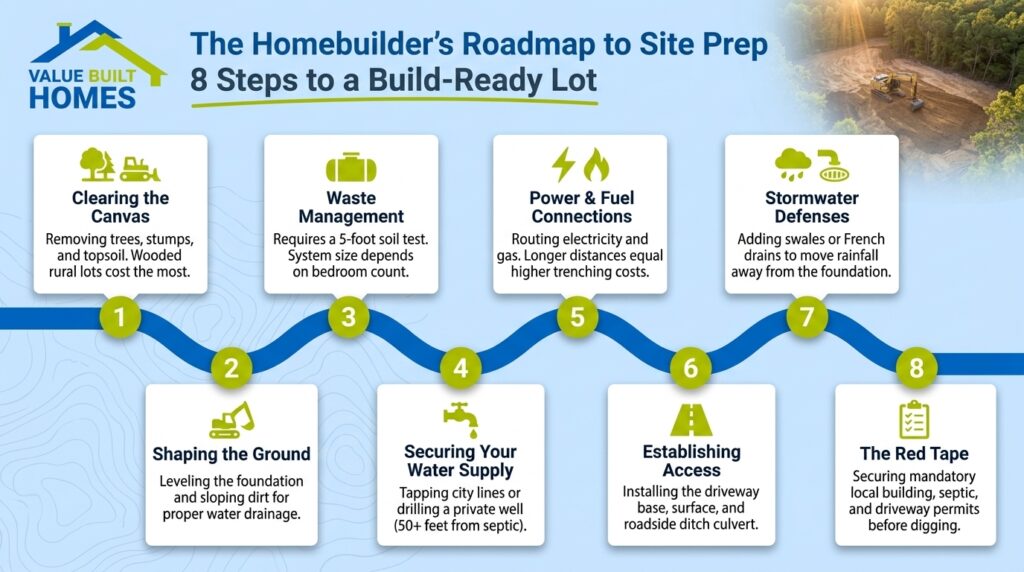
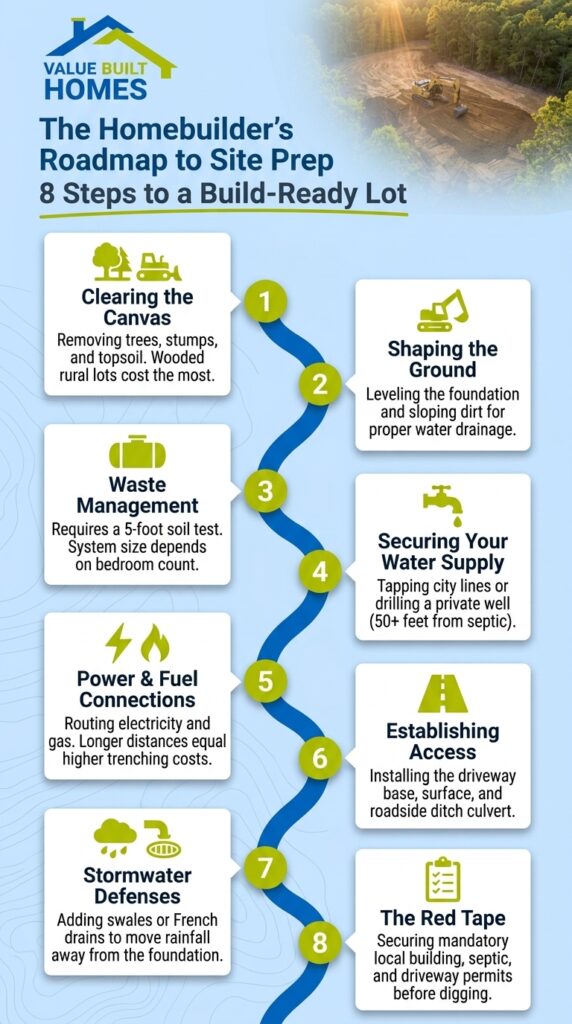
What site prep covers: every cost between owning a buildable lot and having a foundation ready to pour. That includes clearing trees and brush, grading the ground, testing the soil for both foundation and septic suitability, installing a septic system or connecting to sewer, drilling a well or running a water tap, bringing electric and gas to the home, building a driveway and culvert, drainage, and permits. None of it is the house itself, and all of it has to happen first.
Why quotes vary so much: some builders include most of these line items in the home price, while others quote the home alone and leave the rest to the buyer. The finished lot accounted for 13.7% of the average new home sales price in 2024, down from 17.8% in 2022, per the most recent NAHB Cost of Construction Survey, and within construction costs themselves site work made up 7.6% and foundations another 10.5%, roughly a fifth of construction spend going to work that happens before the frame goes up.
The Main Site Prep Cost Categories in Southwestern Indiana
Here is what each of those categories actually includes, in the order they usually come up on a Southwestern Indiana build. The dollar amounts depend on the lot, but the work itself is predictable.
Clearing and Grubbing
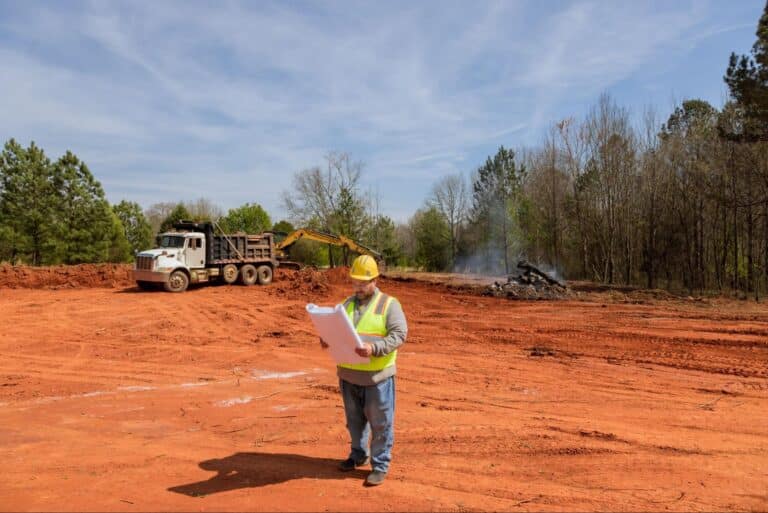
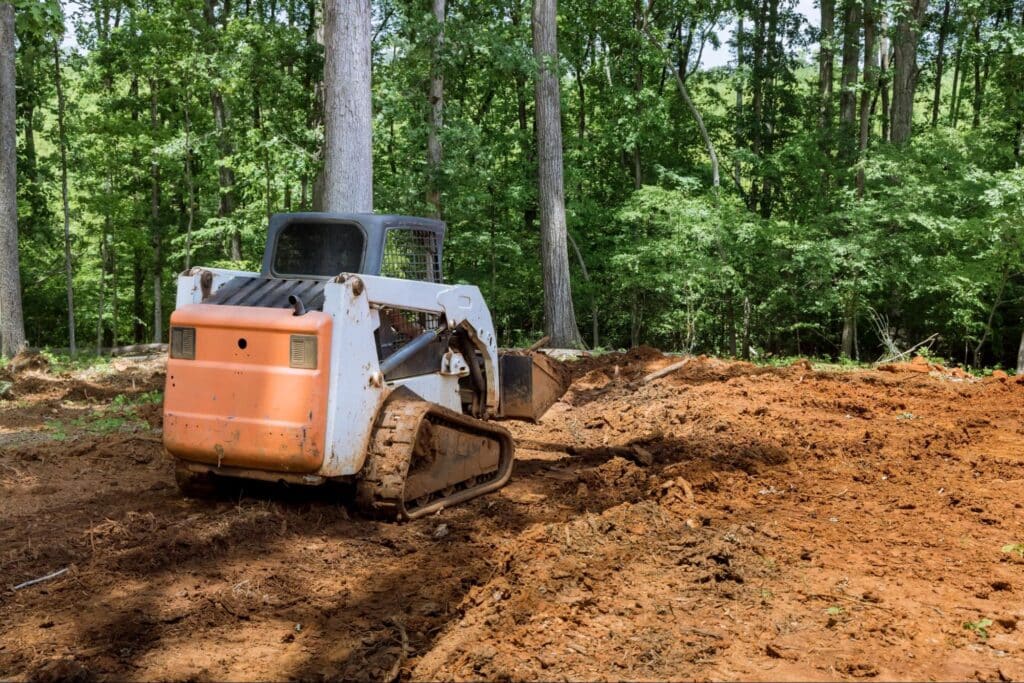
Clearing and grubbing removes trees, brush, stumps, and topsoil from the home’s footprint and access points. On a wooded rural lot in Gibson, Posey, Vanderburgh, or Warrick County, this can be a meaningful line item. On a finished subdivision lot it’s usually minimal, since the developer has already cleared the building envelope. Cost scales with how much vegetation comes out and where the debris goes.
Grading and Earthwork
Grading shapes the ground so water moves away from the house and the foundation sits level. It also includes hauling fill in or hauling spoil out. Lots that slope, sit low, or have soft soil need more work; flat subdivision lots with good drainage need less. Soil and topography drive cost here more than square footage does.
Septic System and Soil Profile Evaluation
Any Indiana lot without municipal sewer needs an on-site septic system, and the state sets specific design and placement rules. For a fuller walkthrough of how the system is sized, installed, and maintained, see our companion guide to septic systems for new construction in Southern Indiana. On the cost side, two state requirements drive timing and price more than the rest:
- Sizing: Indiana sizes residential septic at 150 gallons per day per bedroom under Rule 410 IAC 6-8.3. A three-bedroom home is designed for 450 gallons per day, a four-bedroom for 600. More bedrooms means a larger system.
- Soil profile evaluation: the evaluation must be performed by a Registered Soil Scientist and must examine the soil to at least five feet deep. This is what the county health department uses to issue the permit. Poor soil can mean a more expensive design, an alternate system, or in rare cases a lot that won’t perc at all.
Septic is also one of the line items that varies most between builders. Some include the system, the evaluation, and the permit in the home package. Others quote it separately and let the buyer arrange it with a septic contractor.
Water Well or Municipal Water Tap
If city or rural water is available at the road, the cost is the tap fee, the meter, and the line from the right-of-way to the house. If the lot is too remote for that, the home needs a private well. Indiana sets minimum standards for residential wells, including at least 25 feet of casing at least two inches in diameter, with the casing extending at least one foot above ground (two feet above the 100-year flood elevation in flood hazard areas). Well placement also has to respect the minimum 50-foot separation between a domestic water well and a septic tank or soil absorption system. Local county health departments may set additional or more stringent setbacks, so confirm locally before finalizing well and septic placement.
Electric, Gas, and Other Utility Tie-Ins
Utility tie-in costs depend on how far the home sits from existing service. A subdivision lot with electric already at the road is the cheapest scenario. A rural lot where the utility has to run hundreds of feet of new service can be one of the largest unexpected expenses on the build. Not every rural lot has gas service available, in which case the home is built electric or propane. For the broader picture, see our Indiana utilities master guide for homebuilding.
Driveway and Culvert
A driveway includes base prep, the surface (gravel, asphalt, or concrete), and any culvert pipe needed where the driveway crosses a roadside ditch. County requirements for culvert size and installation vary, and most counties require a driveway permit. For a deeper breakdown of pricing, see our guide to driveway installation costs for Indiana buyers.
Drainage and Stormwater
Drainage covers anything beyond standard grading that moves water away from the home: swales, French drains, sump discharge lines, gutter tie-ins, and in some cases stormwater detention features required by the county. Subdivision lots usually have drainage planned at the development level. Rural lots may need more work, particularly in flat or low-lying parts of Southwestern Indiana.
Permits and Impact Fees
A typical Indiana new build needs a building permit, a septic permit (where applicable), a driveway permit, and sometimes a well permit. In Value Built Homes’ service area, septic permits are issued at the county health department level under the state rule. Building permits go through the county or municipal building authority. Fee structures vary; call the county before finalizing your numbers. For an overview across the tri-state area, see our guide to building permits in SW Indiana, SE Illinois, and W Kentucky.
What’s Bundled in a Home Package vs. Billed Separately
The biggest cost difference between builders isn’t usually the house itself. It’s what each builder includes in the quoted price. Some quote the house alone and let the buyer arrange the rest. Others bundle the major site prep line items into a single package, so the quote is much closer to the all-in cost.
Value Built Homes’ new home construction package includes the home, foundation, basement, garage, driveways, septic systems, water, electric, sidewalks, porches, and patios. Here’s how that bundle maps to the cost categories Indiana buyers ask about most:
- Foundation and basement: included, designed to match the floor plan and lot conditions.
- Driveway: included as part of the package.
- Septic system: included where the lot supports a standard system. Unusual soil or alternate-system designs can carry additional cost.
- Water: included as a municipal connection or as a residential well, depending on what the lot supports.
- Electric: included as the service connection to the home. Unusually long runs from existing utility service may add cost.
- Sidewalks, porches, and patios: included as specified in the floor plan.
- Clearing, grading, drainage, permits, and impact fees: vary by lot. The Value Built Homes team walks you through what’s covered for a specific lot before any agreement is signed.
This package model is built into the company’s cost-engineered approach. Standardized floor plans and bulk material purchasing let Value Built Homes save most buyers between 20% and 30% compared to what they would pay for a comparable home elsewhere. For buyers who don’t need a fully custom design, that simplicity also means fewer decisions and fewer line items to track.
How to Evaluate a Lot Before You Buy: A Pre-Purchase Checklist
The cheapest site prep is the prep you don’t have to do, and the best way to control costs is to ask the right questions before you close on a lot. NAHB Chairman Buddy Hughes recently described the industry as grappling with “labor shortages and a lack of buildable lots”, and that scarcity makes it tempting to jump on the first lot that looks affordable. Slowing down to verify a few things is what separates a clean build from a costly one.
Before you sign anything, get clear answers on the following:
- Soil and percolation: Has anyone tested the soil for septic feasibility? In Indiana, the test has to be done by a Registered Soil Scientist before the county health department will issue a septic permit. A failed perc test on a lot you’ve already bought is the worst kind of surprise.
- Utilities at the road: How far is electric service from the home site, and is gas or city water available? Long utility runs are one of the highest hidden-cost categories on rural lots.
- Sewer or septic: Is municipal sewer available, or will the lot need a septic system? If septic, is there room for both the system and the required 50-foot separation from any well?
- Access and driveway: Where will the driveway connect to the road, and does the county require a culvert? Long driveways and difficult road access add up quickly.
- Flood and drainage: Is any part of the lot in a flood hazard area, and how does water move across the property today? Lots that look fine in summer can have very different stories after a heavy spring rain.
- Zoning and restrictions: Confirm the lot is zoned for a single-family home, that no restrictive covenants conflict with your plans, and that the lot is large enough to meet local setbacks.
Two related guides go deeper on lot-selection criteria: our smart homesite considerations for an Indiana lot purchase and how to choose the ideal land for your home. Both are worth reading before you commit to a purchase.
Why Subdivision Lots Usually Cost Less to Prepare than Rural Acreage
Subdivisions and rural land carry very different site prep cost profiles. Here is what the developer has already handled on a subdivision lot, and what the buyer takes on with raw land.
What the Developer Has Already Paid For
On a subdivision lot the developer has already handled most of the expensive infrastructure work. Roads are paved, drainage is engineered, and utilities are at the lot line. The buyer pays for that prep inside the lot price, not as a separate line item after closing.
Value Built Homes’ active subdivisions follow this pattern. Baldwin Estates in Princeton, Fairview Heights in Gibson County, Farmington Ridge in Poseyville, Poulton Place in Boonville, Waterfront Villas in Vincennes, and Willow Crossing in Evansville have utilities and access ready, which keeps site prep predictable. Buyers can see currently available lots across these subdivisions before deciding where to build.
What You Take On with Rural Land
Rural land has its own appeal, especially for acreage or privacy, but the cost story is different. Plan for more clearing, longer utility runs, a septic and well, a longer driveway, and more drainage work. There’s also a carrying cost: longer site prep means a longer construction loan. Value Built Homes’ free construction financing program covers that interest during the build. Our guide to hidden costs that can wreck a new home budget covers other expenses worth planning for.
Frequently Asked Questions About Site Prep Costs in Indiana
What is the average cost of site preparation for a new house in Indiana?
There is no single average. Site prep costs in Indiana vary based on whether the lot is in a finished subdivision or on raw rural land, how much clearing and grading the lot needs, whether municipal sewer and water are available, and how far utilities have to run. A finished subdivision lot can have minimal site prep beyond the foundation and driveway. A wooded rural lot with a private well, septic, long utility runs, and significant grading can carry tens of thousands more. Ask the builder what’s bundled in the home package and what will be billed separately for your specific lot.
What is included in site preparation for a house?
Site preparation covers everything that has to happen on the lot before the foundation can be poured: clearing brush and trees, grading, soil testing for both foundation and septic feasibility, installing the septic system (or connecting to sewer), drilling a well or running a water tap, electric and gas service to the home, the driveway and any required culvert, drainage, and permits. Some builders bundle these into the home package; others bill them separately.
How much should I budget for land development costs in Indiana?
Budget land development as a category separate from the house itself, and verify each line item against the specific lot before you commit. For a finished subdivision lot where utilities, drainage, and access are already in place, land development costs are usually modest. For raw rural land, the realistic budget can run from low five figures into the high five figures depending on clearing, septic, well, utility runs, driveway length, and drainage work. The lot’s condition drives the number more than the home’s square footage does.
Is site preparation included in the cost of building a house?
It depends on the builder. Some quote the house alone and let the buyer arrange clearing, septic, well, utility tie-ins, driveway, and permits separately. Others bundle most of those items, which is what Value Built Homes does (foundation, basement, garage, driveways, septic, water, electric, sidewalks, porches, and patios are all included). The simplest way to compare quotes is to write out every site prep category and check off which ones each quote includes, then compare on a true total-cost basis.
What is the most expensive part of site preparation?
On most Indiana lots, the most expensive site prep categories are utility tie-ins (especially long electric or gas runs on rural land), the septic system (particularly if soil conditions require an alternate design), and major grading or drainage work. A well can also be a significant cost where municipal water isn’t available. On a finished subdivision lot the ranking shifts, because the developer has already absorbed most of those costs into the lot price.

Ready to Plan a Build in Southwestern Indiana?
The cleanest way to control site prep costs is to know what they are, ask the right questions before you buy a lot, and work with a builder whose quote reflects the full picture. Browse the current Value Built Homes floor plans to see what fits your family and your lot, or contact the Value Built Homes team to talk through a specific build.