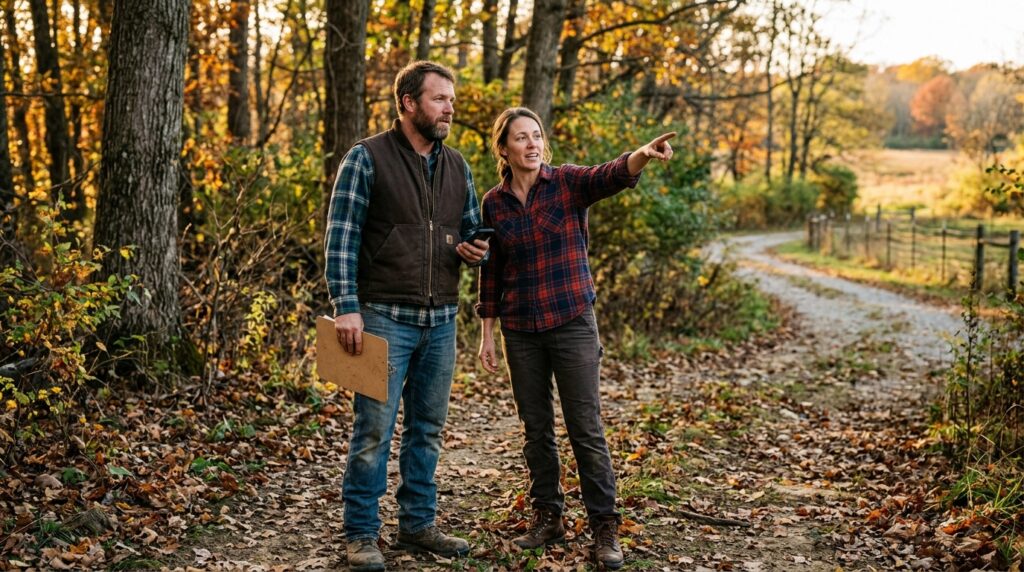
You already have the land. The question now is what changes when you build a house on your own land instead of buying into a subdivision. The parts that catch landowners off guard usually have nothing to do with the house itself.
Key Takeaways
- Walking your parcel before you call any builder is the single most useful thing you can do as a landowner. Standing water, slope, road frontage, and where the power line drops will shape your build more than your floor plan choice.
- Two parcels of identical size can have very different buildable areas once you read the survey, recorded easements, and any deed restrictions or covenants.
- The financial unknowns that move a landowner’s budget most are well versus public water, septic placement, clearing, electrical drop distance, and driveway access, not the house itself.
- Land you own free and clear typically counts as your down payment on a construction-to-permanent loan. Land you’re still paying for can usually still be used, but it adds a step.
- Indiana, Kentucky, and Illinois differ on zoning, septic permitting, and warranty coverage. Value Built Homes provides a 2-year workmanship warranty in Indiana and a 1-year workmanship warranty in Kentucky.
Walk Your Parcel Before You Call a Builder
Walk your property with a clipboard before you call any builder. Two hours of careful walking tells you more about what your parcel will support than any builder consultation, and the time to do it is before you commit to a floor plan or sign anything. Run the walk twice if you can: once after a heavy rain, once on a dry day. Here’s what to look for:
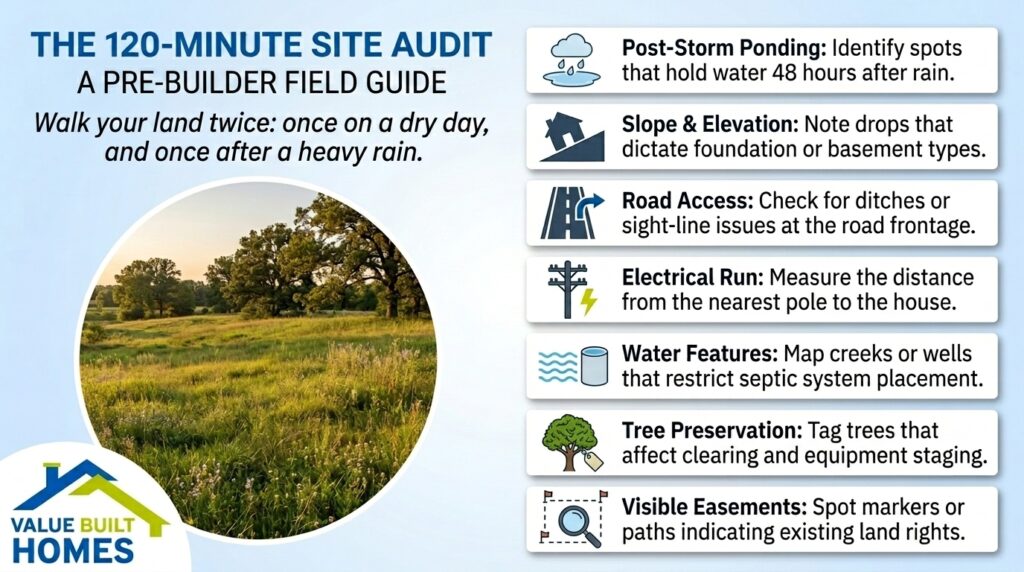
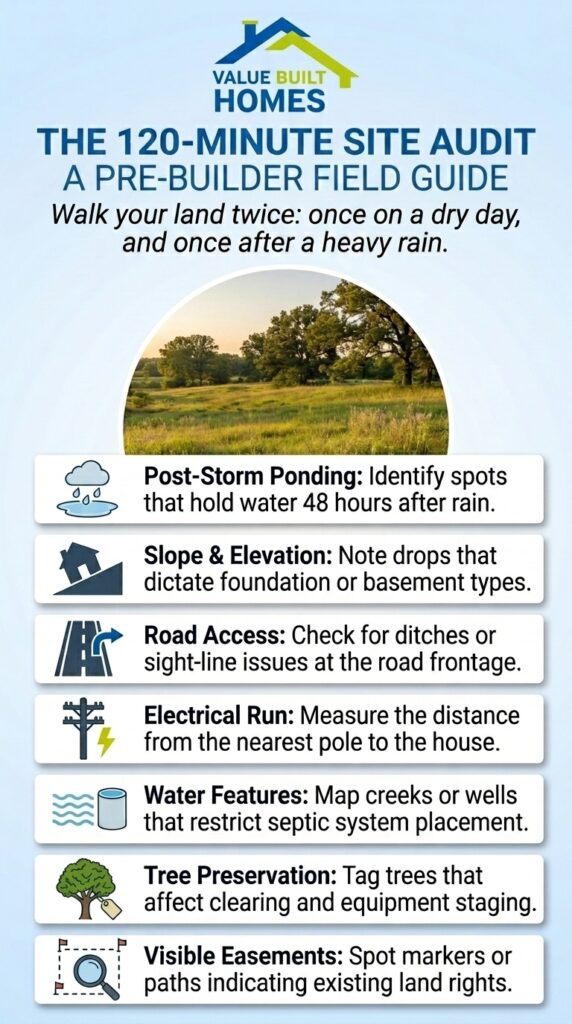
- Standing water and drainage: A spot that ponds for two days after a storm is not a building site, no matter how flat it looks in July.
- Slope: Significant slope changes the foundation strategy, the basement option, and the cost of getting a level pad.
- Road frontage and access: How will the driveway come in? Is there a sight-line problem from the road, or a ditch that has to be crossed? County road frontage usually requires a curb cut permit.
- Where the power line drops: The closest pole to your future house position determines how far the electrical service has to be run. Distance from the road equals dollars.
- Existing well, surface water, and old septic: A creek, pond, or wet-weather drain controls where a new septic field can legally be placed. Note where any existing well sits relative to where the house would go.
- Mature trees worth keeping: Tag the ones you want preserved. They affect site placement, clearing cost, and where heavy equipment can stage.
- Visible easements: Utility poles cutting across the parcel, gas line markers, drainage tiles, or worn vehicle paths all suggest someone else has a recorded right to use part of your land. Confirm against your deed.
What Your Deed Doesn’t Tell You: Surveys, Easements, and Restrictions
The paperwork on your land matters as much as the dirt. Two parcels of identical size can have very different buildable areas once you read the survey, the recorded easements, and any restrictions tied to the deed. Order these documents from your county recorder’s office and confirm:
- Boundary survey: A current boundary survey shows the actual corners of your parcel, not the approximate lines on a county GIS map. If your most recent survey is decades old, a new one is worth the cost.
- Recorded easements: Utility, access, and drainage easements stay with the land. A 30-foot utility easement running across the middle of your parcel can rule out the building site you had in mind.
- Deed restrictions and covenants: If your parcel was carved off a larger tract, it may carry restrictions on minimum square footage, exterior materials, accessory buildings, or animal use. These don’t expire on their own.
- Zoning, ag-use, and setbacks: Rural parcels in Gibson, Posey, Warrick, and surrounding counties are often zoned agricultural. Confirm with your county planning office before assuming residential use is automatic. Setbacks are measured from boundary lines, so a parcel with unusual frontage or a flag-lot configuration can have a much smaller buildable footprint than its acreage suggests.
The Big Financial Unknowns of Building on Existing Land
When you already own the land, the line items most likely to surprise your budget are not the house itself. Value Built Homes’ standard package covers the home, foundation, basement, garage, driveway, septic, water, electric, sidewalks, porches, and patios. What those site-specific systems cost on your parcel changes the math. The five line items below are the ones most likely to move the budget:
Well vs. Extending Public Water
If a public water main runs along your road frontage, you’re tapping in. If it doesn’t, you’re drilling a well. The cost difference isn’t small, and a long water-line run from the road to a building site set back hundreds of feet adds up fast either way.
Septic Placement and Soil Suitability
A new septic system requires a percolation test (“perc test”) and a soil profile, and the leach field has to be a certain distance from any well, surface water, and your foundation. On a wooded parcel or one with multiple drainage features, septic placement can dictate where the house ends up, not the other way around.
Clearing Costs on Wooded Parcels
Clearing a building pad, a driveway path, and a yard from a wooded parcel is a separate scope of work, with stump removal and grading on top. If you’re imagining a house tucked into the woods, you’re also imagining a clearing budget that needs to be specced out before the house budget gets locked.
Electrical Drop Distance
How far is the closest power pole from where the house will sit? On rural parcels it’s common for the utility to charge for the additional poles or trenching needed to reach a building site set back from the road. Your local rural electric cooperative can give you an estimate once you’ve picked a site.
Driveway Access and Curb Cut Permits
Pulling a new driveway off a county road usually requires a curb cut permit, and the longer the driveway, the more it costs to grade, surface, and (in some cases) culvert. The Value Built Homes guide to driveway installation costs covers the regional cost framework, and the Indiana utilities guide covers the well-versus-public-water side.
Using Your Land as Equity
Land you own free and clear typically functions as your down payment on a construction-to-permanent loan. The appraised value contributes to the equity portion of the loan and can reduce or eliminate the cash you need at closing.
A construction loan is a short-term loan that funds the build, and after construction completes, you either pay it off or roll it into a permanent mortgage. The structure is described by the Consumer Financial Protection Bureau. Most landowners building a primary residence will want the construction-to-permanent variant, which rolls those into one closing; the Value Built Homes guide to construction-to-permanent financing walks through the mechanics. A few situations to be aware of:
- Land you’re still paying for: You can usually still use the land as equity, but the existing land loan has to be addressed, typically by rolling it into the construction loan at closing. Tell your lender about the balance early; it changes the paperwork, not the eligibility.
- USDA Rural Development eligibility: Most of the Value Built Homes service area, including Gibson, Posey, Warrick, and surrounding rural counties, falls within USDA-eligible rural areas. USDA’s Single Family Housing programs include direct and guaranteed loan options that, for qualifying borrowers, can include 0% down.
- Free Construction Financing: During the construction phase, Value Built Homes pays the interest on the construction loan. This is a permanent program, detailed on the Free Construction Financing page. For most buyers, that means thousands of dollars they don’t have to budget for during the build.
Tri-State Differences for Landowners: Indiana, Kentucky, and Illinois
If your parcel is in Southwestern Indiana, the Henderson area of Kentucky, or Southeastern Illinois, the building experience is broadly similar but the paperwork is not. The differences that matter most for landowners:
- Zoning verification: Rural Indiana parcels are often handled by county-level planning, while Kentucky and Illinois zoning can run through different jurisdictions depending on whether the parcel is incorporated. Verify with the actual office before assuming what you can build.
- Septic permitting authority: Septic systems are permitted by the county health department in Indiana, but the responsible authority and the perc-test process differ in Kentucky and Illinois.
- Building permit timing: Permit timelines vary by jurisdiction, sometimes by weeks. If your build calendar is tight, this is worth confirming up front.
- Warranty coverage: Value Built Homes provides a 2-year workmanship warranty in Indiana and a 1-year workmanship warranty in Kentucky. Structural and systems coverage runs through the 2-10 Home Buyers Warranty regardless of state.
For the deeper jurisdiction-by-jurisdiction breakdown, the Value Built Homes building permits guide for SW Indiana, SE Illinois, and W Kentucky covers what each office requires, and this guide to building a home in Southern Indiana adds broader regional context.
Picking a Plan That Fits the Parcel
Plan selection happens after the parcel work, not before. The shape of your buildable area, the slope, the orientation to the road, and where utilities can reach all influence which standardized plans will actually work.
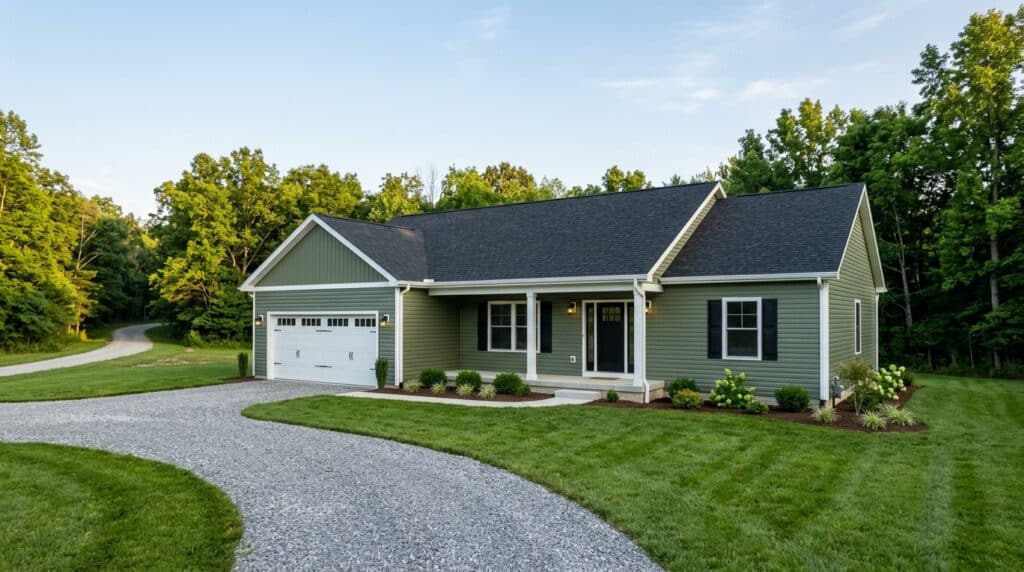
Value Built Homes’ model is built around standardized, cost-engineered plans that range from 2 to 5 bedrooms and 933 to 2,514 square feet, which keeps the build to roughly five to seven months. Once your parcel work is done, browsing the available Value Built Homes floor plans with the actual buildable footprint in mind tends to narrow the options quickly. If you’re still weighing whether to build on your land, the overview of on-your-lot home builders is a useful step back.
What Comes Next
Once your parcel work is in hand and your plan is picked, the rest tracks the standard new-construction sequence. The eight steps to building a house in Indiana walks through the full process from first decision to move-in, the pre-construction checklist covers what to lock in before ground breaks, and the six stages of home construction walks through each phase of the build itself.
Frequently Asked Questions About Building on Your Own Land
Is it cheaper to build on your own land?
Often yes, because the land cost is already covered and the appraised value typically becomes part of your equity at closing. The 2024 NAHB Cost of Constructing a Home study reports a national average construction cost of $428,215 for new single-family homes. That figure excludes land, financing, and builder profit. Value Built Homes’ standardized model is designed to come in well below the national figure, and most buyers save between 20% and 30% compared to other build options.
Can I build a house on land I’m still paying for?
Usually, yes. The existing land loan is rolled into the construction loan at closing, or the two are coordinated between lenders. Tell your lender about the land balance early in the conversation; it changes the paperwork, not the eligibility.
What are the most common surprise costs on raw land?
The five most common: a long water-line run if no public water is available; septic placement constraints that force the building site to move; clearing on wooded parcels; the electrical drop distance from the closest pole; and driveway length combined with curb cut permitting. Each is parcel-specific, so they’re worth identifying during the parcel walk before you finalize a budget.
Ready to Build on Your Land?
If you have a parcel in Gibson, Posey, Warrick, Vanderburgh, or one of the surrounding tri-state counties, the Value Built Homes team works with landowners on this specific scenario routinely. Reach out to talk through your parcel and what plans might fit it. Bringing your survey to the first call makes the conversation dramatically more useful.