If you’re building a new home in Southern Indiana outside the reach of city sewer lines, your wastewater plan will almost certainly involve a septic system. Understanding how a septic system for new construction is designed, installed, and lived with takes a process that feels intimidating and turns it into something straightforward. This guide walks through what to expect, from the soil under your lot to the day you turn on the faucet for the first time.
Key Takeaways
- Septic systems treat wastewater on your property by separating solids in a tank and dispersing treated liquid through a drain field. They are the standard wastewater solution for homes outside city sewer service across Southwestern Indiana and the tri-state region.
- Indiana regulates residential septic systems under 410 IAC 6-8.3, with permits issued through your local county health department. Soil testing on your specific lot determines what kind of system the site can support.
- Local Indiana health departments issue more than 15,000 new septic permits each year, making septic the dominant wastewater approach for rural and suburban-rural new construction in the state.
- The EPA recommends inspecting septic systems at least every three years and pumping the tank every three to five years. Day-to-day care comes down to what goes down the drain and how the drain field is treated above ground.
- Value Built Homes coordinates septic design, permitting, installation, and inspection as part of the build; the system itself is quoted separately based on home size and soil conditions.
What Is a Septic System and How Does It Work?
A septic system is a self-contained wastewater treatment system installed on your property, used in places where city sewer service isn’t available. Wastewater from your home flows into an underground tank where solids settle and bacteria break down waste. The remaining liquid moves out to a drain field, where soil filters and disperses it back into the ground.
A standard septic system has three main parts:
- The septic tank: A watertight underground container where wastewater settles and solids are partially broken down by anaerobic bacteria.
- The distribution system: A network of pipes that moves treated liquid from the tank into the drain field.
- The drain field: A series of perforated pipes or chambers buried in soil that filter the effluent before it returns to groundwater.
Beyond the conventional tank-and-drain-field setup, the EPA recognizes around ten different septic system designs, including alternatives like aerobic treatment units, mound systems, and recirculating sand filters for sites with challenging soil. Which design fits your lot depends on the soil’s drainage rate, the depth to bedrock or groundwater, and how close the system has to be to wells or surface water. For most Southern Indiana new builds on suitable soil, a conventional gravity-fed system is the standard.
Why So Many Southern Indiana Homes Use Septic Instead of Sewer
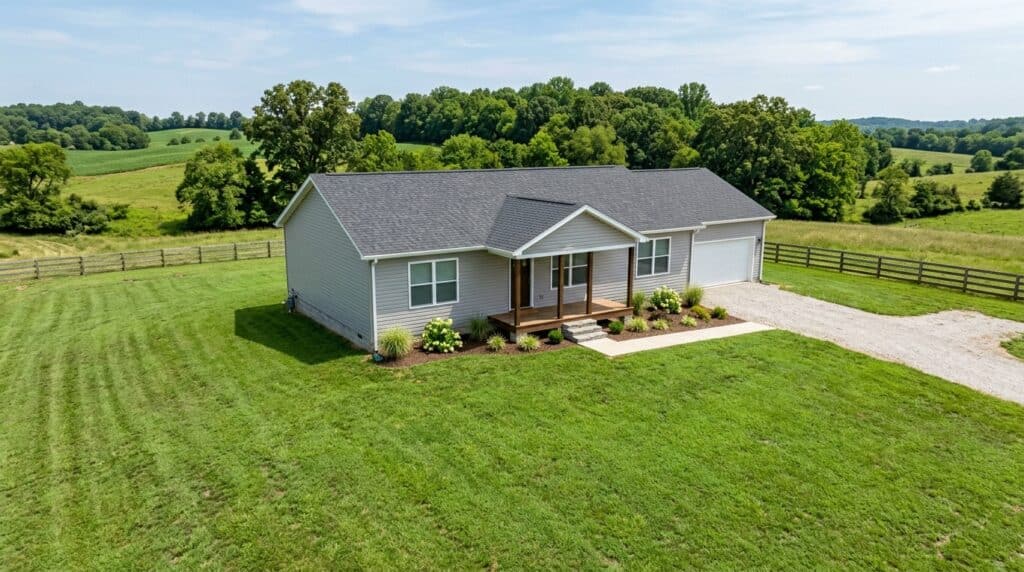
Outside the city limits of Evansville, Vincennes, Princeton, Boonville, and the other municipalities in Southwestern Indiana and the tri-state area, public sewer service simply doesn’t reach. New construction on rural and semi-rural lots needs an on-site wastewater solution, and septic has been the proven choice for generations.
The land Value Built Homes builds on stretches across Gibson County, Vanderburgh County, Posey County, Warrick County, and Knox County in Indiana, plus parts of Western Kentucky and Southeastern Illinois. A lot of that area is farmland, woodland, or small acreage. Sewer mains aren’t on the road, and they aren’t coming any time soon. If you’re evaluating land for a new home build, septic capacity is one of the first things to consider.
Local Indiana health departments issue more than 15,000 new septic permits per year, plus around 6,000 repair permits annually, according to the state’s Onsite Sewage Systems Program. That’s the working scale of new septic in this state, and it tells you something useful: septic isn’t exotic, isn’t experimental, and isn’t a hassle when it’s done right.
How Septic Fits Into a Value Built Homes Build
On a lot without a sewer connection, a septic system is priced separately from the base home price. Value Built Homes quotes it as its own line item because the cost depends on your home size (Indiana sizes systems by bedroom count) and on what the soil on your specific lot can support. What you won’t do is manage it yourself. Value Built Homes coordinates the soil evaluation, the county health department permit, the installation, and the final inspection as part of the build, so the septic system is designed and in the ground before the home is finished.
The standard base price covers the site-built home, foundation, water and electric service, a standard sewer connection on lots that have sewer, and a rock construction drive. Septic, basement, a finished driveway, and sidewalks are always quoted separately, and a garage, porch, or patio is included only when your floor plan calls for it. For the full breakdown, see what’s included in a new construction home. Knowing which items sit outside the base price up front is what keeps a quote honest and prevents septic from turning into a hidden cost in a new home budget.
A well-designed system runs almost invisibly for decades. Penn State Extension notes that properly designed and installed systems give years of trouble-free service when operated and maintained correctly. Value Built Homes handles the design and installation up front; the maintenance habits are short and simple, covered later in this guide.
What to Expect During Septic Installation on a New Build
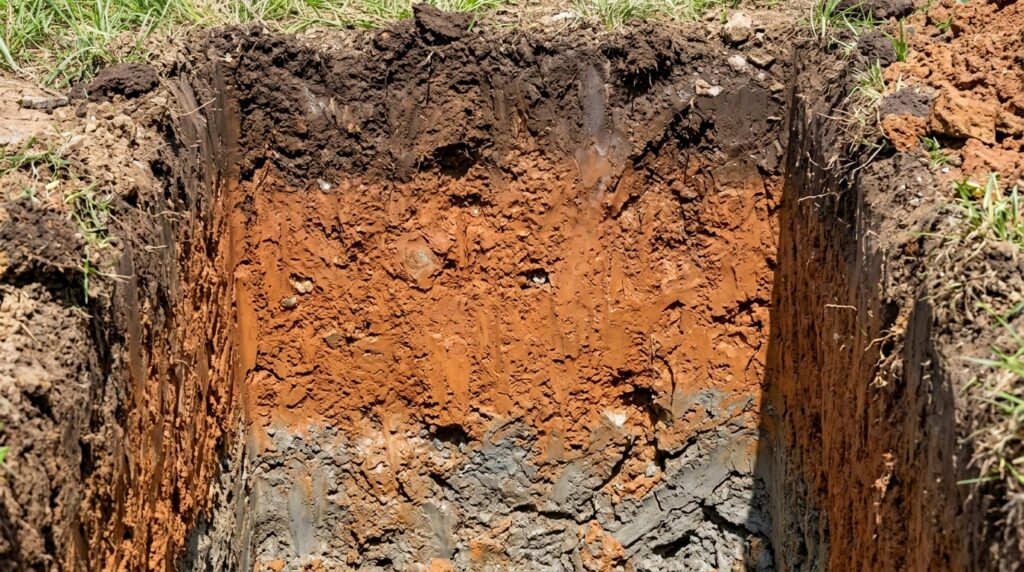
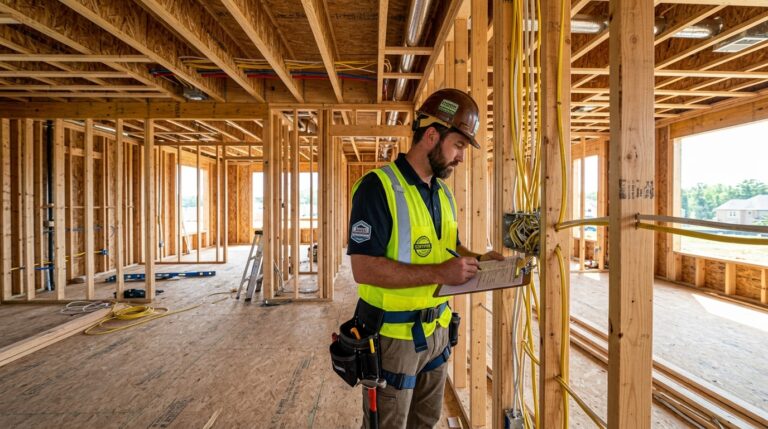
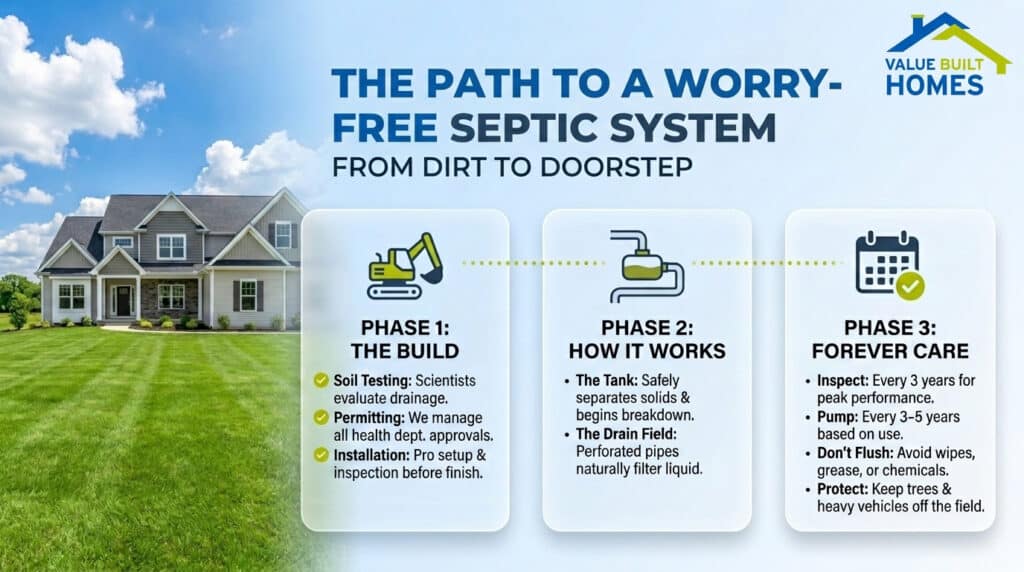
Septic installation moves through three main stages: site evaluation and soil testing, permitting through your county health department, and the physical install. On a turnkey project, your builder coordinates each one, so you’re not chasing soil scientists, county clerks, and excavators independently.
Soil Testing Determines What Your Lot Can Support
Before any system is designed, the soil on your lot has to be evaluated. A licensed soil scientist or registered installer examines test pits or borings to measure how quickly water moves through the ground, how deep the water table is, and how much usable soil sits above any restrictive layer. Those results decide whether your lot supports a conventional system or needs an alternative design.
Soil quality matters beyond septic. The same kind of evaluation also informs foundation work and lot grading. If you’re new to the idea of subsurface soil testing, our guide to soil testing for new construction covers what’s done and why it matters.
Permitting Through the County Health Department
Septic permits in Indiana are issued by your local county health department, not by the state directly. The framework is consistent across counties: design submitted, lot reviewed, permit issued, install inspected. Each county can have minor procedural differences, but the steps are the same.
Indiana regulates residential septic systems under 410 IAC 6-8.3, the state’s Residential Onsite Sewage Systems rule, with permit administration handled by your county health department. The full permit picture for a Value Built Homes build, including septic, water, electric, and the building permit itself, is covered in our broader permitting guide for Southwestern Indiana, Southeastern Illinois, and Western Kentucky.
Installation and Final Inspection
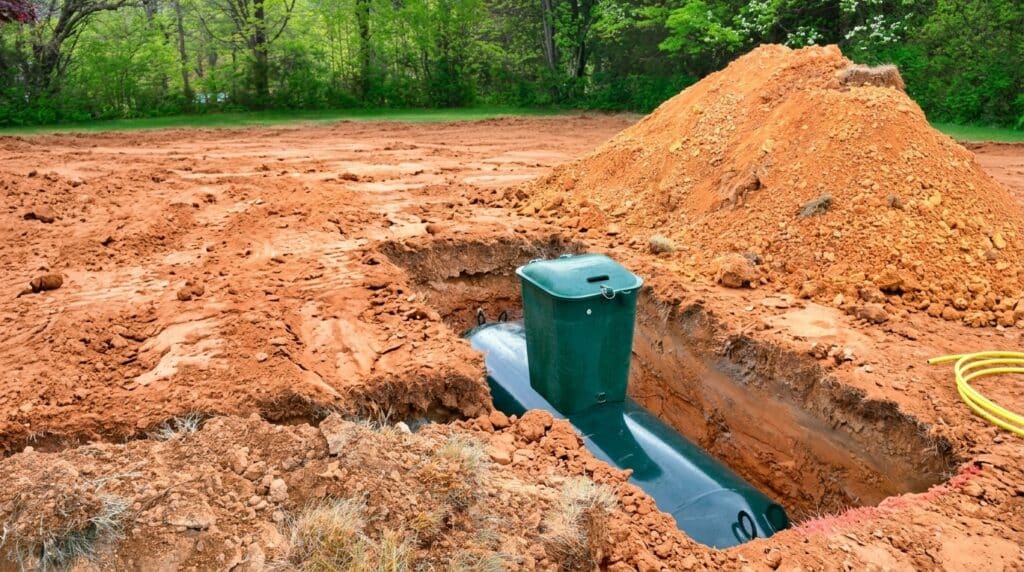
Once the permit is issued, septic installation moves quickly compared to most other phases of the home build. Excavators dig the tank pit and the drain field trenches, set the tank, lay the distribution lines, backfill, and final-grade the disturbed area. The county health department inspects the work before it’s covered with soil. Then it’s done, and the system is ready to use the day the home is.
The septic phase fits into the broader build sequence. Buyers who want to see how every step lines up before construction starts can review the full pre-construction checklist for a low-stress build.
Living With a Septic System: What Homeowners Should Know
A well-designed septic system, used and maintained properly, runs cleanly for decades. The two most important habits are watching what goes down your drains and keeping the tank pumped on schedule. The third is leaving the drain field alone.
The basics, per the EPA:
- Inspect the system at least every three years. The EPA’s recommended inspection schedule catches small problems early, before they become drain field replacements.
- Pump the tank every three to five years. The exact pumping interval depends on tank size, household size, and how the system gets used. Smaller tanks and larger households need it sooner.
- Use water efficiently. High-efficiency toilets, fixed leaks, and laundry spread across the week reduce strain on the system.
- Plant grass over the drain field. Tree and shrub roots will find their way into pipes if given the chance.
What to avoid:
- Don’t flush the wrong things. Wipes (even those labeled “flushable”), grease, dental floss, coffee grounds, feminine hygiene products, and household chemicals all cause problems. If it isn’t human waste or toilet paper, it doesn’t belong in a septic system.
- Don’t park or drive on the drain field. The pipes sit shallow, and soil compaction destroys the structure that does the actual filtration work.
- Don’t ignore early warning signs. Slow drains, gurgling pipes, sewage odors, or persistent wet spots in the yard all signal something is wrong, and small problems get expensive fast.
For homeowners new to septic, the learning curve is short. Once the pumping schedule is on the calendar and the family knows what not to flush, the system stays out of mind almost entirely.
Frequently Asked Questions About Septic Systems and New Construction
How long do septic systems last?
A well-designed and well-maintained septic system can run trouble-free for decades. How long it lasts depends on soil conditions, household size, and what gets flushed. Pumping the tank on schedule and keeping the drain field clear extend the working life of the entire system significantly.
Do I need a permit for a septic system in Indiana?
Yes. Every new septic system in Indiana requires a permit issued by your local county health department, with design and installation governed by 410 IAC 6-8.3. On a Value Built Homes build, permitting is handled as part of the home package, so the homeowner doesn’t have to navigate the county process themselves.
Is a septic system worse than city sewer?
Not necessarily. A septic system is more independent: no monthly sewer bill, no reliance on a municipal treatment plant, and the technology is well understood and reliable when designed correctly. The trade-off is that the homeowner is responsible for the system rather than the city, which means periodic pumping and basic care. For most rural and semi-rural Southern Indiana lots, septic isn’t a compromise. It’s the appropriate choice for the location.
Is it hard to maintain a septic system?
No. Routine maintenance comes down to a few habits: schedule professional inspections, pump the tank on its recommended interval, use water efficiently, and don’t flush anything except human waste and toilet paper. The system does the work; the homeowner just needs to stay out of its way.
How much does a septic system cost?
It depends on the system type, soil conditions, and home size. With Value Built Homes, the septic system is quoted as a separate line item rather than bundled into the base price, though Value Built Homes still handles the soil testing, permit, installation, and inspection as part of your build. For a personalized estimate, the Value Built Homes team can walk through what your specific home and lot will involve.
Build Your Forever Home With Confidence
Building new in Southern Indiana? Septic should be a known line item on your quote. Browse Value Built Homes’ floor plans to find a layout that fits your family, or reach out to the Value Built Homes team to talk through your land, your lot, and your build.