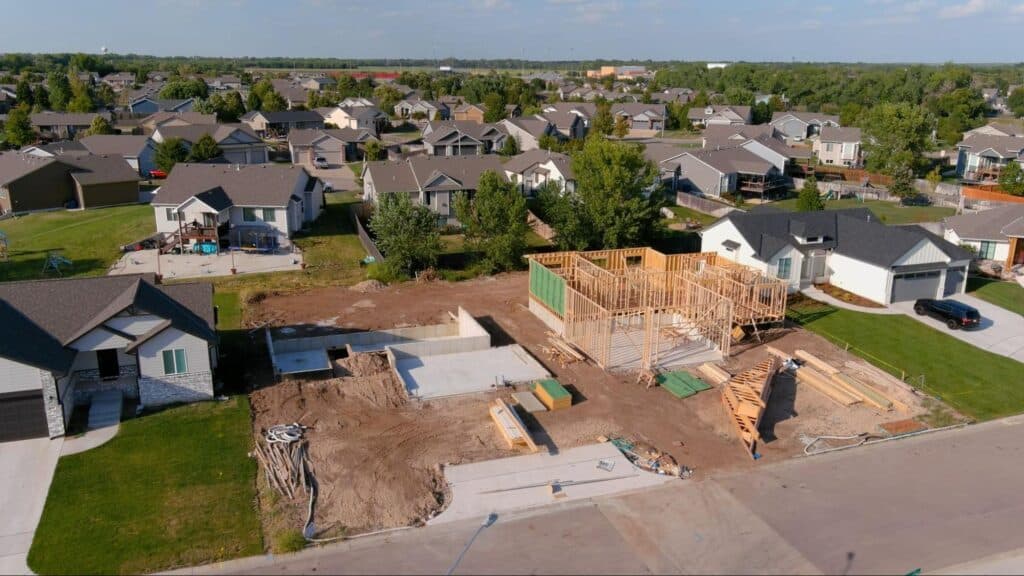
If you are looking at a new-construction lot in Southern Indiana, one question tends to sit in the back of your mind: what rules come attached to it? Understanding HOA rules for new construction in Indiana before you pick a lot helps you avoid surprises about dues, restrictions, and who gets a say in what you build. Here is what to expect, and how to check for any lot you are considering.
Key Takeaways
- Not every new home comes with an HOA. Nationally, 65.7% of new single-family homes started in 2024 were in a community or homeowners association, but that share is driven by coastal and Sun Belt regions and runs lower across the Midwest.
- An HOA, a covenant, and a deed restriction are three different things. A subdivision can have recorded covenants that limit what you build without having an active HOA that collects dues.
- HOA dues are not part of your mortgage payment and can range from a few hundred dollars a month to more than a thousand. Lenders count them when they size your loan.
- Indiana law limits what an HOA can do. The Indiana Homeowners Association Act (for associations formed after June 30, 2009) requires a member-approved annual budget and a grievance process, and it protects your right to install rooftop solar.
- The covenants and deed restrictions on a specific lot are recorded documents. You can read them before you make an offer by asking for the CC&Rs, the plat, and any HOA bylaws.
- Many Southern Indiana subdivisions carry lighter rules than the coastal norm, which appeals to value-focused buyers who want fewer restrictions and lower carrying costs.
Do All New Construction Homes Have an HOA?
No, not every new-construction home has an HOA. Nationally, 65.7% of new single-family homes started in 2024 were built inside a community or homeowners association, up from 64.8% in 2023. But that average hides a wide regional split, with the Midwest well below the states that pull the number up.
HOA saturation is highest in the Mountain West, where 81.6% of new homes are built in an association, and lowest in the Middle Atlantic at 32.5%. New-construction HOAs are more a coastal and Sun Belt pattern than a Midwest one, so in Southwestern Indiana an HOA is common but not guaranteed. The only way to know for a given lot is to read its documents.
Buyers do not rate HOAs highly, either. Only 39% rank a homeowners association among the most influential community features, versus more than 65% who say so about nearby retail, parks, and trails. For value-focused buyers, fewer rules and lower carrying costs often matter more.
HOA, Covenants, and Deed Restrictions: What Is the Difference?
An HOA is an organization that governs a community, collects dues, and enforces rules. Covenants (often called CC&Rs, for covenants, conditions, and restrictions) are the recorded rules themselves, and a deed restriction is a limit written into a property’s deed or plat. You can have covenants without an HOA, but an HOA always operates under covenants.
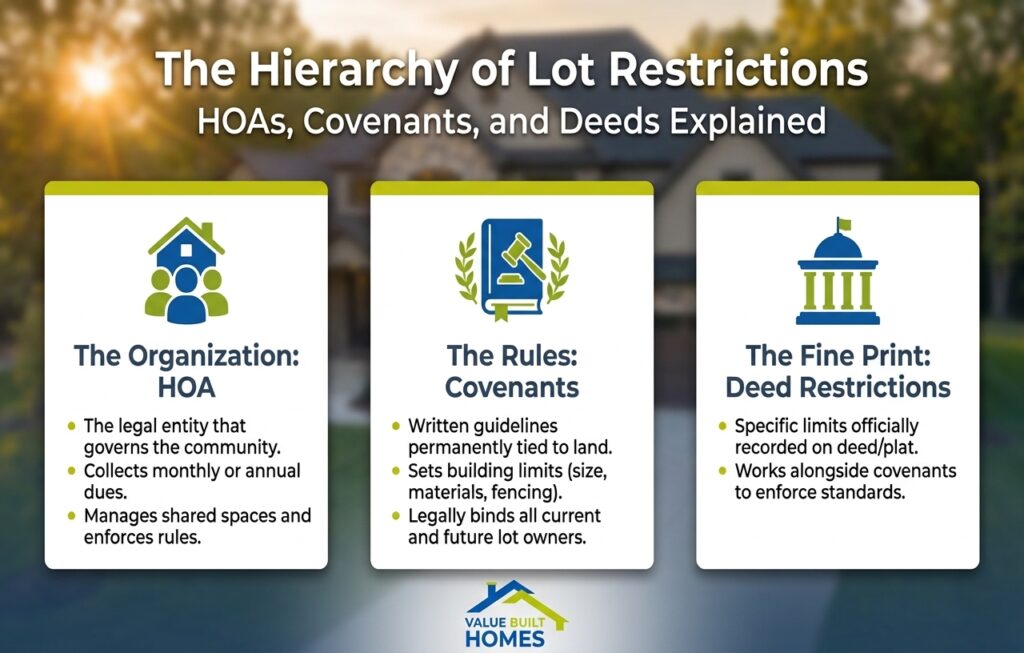
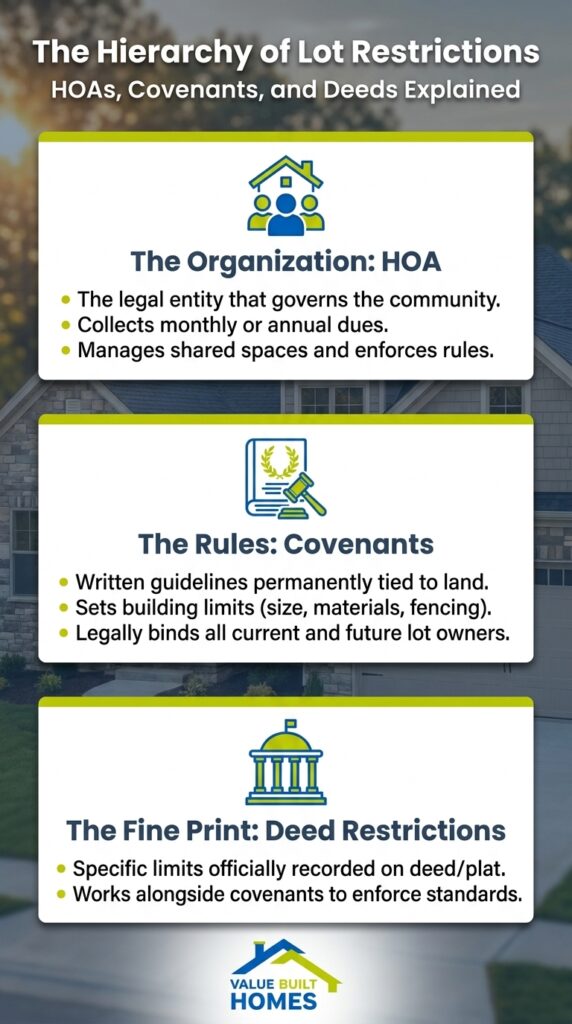
Here is how the three fit together:
- HOA (the organization): A homeowners association is a legal entity, usually a nonprofit, that manages shared areas, collects dues, and enforces the community’s rules. It has a board and a budget, and it can fine owners or place a lien for unpaid dues.
- Covenants and CC&Rs (the rules): These are the written rules recorded against every lot in a subdivision. They run with the land, so they bind whoever owns the lot. Covenants can set minimum home size, exterior materials, fencing, and outbuildings.
- Deed restrictions (limits on a specific parcel): A deed restriction is a limitation recorded on a property’s deed or plat. In practice it overlaps heavily with covenants, and both bind future owners.
The umbrella term for all of these, plus any HOA bylaws and articles of incorporation, is the community’s governing documents. Those are the documents you want to read before you buy.
Can a Subdivision Have Covenants but No HOA?
Yes. A subdivision can record covenants that restrict what owners build without ever forming an active HOA. This is common in smaller Indiana subdivisions.
When there is no HOA, the covenants do not disappear. They are still recorded against the land and still enforceable, usually by the developer while lots are selling or by the neighbors, who can ask a court to enforce them. The practical difference for you: no monthly dues and no board, but the building rules on the plat still apply.
Indiana Laws That Limit What an HOA Can Do
Indiana law sets baseline rules that apply no matter what your subdivision’s covenants say. The Indiana Homeowners Association Act governs associations formed after June 30, 2009 (older ones can vote to opt in), and separate provisions protect rooftop solar, require a grievance process, and give members budget and meeting rights.
Because most new-construction associations are recent, the Act almost certainly applies. Here is what it guarantees:
| Protection | What Indiana law does | Statute |
|---|---|---|
| Which HOAs the law covers | The Indiana Homeowners Association Act governs associations formed after June 30, 2009. Older associations can vote to opt in. Because most new construction is recent, the Act applies to a new subdivision you are considering. | IC 32-25.5-1 (Applicability) |
| Solar panels | An HOA cannot flatly ban rooftop solar. It may block a system or require its removal only for specific reasons (for example, a court finds it a safety or legal violation, or it sits on common property), and homeowners can petition other members for approval. | IC 32-25.5-3.5-4 and -5 (added 2022) |
| A required dispute process | An association’s governing documents must include grievance resolution procedures that apply to members and the board, so there is a defined path before disputes escalate. | IC 32-25.5-5 (Grievance Resolution) |
| Budget and meeting rights | The association must keep a member roster, prepare an annual budget approved by the members, and let members attend board meetings. Members who petition in sufficient number can require the board to address an item. | IC 32-25.5-3 (Homeowners Associations) |
Can an HOA Stop You From Installing Solar Panels in Indiana?
No, an Indiana HOA cannot flatly ban rooftop solar. Under Indiana’s solar-access law, an association may block or require removal of a system only for narrow reasons, and even then a homeowner can petition the other members for approval.
The enumerated reasons are limited: a court finding that the system threatens public health or safety, a court finding that it violates a law, or the system sitting on HOA-owned or common property. For buyers who care about energy costs, that protection pairs well with the way an energy-efficient home is built.

HOA Dues and Costs: What to Budget and How They Affect Your Mortgage
HOA dues are not included in your mortgage payment and can range from a few hundred dollars a month to more than a thousand, depending on the community. They are paid directly to the association, and lenders factor them into what you can borrow, so higher dues can lower the loan you qualify for.
Keep these cost points in mind before you commit:
- Dues are separate from your mortgage. You pay the association directly, not your mortgage servicer, so budget for them on top of principal, interest, taxes, and insurance.
- Some communities charge a capital contribution at closing. This is a one-time fee that seeds the association’s reserves, separate from ongoing monthly dues.
- Unpaid dues have teeth. An HOA can levy fines and place a lien for unpaid assessments, so the size and trajectory of the dues matter before you sign.
Lower carrying costs are part of why value-focused buyers favor subdivisions with modest or no dues, and why some pair a lighter-rules lot with free construction financing to cut what they spend during the build.
How to Find the Covenants That Apply to a Specific Lot
To find the covenants on a specific lot, request the community’s recorded governing documents before you make an offer. The core set is the CC&Rs, the recorded plat, and, if there is an HOA, the bylaws, articles of incorporation, and rules.
- Ask the builder or listing agent for the governing documents. Request the CC&Rs, the recorded plat, and any HOA bylaws, articles of incorporation, and rules.
- Read for the rules that affect your plans. Look for minimum square footage, allowed exterior materials, fencing and outbuilding limits, and any build-timeline requirements.
- Check for an HOA and its dues. Confirm whether an association exists, what the current dues are, and whether a capital contribution is due at closing.
- Confirm through a title search. Your title company will surface recorded covenants and deed restrictions during closing, but reading them earlier keeps you from committing to rules you cannot live with.
The industry checklist matches this. A community’s key buyer documents are its CC&Rs, bylaws and rules, articles of incorporation, and the plat. As the head of the Community Associations Institute put it, “Being informed is just the first step,” so reading the documents before you commit is the best way to avoid a surprise.
For a Value Built Homes community, you can skip the legwork: the team keeps recorded covenants for each of its Southern Indiana subdivisions and shares them on request, so you can read a neighborhood’s rules before you make an offer.
What Covenants Look Like in a Southern Indiana Subdivision
Farmington Ridge in Poseyville, where Value Built Homes builds, is a good local example of a covenant-protected community. Its recorded standards include single-family home-size minimums, a requirement to start and finish construction within set timelines, written approval of building plans and materials, and modest annual dues.
Rules like these protect the look and long-term value of the neighborhood, part of why well-kept new-construction communities tend to hold their value. Whether that trade is right for you depends on how much flexibility you want. Covenants that bar metal or post-frame buildings, for instance, are one reason some buyers weigh a barndominium against a traditional stick-built home.
Prefer Fewer Rules? Options for Value-Focused Buyers in Southern Indiana
If you want fewer restrictions, you have options in Southern Indiana. You can choose a subdivision with lighter covenants and low or no dues, or build on land outside a platted subdivision, where subdivision covenants generally do not apply.
- A subdivision with lighter rules. Many local communities keep covenants minimal and dues low or nonexistent, so read each lot’s documents to confirm what applies.
- Land outside a subdivision. Building on an individual parcel usually means no subdivision covenants and no HOA, though local zoning and any deed restrictions on that parcel still apply.
Our guide to choosing a neighborhood for new construction covers commute, schools, and resale, and when you are ready you can browse available home lots across Southwestern Indiana and ask for each community’s covenants first.
Frequently Asked Questions About HOA Rules for New Construction in Indiana
Can you opt out of an HOA once you buy the lot?
No. If a lot is inside an HOA and the covenants run with the land, membership and dues are mandatory and transfer to you at purchase. You generally cannot opt out, so confirm whether a lot has an HOA, and what it costs, before you make an offer.
Do restrictive covenants expire?
Sometimes. Some recorded covenants include a set term with automatic renewal, while others continue until a majority of owners vote to change or end them. The only way to know is to read the recorded covenants for that subdivision, which state their own duration and amendment rules.
Are HOAs a bad thing for new-home buyers?
Not necessarily. About one in three U.S. homeowners live in a community association, and 86% of residents rate their experience as good or neutral. HOAs and covenants exist to keep a neighborhood’s standards consistent, which can protect resale value. The real question is whether a specific community’s rules and dues fit how you want to live.
How do I know if a lot has an HOA before I make an offer?
Ask the builder or agent directly, and request the recorded plat and covenants for the subdivision. Those documents state whether an association exists and what it governs, and a title search will surface any recorded HOA or covenants tied to the lot before you commit.
Ready to Find a Lot That Fits Your Plans?
The right lot is the one whose rules match how you want to live and build. Before you commit, read the covenants, confirm any HOA and its dues, and make sure the standards fit your plans. See how the standardized new home construction approach keeps the process simple, and if you have questions about building in Southern Indiana, contact the Value Built Homes team to find a lot that fits.