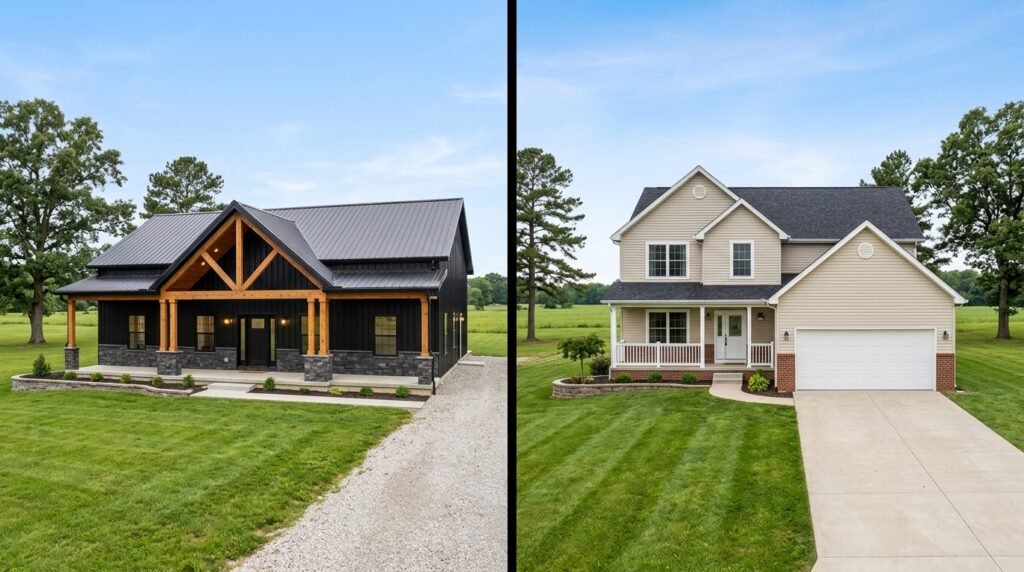
If you’re weighing a barndominium vs. a stick-built home in Southwest Indiana, you’re really trying to answer one question: which one gives your family the most home, and the least risk, for the money? Both can be wonderful places to live. The differences that matter most show up in financing, appraisal, energy bills, and resale, and they matter even more in Indiana’s freeze-and-thaw climate.
Key Takeaways
- Construction category: A barndominium is a post-frame, pole-barn-style dwelling built on a steel or wood frame, which puts it in a different category from a traditional stick-built home.
- Financing and appraisal: Stick-built homes qualify for widely available conventional mortgages, while barndominiums often rely on specialty, farm-credit, or local-bank lenders and can be harder to appraise because of limited comparable sales.
- Energy performance: The building envelope (insulation, air sealing, and the HVAC system) controls comfort and utility bills far more than whether a home started as a metal shell or wood framing.
- Indiana climate: The tri-state’s cold winters call for high attic insulation levels, and a properly built stick-built home is designed to hit those cold-climate targets.
- Long-term value: A standardized stick-built home offers predictable pricing, an all-inclusive package, and a broad resale buyer pool, which reduces the surprises common to a one-off barndominium build.
What Is a Barndominium, and How Is It Different From a Stick-Built Home?
A barndominium is a post-frame, pole-barn-style home built on a steel or wood frame and finished with living space inside. A stick-built home, also called a site-built home, is framed board by board and assembled 100% on site. The core difference is structural: a barndominium starts as a pre-engineered shell, while a stick-built home is built in place using traditional framing methods.
That starting point is also what separates a barndominium from the other non-traditional options buyers run into:
- Barndominium: a post-frame, pole-barn-style home built on a steel or wood frame.
- Modular home: built as finished modules in a factory, then assembled on a permanent foundation on site.
- Manufactured home: built to the federal HUD code on a permanent steel chassis.
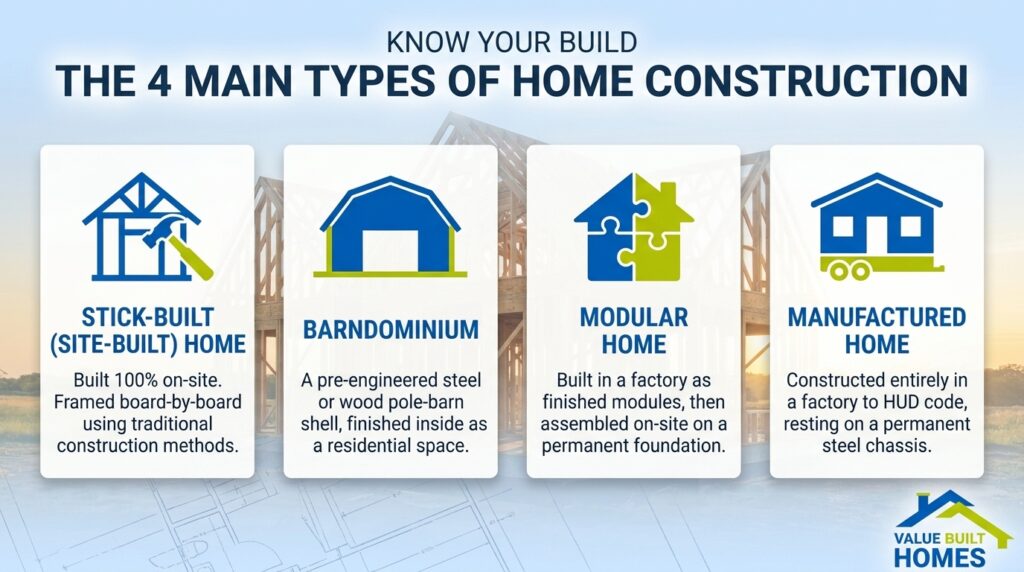
If you’re sorting through those categories, our guides to factory-built vs. site-built homes and the benefits of site-built homes over manufactured homes break down how each one is built, inspected, and valued over time.
Value Built Homes builds traditional site-built (stick-built) homes, constructed entirely on site in Southwest Indiana and the tri-state area. The company does not build barndominiums, modular, or manufactured homes, so this comparison is meant to help you weigh your options honestly, not to steer you toward one style.
Barndominium vs. Stick-Built Home: A Side-by-Side Comparison
For most Southwest Indiana buyers, the practical differences come down to seven factors: cost predictability, financing, appraisal and resale, climate and insulation, build time, customization, and maintenance. The table below shows how a barndominium and a stick-built home typically compare on each.
| Factor | Barndominium | Stick-Built Home |
| Cost predictability | The shell can be inexpensive, but interior finish, site prep, and custom choices make the final budget harder to pin down. | Standardized floor plans and all-inclusive packages make the final cost easier to predict up front. |
| Financing | Often needs specialty, farm-credit, or local-bank lenders; some banks are unfamiliar with the structure. | Qualifies for widely available conventional mortgages. |
| Appraisal and resale | Harder to appraise due to limited comparable sales; resale depends on finding a buyer who wants the style. | Broad buyer pool and plentiful comparable sales support appraisal and resale. |
| Climate and insulation | A metal shell needs careful insulation and condensation control to perform through Indiana winters. | Designed and insulated to meet cold-climate targets from the framing stage. |
| Build time | The shell can go up quickly, but full interior finish still takes months. | Standardized plans support an efficient, scheduled timeline. |
| Customization | Highly flexible layouts, but more design decisions and more chances for cost creep. | Streamlined, pre-engineered plans with fewer decisions and fewer surprises. |
| Maintenance | Durable metal exterior, though it may need specific upkeep such as fastener checks, panel care, and sealing. | Traditional materials with familiar, widely available maintenance and repair. |
Is It Cheaper to Build a House or Barndominium?
It depends on what you count. A barndominium shell can cost less than a comparable stick-built frame, but once you add interior finishes, site preparation, and custom design choices, a finished barndominium often lands close to a comparable stick-built home, and the final number is harder to predict. For budget-focused buyers, that predictability is usually worth as much as the sticker price.
With a barndominium, the headline cost is the shell, and that’s the part that looks affordable. The full picture includes insulation, drywall, flooring, cabinetry, and mechanicals, plus the same site work any home needs. Because barndominiums are usually custom, each of those items is a separate decision, and each decision is a place where the budget can drift.
A standardized stick-built home flips that equation. Value Built Homes uses cost-engineered floor plans and bulk material purchasing to keep pricing predictable, an approach the company says can save most buyers between 20% and 30% compared with building elsewhere.
Predictable pricing also comes from a complete package, so the major site-prep costs are accounted for rather than billed as surprises later. A Value Built Homes build includes:
- Structure: the home, foundation, and basement.
- Site and access: garage, driveways, sidewalks, porches, and patios.
- Utilities: septic system, water, and electric.
Buyers who already own rural acreage, or are shopping for it (the kind of lot many barndominium dreamers picture), can review available lots for sale in the company’s Southwest Indiana subdivisions.
The comparison plays out in real life. One Value Built Homes homeowner shared that they ended up spending the same amount on their stick-built home as they would have with a modular company, and were happy with the result.
Can You Get a Loan for a Barndominium?
Yes, but it is often harder. Many conventional lenders are unfamiliar with barndominiums, so buyers frequently turn to specialty construction lenders, farm-credit institutions, or local banks. Appraisals can be a sticking point too, because limited sales of similar homes make value harder to establish. A stick-built home, by contrast, fits neatly into widely available conventional mortgage programs.
Barndominiums run into a few specific hurdles that a stick-built home largely avoids:
- Lender familiarity: many conventional lenders rarely see barndominiums, so buyers often turn to specialty construction, farm-credit, or local-bank programs.
- Appraisal: limited sales of similar homes give appraisers few comparisons, a difficulty that one certified residential appraiser ties to a barndominium’s “unique nature and limited sales of similar homes.” That same appraiser notes well-maintained barndominiums can still hold their value, so this is about unfamiliarity, not a poor investment.
- Resale: a narrower buyer pool can slow the eventual sale, a dynamic we cover in do new construction homes hold their value.
Stick-built homes sidestep most of that friction. They are common, easy to compare against recent sales, and straightforward for lenders. Value Built Homes also eases the financing squeeze with its free construction financing program, paying the interest on the construction loan during the build so buyers aren’t carrying that cost while they wait to move in.
Are Barndominiums Energy Efficient in Indiana’s Climate?
A barndominium can be energy efficient, but it isn’t automatically so. Because heating and cooling account for nearly half of a home’s energy use, the insulation, air sealing, and HVAC system matter far more than the type of shell. A bare metal building needs deliberate insulation and condensation control to match the comfort of a well-built, properly insulated stick-built home.
In Indiana’s freeze-and-thaw climate, three things drive a home’s energy performance far more than the shell it started as:
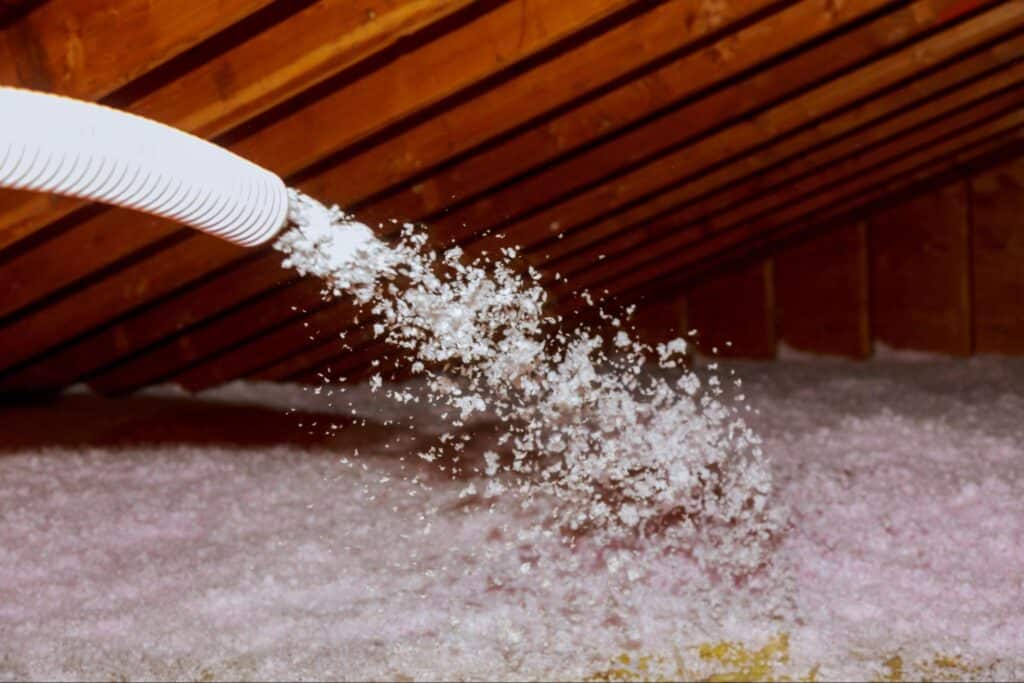
- Insulation levels: ENERGY STAR recommends R49 to R60 of attic insulation for the cold-climate zones that cover Southwest Indiana and the tri-state.
- Air sealing and condensation control: a bare metal barndominium shell is prone to sweating during temperature swings and needs careful detailing, while a stick-built home is insulated and sealed from the framing stage.
- Installation quality: getting the work right matters as much as the materials, since improper HVAC installation can cut system efficiency by up to 30%.
Value Built Homes builds with modern insulation techniques and energy-saving materials to keep homes comfortable year-round. For a closer look at how envelope choices lower bills, see our guide to building an energy efficient home.
How Long Does It Take to Build a Barndominium vs. a Stick-Built Home?
A barndominium shell can go up fast, but a finished barndominium still takes months once the interior is done. For context, building a single-family home took an average of 9.1 months from authorization to completion in 2024, and homes in the East North Central division, which includes Indiana, averaged 9.4 months. A standardized stick-built plan can move faster than a one-off custom build because the design decisions are already made.
Speed is one of the most common reasons buyers consider a barndominium, and the shell really can rise quickly. The finished home is another story, because interior framing, mechanicals, and finishes take the same time they would in any house. Value Built Homes estimates about 5 to 7 months to build one of its site-built homes, depending on the site, the weather, and the crew. A custom barndominium, with its open-ended choices, can take longer to finish than the quick shell suggests.
Why a Standardized Stick-Built Home Is the More Predictable Long-Term Value
For budget-conscious tri-state families, a standardized stick-built home tends to be the more predictable long-term value. It pairs fixed, all-inclusive pricing with conventional financing, a broad resale market, and warranty protection, which together reduce the financial surprises that can come with a one-off barndominium. The trade-off is less customization, but for many buyers that simplicity is the point.
Value Built Homes is a family-owned builder based in Haubstadt, Indiana, building traditional site-built homes across Southwest Indiana and the tri-state area. The model is deliberately simple: a set catalog of cost-engineered plans, fewer decisions, and a streamlined process that keeps both stress and cost down. Less customization is the trade, and for buyers who want a dependable path to a forever home, that trade is often welcome.
Protection is part of the value too. Every home is covered by a 2-10 Home Buyers Warranty, which provides:
- Structural coverage: 10 years of protection against major structural defects.
- Systems coverage: 2 years of coverage for the home’s major systems.
- Workmanship and materials: 2 years in Indiana and 1 year in Kentucky.
That kind of coverage is well established for stick-built homes and reassuring for buyers thinking decades ahead.
The all-inclusive approach resonates with homeowners. One Value Built Homes homeowner shared that the team took care of everything, from running power, water, and septic to the poured-wall basement and the driveway, and kept them updated throughout the build.
Frequently Asked Questions About Barndominiums and Stick-Built Homes
Is a barndominium considered a house?
Yes. A barndominium is a residential dwelling and is treated as a house for living purposes. Its post-frame construction can still affect how it is financed, insured, and appraised compared with a conventional stick-built home.
What are the disadvantages of a barndominium?
The most common drawbacks are financing and appraisal challenges, a narrower resale market, and the need for careful insulation and condensation control in cold climates. None of these make a barndominium a bad choice, but they add uncertainty that a standardized stick-built home avoids.
Are barndominiums cheaper than a house?
Not necessarily. The shell can be inexpensive, but a fully finished barndominium with comparable square footage, finishes, and site work often costs about the same as a comparable stick-built home, and the final figure is harder to predict.
Can you build a barndominium anywhere in Indiana?
Not always. Zoning rules, subdivision covenants, and lender requirements can limit where a barndominium is allowed, which is one reason many are built on rural acreage. Stick-built homes are accepted in essentially every residential setting, including established subdivisions.
Build With Confidence in Southwest Indiana
Choosing between a barndominium and a stick-built home comes down to how much predictability you want in cost, financing, and resale. If a streamlined path to an affordable, energy-conscious forever home sounds right for your family, reach out to the Value Built Homes team to talk through your options and get your questions answered.