Choosing a neighborhood for new construction is really two decisions at once: the house you build and the community you build it in. You can love a floor plan and still end up unhappy if the commute, the schools, or the lot timing don’t fit your life. This guide walks through what actually matters when you’re comparing new home communities near Evansville and across the tri-state area.
Key Takeaways
- Weigh the community and the floor plan together. The right home in the wrong location, or the right location with no plan that fits, leaves most buyers frustrated.
- In Southwestern Indiana, the factors that move the needle most are commute to major employers, school district, lot availability and phase timing, and county-level differences in taxes and services.
- New subdivisions and established neighborhoods each have real tradeoffs. New construction offers warranties, energy efficiency, and fewer surprises; established areas offer mature trees and known character.
- Buyer demand for new homes is high. 61% of buyers say a newly built home is their first preference, the highest share since 2007.
- Resale value tracks location more than anything else. School quality, commute access, and how a community is managed over time protect your investment.
- Value Built Homes builds in six active Southwestern Indiana communities, so you can compare towns and counties without leaving one builder’s standardized, value-engineered process.
Should You Pick the Floor Plan or the Neighborhood First?
Pick them together, not in sequence. The floor plan determines how your daily life flows inside the house; the neighborhood determines your commute, your kids’ schools, your taxes, and how well the home holds value. Buyers who lock in one before checking the other usually end up compromising on whatever they decided last.
A practical way to balance the two is to start with a short list of communities that fit your location needs, then see which floor plans are available in each. Standardized plans make this easier, because the same well-tested layouts are offered across multiple subdivisions. Value Built Homes builds with a value-engineered, standardized-plan approach that keeps customization intentionally simple, which means fewer decisions, less stress, and a faster path to move-in.
What to Look for When Comparing New Construction Communities
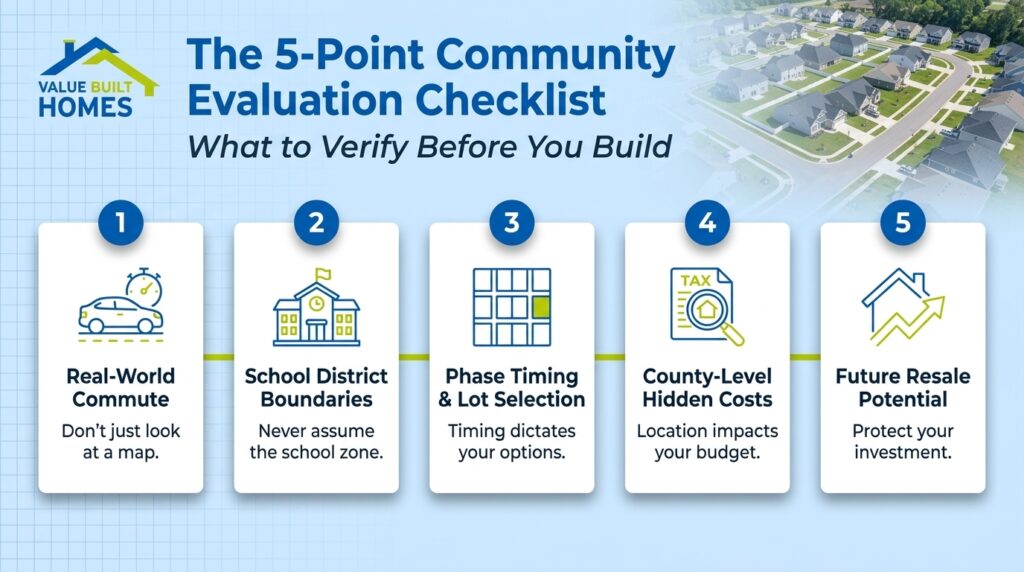
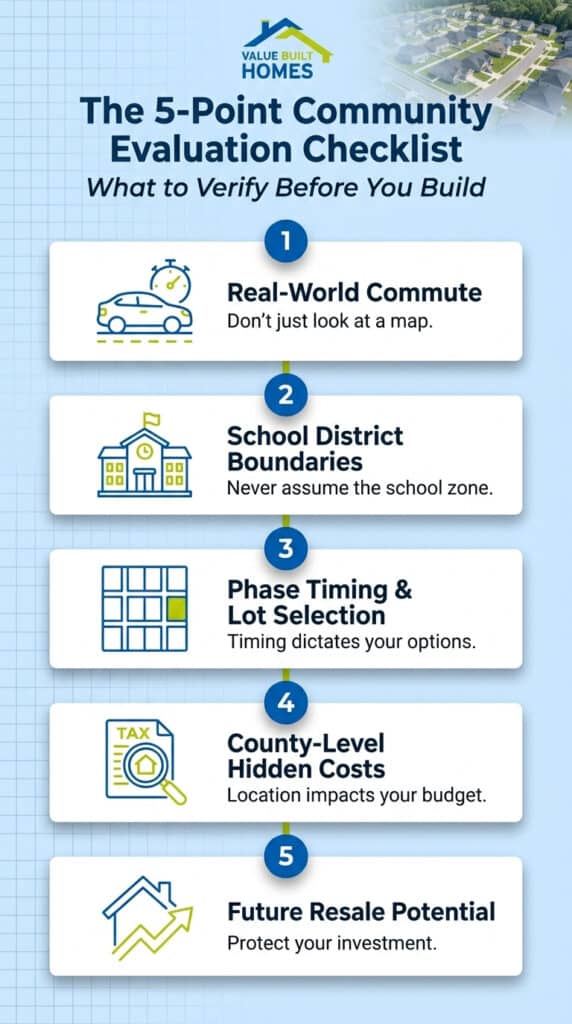
The factors that matter most when choosing a subdivision in Southwestern Indiana are commute, schools, lot availability, county differences, and long-term value. National checklists tend to stop at generic advice. Here is how each one plays out locally.
Commute to Major Employers
Map your real commute before you fall in love with a community. A neighborhood that feels close on a map can add 30 minutes a day once you factor in the actual route to work, daycare, and the places you visit weekly.
Across the area, the practical anchors are different depending on where you land:
- Evansville: the regional employment and shopping hub, served by communities like Willow Crossing in Evansville.
- Boonville and Warrick County: an easy reach to Evansville’s east side, with Poulton Place in Boonville as an option.
- Princeton and Gibson County: close to the Toyota Indiana plant and the I-69 corridor, with Baldwin Estates in Princeton and Fairview Heights in Gibson County.
- Vincennes: a Knox County employment center to the north, with Waterfront Villas in Vincennes.
School Districts and Family Fit
School district lines often change which community makes sense, even between two towns a few miles apart. In Southwestern Indiana, district boundaries follow county and township lines that aren’t always obvious from a listing, so confirm the assigned schools for the specific subdivision, not just the town. If schools are a priority, build them into your short list from the start. It’s far easier to choose a community inside the right district than to wish you had after you’ve broken ground.
Lot Availability and Phase Timing
In active subdivisions, the lots release in phases, so timing affects both your options and your price. Early phases often have more choice; later phases may sit closer to finished homes and mature landscaping. The lot you can get this month may not be available next quarter.
Before you commit, check what’s actually available. The lots for sale across Value Built Homes’ communities are listed in one place, which makes it easier to compare towns and phases side by side. When you narrow to a single parcel, our guide to smart homesite considerations for your Indiana purchase covers what to check at the lot level.
County and Township Differences
County lines change your taxes, services, and even your utility providers. Two homes 15 minutes apart can sit in different counties with different property tax rates, trash and recycling service, and emergency response. None of this shows up in a floor plan, and all of it shows up in your monthly budget.
Value Built Homes’ active communities sit across five counties: Vanderburgh, Warrick, Gibson, Knox, and Posey. It’s worth asking how the day-to-day differs between the communities you’re considering. The Farmington Ridge community in Poseyville sits in Posey County, for example, with its own services and school assignment distinct from the Princeton-area neighborhoods.
Long-Term Resale and Investment
Location protects resale value more than any single feature inside the house. Buyers a decade from now will weigh the same things you’re weighing: commute, schools, and how well the community has held up. A strong location can carry a modest home; a weak one is hard to overcome no matter how nice the finishes. For a deeper look at how location drives value before you ever break ground, see our breakdown of how to elevate pre-construction home value with the right location.
New Subdivision vs. Established Neighborhood: Which Is the Better Buy?
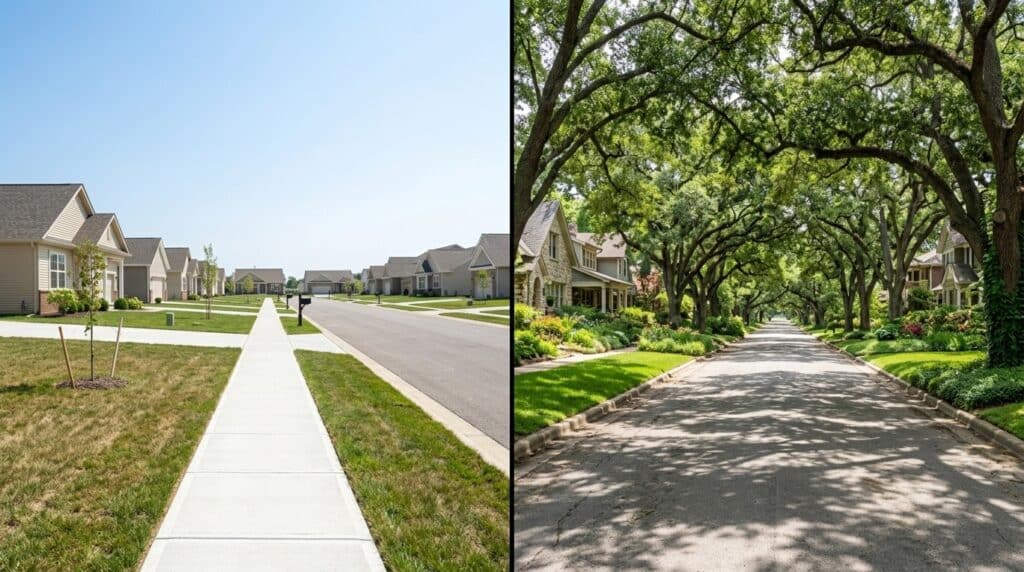
Neither is universally better; it depends on what you value. A new subdivision gives you a fresh build with current efficiency standards and warranty protection. An established neighborhood gives you mature trees, known character, and a track record you can see. Here is how the two compare on the points buyers ask about most.
| Factor | New Subdivision | Established Neighborhood |
| Efficiency | Built to current insulation and materials standards | Often needs updates to match newer efficiency |
| Maintenance | New systems and a builder warranty reduce early surprises | Aging roof, HVAC, and systems may need attention sooner |
| Landscaping | Young; you build it over time (budget for it) | Mature trees and established yards |
| Customization | Choose your plan and lot before the build | You inherit someone else’s choices |
| Construction noise | Possible while later phases finish out | Settled, with little ongoing building |
The cost picture has also shifted in favor of building. The price gap between new and existing homes has narrowed: in 2024 the median price for existing homes rose 5% to $412,000 while the median for new homes fell 2% to $420,000. New construction is more attainable than many buyers assume.
Demand reflects that. 61% of buyers now say a newly built home is their first preference, the highest share since 2007. As one industry researcher put it, “There’s a simple reason this is happening: Townhomes are more affordable as material, lot and labor prices continue to increase.” If you’re weighing the broader choice, our comparison of new construction versus existing homes goes deeper, and if you’re still deciding whether to buy at all, see renting versus buying in Southwest Indiana.
Hidden Costs and Common Concerns With New Subdivisions
The most common surprises in a new subdivision are landscaping, window treatments, and the way property taxes are assessed after the home is finished. None of these are dealbreakers, but planning for them keeps your budget honest.
- Landscaping and yard finishing: a new lot starts as a blank slate. Budget for grass, trees, and any hardscaping you want beyond what’s included.
- Window treatments and final touches: blinds, curtains, and similar finishing items are usually a buyer expense in any new build.
- Property tax timing: assessments often update after construction is complete, so your first full-year tax bill can differ from the land-only figure.
- Construction activity nearby: in an active subdivision, later phases may still be building. Ask where your lot sits relative to the remaining phases.
A few of these concerns are smaller than buyers fear. New homes come with protection that resale homes don’t: every Value Built Homes home includes a 2-10 Home Buyers Warranty covering structural defects, systems, and workmanship, with coverage that varies by state. And our free construction financing program covers the interest on the construction loan during the build, which removes one of the larger upfront costs buyers worry about.
How to Research a New Community Before You Commit
Research a community by confirming the things that won’t change easily: schools, county, future development plans, and the builder’s reputation. A floor plan can be swapped; the location and the people building it cannot. Work through these steps before you sign.
- Confirm the assigned schools. Verify the district and specific schools for the exact subdivision, not just the town.
- Check the county and its rates. Look up the property tax rate, utility providers, and trash and recycling service for that address.
- Ask about future phases and nearby land. Find out what’s planned around the community and how many phases remain.
- Evaluate the builder. Read reviews, ask about warranty coverage, and look at how the builder communicates during the build.
- Map your real commute. Drive the route to work and to the places you go weekly, at the times you’d actually travel.
On the builder question, transparency during the build is one of the clearest signals. As one Value Built Homes homeowner shared, the team “kept up with pictures and updates on the BuilderTrend app. It was a nice way to see what had been done.” Another noted the turnkey scope: the builder “took care of everything like running power, water, septic, poured wall basement, and even the driveway.” That kind of clarity is what tells you a community is run well, not just sold well.
Why Energy Efficiency Should Factor Into Your Community Choice
Efficiency belongs in the comparison because it shows up in your monthly bills for as long as you own the home. New construction is built to current standards, which generally means lower energy use than older homes in established neighborhoods. As a reference point, ENERGY STAR-certified homes use 15 to 30 percent less energy than typical new homes, and more than most resale homes on the market. Value Built Homes builds with modern insulation techniques, energy-saving materials, and brand-name components, so efficiency is part of the standard process rather than an upgrade you negotiate for.
Frequently Asked Questions About Choosing a Neighborhood for New Construction
Should I prioritize the floor plan or the neighborhood location?
Treat them as one decision. The neighborhood sets your commute, schools, taxes, and resale value; the floor plan sets your daily life inside the house. Start with the communities that fit your location needs, then choose among the floor plans available in each. Standardized plans make this easier because the same layouts are offered across multiple subdivisions.
Is a new subdivision or an established neighborhood the better buy?
It depends on what you value. New subdivisions offer current efficiency standards, warranty protection, and fewer early repairs; established neighborhoods offer mature landscaping and known character. The cost case has shifted toward building, with the price gap between new and existing homes narrowing in recent years, so new construction is more attainable than many buyers assume.
What are the hidden costs of a brand-new subdivision?
The usual surprises are landscaping, window treatments, and property taxes that update after the home is finished. A new lot starts bare, so budget for yard work and finishing touches. Ask how the county assesses taxes once construction is complete so your first full-year bill isn’t a shock.
Will a new-construction neighborhood be noisy with construction for years?
Sometimes, while later phases finish out. The fix is simple: ask where your lot sits relative to the remaining phases. Lots in earlier phases or near already-finished homes see less ongoing activity. In most communities, building wraps up phase by phase rather than dragging on indefinitely.
How can I tell whether a new neighborhood will hold its value?
Look at location first: commute access, school quality, and how the community is managed. These are what future buyers will weigh too. Strong demand for new homes helps; 61% of buyers say a new home is their first preference, the highest share since 2007. A well-located home in a well-run community is the most reliable way to protect resale value.
Find the Right Community for Your Forever Home
Choosing a neighborhood for new construction comes down to matching the right location to the right floor plan, and Value Built Homes makes it possible to compare both across six active Southwestern Indiana communities. Ready to see what fits your family? Contact the Value Built Homes team to talk through your options and start the conversation about your forever home.