Building a new home comes with a long financial checklist, and property taxes deserve a spot near the top. In Indiana, property taxes on new construction work differently than they do on an existing home. There’s an assessment timeline to understand, a filing deadline that matters, and a constitutional protection most buyers don’t know about. This guide covers how Indiana property taxes work for new construction buyers, what to expect in year one versus year two, and the two steps that can meaningfully reduce your annual bill.
Key Takeaways
- Indiana’s effective property tax rate on owner-occupied housing is 0.76%, which is below the national average of approximately 1.0% to 1.1%.
- Indiana taxes property in arrears, so your first bill after closing reflects the assessed value from January 1 of the prior year. For new construction, that’s often land value only.
- Expect a noticeably higher property tax bill in year two, once the finished home is fully assessed and that value is on record.
- The Indiana homestead standard deduction reduces your assessed value by a flat dollar amount that decreases each year through 2030, for your primary residence. File by January 15 of the year taxes are first due to qualify.
- Indiana’s Circuit Breaker constitutionally caps property taxes on homestead properties at 1% of gross assessed value, giving you a defined ceiling on long-term tax increases.
- Property tax rates vary by county and taxing district across SW Indiana. The Indiana Gateway calculator is the best tool for a county-level estimate before you finalize your budget.
How Indiana Property Taxes Work on a New Home
Indiana calculates property taxes based on a home’s assessed value as of January 1 each year, and they are paid in arrears. The bill you pay in spring 2026 is based on what your property was worth on January 1, 2025. For most homeowners, that’s a straightforward calculation. For new construction buyers, it gets a little more nuanced.
Property assessment captures value as of the January 1 date. If your home closes mid-year, the assessor may record only the land value, or a partial construction value, for that cycle. The completed home’s full value typically enters the tax record on the following January 1 assessment. That’s the mechanic that drives the difference between your first-year bill and your second-year bill.
Mark your calendar: property tax payments in Indiana are due May 10 and November 10 each year. Your first bill after closing may be lower than you expect. That isn’t a mistake. It’s the assessment cycle working as designed, and the second-year bill is the one to build into your budget.

The Assessment Gap: Why Your Second-Year Tax Bill Will Be Higher
Most new construction buyers in Indiana see a lower first-year property tax bill and a noticeably higher bill in year two. This happens because the assessment date and the payment-in-arrears structure interact in a specific sequence. Understanding it in advance makes budgeting much cleaner.
Here’s the typical sequence for a home that closes mid-2025:
- The January 1, 2025 assessment captures land value only. The home isn’t built yet.
- The January 1, 2026 assessment captures the completed home’s full value.
- The May 2026 and November 2026 bills reflect that higher, fully assessed amount.
This is what the mortgage and real estate world calls the “assessment gap,” and it affects new construction buyers across Indiana. Your lender will typically adjust your escrow account once the full assessed value is on record, but the adjustment can feel abrupt if you haven’t budgeted for it. Planning for the higher second-year bill from day one is the cleaner approach.
If you want a complete picture of costs that can catch new construction buyers off guard, the Value Built Homes guide to hidden costs in a new home budget covers several expenses that first-time builders often underestimate.
The Indiana Homestead Deduction: File It Early and Don’t Miss the Deadline
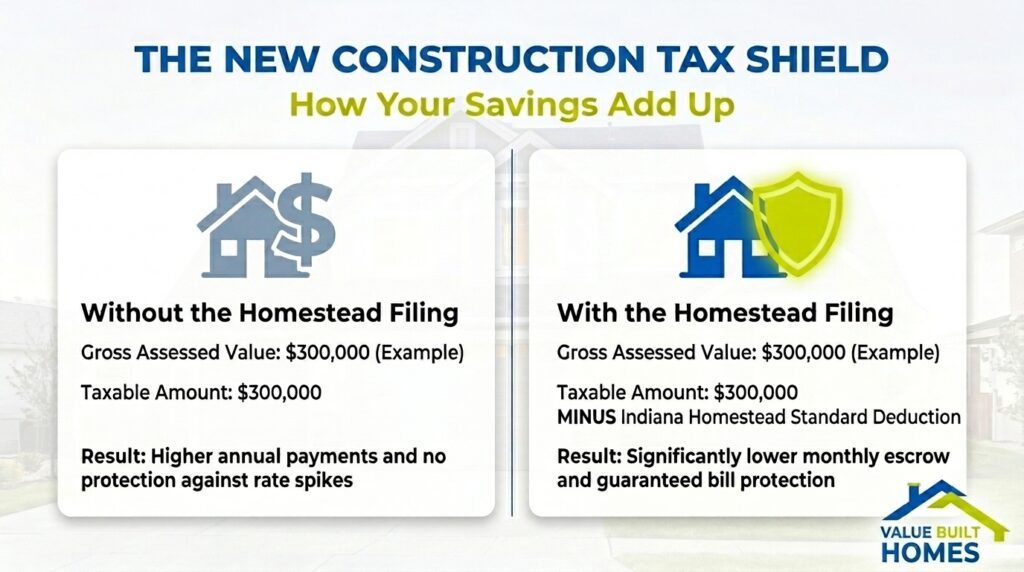
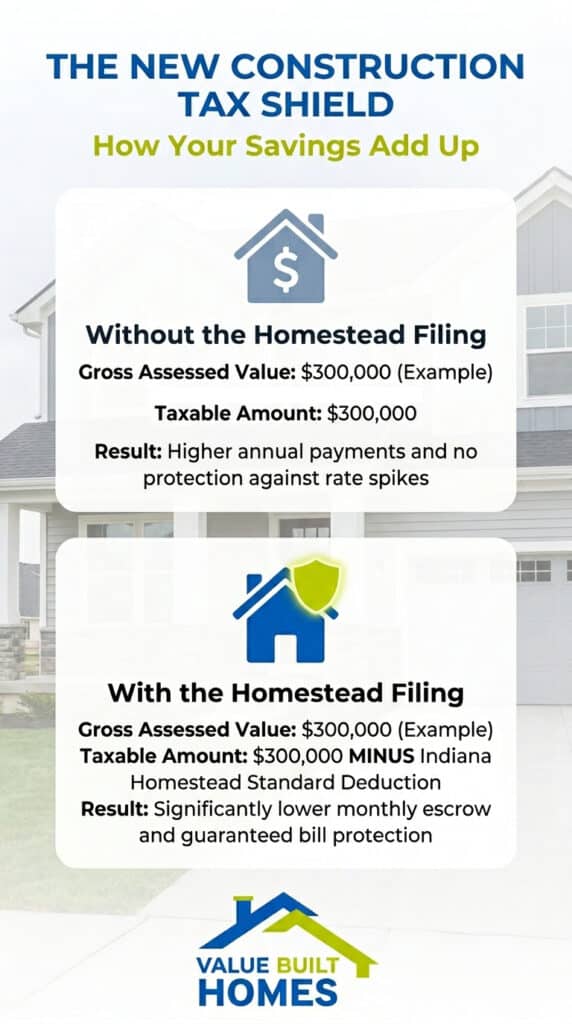
The Indiana homestead standard deduction is the most important property tax benefit available to new homeowners. It reduces your assessed value by a flat dollar amount that decreases each year through 2030. For most new construction buyers in SW Indiana, that’s a meaningful reduction in your annual bill.
Here’s what to know before you file:
- Who qualifies: Indiana residents who own and occupy their home as their primary residence.
- What it covers: The deduction applies to the structure and up to one acre of land immediately surrounding it.
- Filing deadline: January 15 of the year taxes are first due and payable. Missing this deadline means waiting a full additional year.
- How to file: Contact your county assessor’s office. Forms and additional guidance are available through the Indiana Department of Local Government Finance.
File as soon as you close. Don’t wait until you’re settled in. The January 15 deadline is firm, and the difference between filing on time and missing it is an entire year of paying the higher rate without the deduction.
Filing your homestead deduction also activates Indiana’s Circuit Breaker cap, which is the next protection every new construction buyer should know about.
Indiana’s Circuit Breaker Cap: A Built-In Protection for Homestead Owners
Indiana’s Circuit Breaker is a constitutional property tax cap that sets a ceiling on what homestead owners pay. For owner-occupied primary residences, total property tax liability cannot exceed 1% of the property’s gross assessed value. That limit is written into the Indiana Constitution, which means it doesn’t require annual legislative action to stay in effect.
For buyers who are concerned about property taxes rising as their home’s value increases over time, the Circuit Breaker is a meaningful assurance. It gives you a defined ceiling on your tax exposure as long as the homestead deduction is active.
One catch to know: the Circuit Breaker applies only to properties with a filed and approved homestead deduction. Filing your homestead deduction promptly after closing is the single step that unlocks both benefits at once.
What to Expect for Property Taxes in SW Indiana
Indiana’s overall property tax burden is below the national average. The state’s effective property tax rate on owner-occupied housing is 0.76%, compared to a national average of approximately 1.0% to 1.1%. That’s a favorable baseline for new construction buyers comparing their options across state lines.
The rate on your specific home will depend on your county and taxing district. SW Indiana spans multiple counties with their own levy structures, and rates can vary between adjacent subdivisions depending on which school, fire, and library districts serve a given parcel. The most reliable tool for a realistic estimate is the Indiana Gateway property tax calculator.
A few factors that shape your final rate:
- Which taxing districts serve your parcel, including school, library, fire, and township
- Your county’s total levy for that tax year
- Any additional deductions or credits you qualify for beyond the homestead deduction
Property taxes are one of several ongoing costs to fold into your monthly payment estimate when you’re planning a new build. The Value Built Homes monthly payment checklist for Indiana homebuyers walks through all the line items to include, including how property taxes flow through your escrow account.
For a broader view of what new construction costs look like from contract through the first year of ownership, the Value Built Homes new home construction budget breakdown covers the full picture.
Frequently Asked Questions About Property Taxes on New Construction in Indiana
When do I start paying property taxes on a new construction home in Indiana?
Property taxes in Indiana are paid in arrears, so your first bill reflects the assessed value from January 1 of the prior year. For new construction, the initial assessment often captures only land value or partial construction value, which means your first bill is lower than it will be going forward. Expect the full tax picture to settle in approximately one to two years after closing, once the finished home is fully assessed and that value is in the payment cycle.
How much is the Indiana homestead deduction?
The Indiana homestead standard deduction reduces your assessed value by a flat dollar amount that decreases each year through 2030. It applies to your primary residence and must be filed with your county assessor by January 15 of the year taxes are first due. Filing promptly after you close is the most important action you can take as a new homeowner.
Does building a new home increase your property taxes?
Yes. Once the completed home is fully assessed, your property tax bill will reflect the value of both the land and the finished structure, which is typically much higher than the land-only bill in year one. The good news is that Indiana’s Circuit Breaker cap limits homestead property taxes to 1% of gross assessed value, which gives you a defined ceiling on future increases.
Does Indiana’s Circuit Breaker apply automatically?
The Circuit Breaker cap applies to all homestead properties in Indiana, but the homestead deduction must be filed and approved for the cap to take effect. Filing your homestead deduction promptly after closing activates both the deduction and the cap at the same time.
Where can I look up property tax estimates for a specific location in SW Indiana?
The Indiana Gateway property tax calculator is the most reliable starting point for county-level estimates. Rates vary by taxing district, so it’s worth looking up the specific parcel if you’re comparing lots or subdivisions before you decide where to build.
Ready to Start Planning Your New Home in SW Indiana?
Property taxes don’t have to be a surprise. Knowing when your first full bill arrives, filing the homestead deduction as soon as you close, and understanding how the Circuit Breaker cap works gives you a clearer picture of what homeownership actually costs year over year. Indiana’s below-average tax rate and constitutional cap make it a favorable place to build, and a little advance planning puts you well ahead of most buyers.
Browse Value Built Homes’ floor plans to see what a new site-built home in SW Indiana looks like. Have questions about building in one of their active subdivisions? Contact the Value Built Homes team to get started.