Building a home should feel exciting, but the appraisal step tends to make people nervous, especially the fear that a value comes in low. A new construction appraisal works differently from the one you would get on a house that already exists, and understanding it takes most of the worry out. Here’s how the process works when you build in Southwestern Indiana, and what actually happens if the number lands lower than you expected.
Key Takeaways
- A new construction appraisal is a forward-looking, “as-completed” valuation: the appraiser estimates what your finished home will be worth from the plans, specifications, comparable sales, and the lot, not from a walk-through of a house that already exists.
- On a construction loan, your loan amount is based on the lesser of the total project cost or the appraised as-completed value, so the appraisal doubles as a financial checkpoint on the build.
- Appraised value, purchase price, and loan amount are three separate numbers. A low appraisal does not automatically cancel your build; it changes the math you and your lender work with.
- New homes can appraise low when comparable sales are thin, which is common on rural land and in newer Southwestern Indiana subdivisions, or when optional upgrades cost more than they add in market value.
- If your appraisal comes in low, you generally have five options: request a reconsideration of value, bring additional cash, adjust your selections, ask about builder terms, or escalate to an appraisal review.
- A reconsideration of value goes through your lender, not the appraiser, and it guarantees a review, not a higher number.
What Is a New Construction Appraisal?
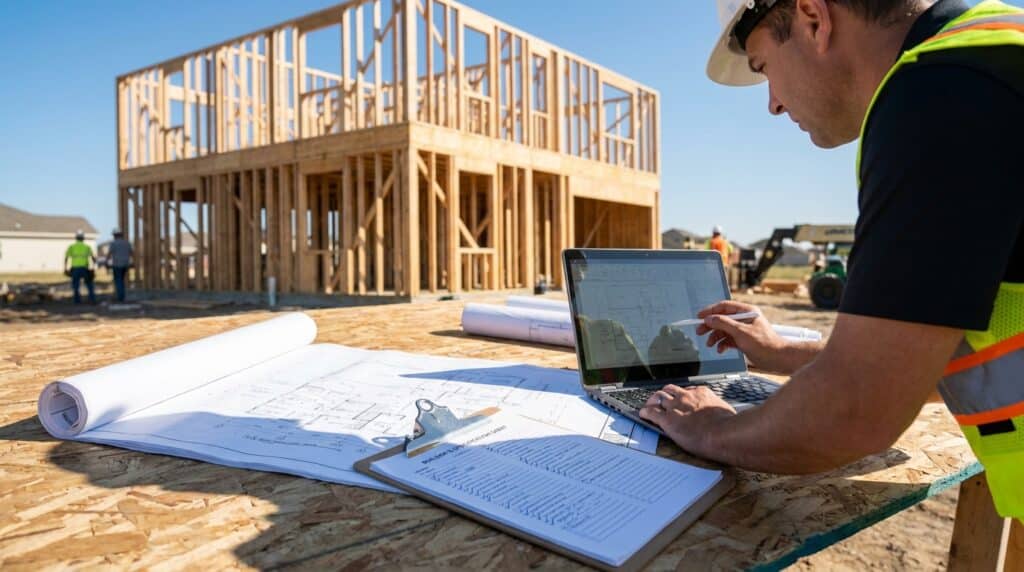
A new construction appraisal is a forward-looking estimate of what your finished home will be worth. Because the house is not built yet, the appraiser works from your plans, specifications, comparable sales, and the lot rather than walking through completed rooms. Lenders often call this an as-completed or subject-to appraisal.
To reach that number, the appraiser typically reviews three things:
- Your builder’s plans and specifications, including square footage, layout, and the finishes and materials you have selected.
- Comparable sales, meaning recent sales of similar homes in the area that help anchor the value.
- The lot itself, including location, size, and site improvements such as the driveway, water, and septic.
An appraisal is not a home inspection. The appraisal estimates value, while a home inspection checks the condition and construction quality of the finished house. You may go through both during your build, but they answer different questions.
How the Appraisal Sets Your Construction Loan Amount
On a construction loan, your loan amount is based on the lesser of the total project cost or the appraised as-completed value. In plain terms, the lender will not fund more than the home is projected to be worth, which protects you as much as it protects them.
This is why the appraisal matters on a construction-to-permanent loan, the single loan that covers the build and then converts to your mortgage. The appraisal acts as a built-in checkpoint that the project is financially sound before the money is committed.
Where Value Built Homes fits in: its standardized, cost-engineered plans keep your project cost predictable, and its free construction financing program covers the interest on the construction loan while your home is being built. The appraisal still sets the loan amount, but knowing your plan and its cost up front removes much of the guesswork.
It also helps that the package is turnkey, so the project cost the appraiser weighs is comprehensive. As one Value Built Homes homeowner put it: “They took care of everything like running power, water, septic, poured wall basement, and even the driveway.”
Appraised Value, Purchase Price, and Loan Amount Are Three Different Numbers
Appraised value, purchase price, and loan amount are three separate figures, and keeping them straight makes the whole process easier to follow. They are related, but they are not the same thing.
- Purchase price or project cost: the amount in your contract, including the home, land, and site work.
- Appraised value: the appraiser’s independent, as-completed opinion of what the finished home is worth.
- Loan amount: what your lender authorizes, based on the lesser of project cost or appraised value.
So do new construction homes appraise for more or less than the purchase price? Neither is automatic. In a rising market with strong comparable sales, the value can meet or exceed your contract. In areas with few recent comparable sales, the appraisal can come in under the contract even when the home is well built and fairly priced.
Why New Construction Homes Sometimes Appraise Low
New construction homes most often appraise low for one of two reasons: there are not enough comparable sales to support the value, or the contract price includes upgrades that cost more than they add to market value. Neither one means you overpaid or did anything wrong.
Thin Comparable Sales
In areas with limited new construction, strong comps are harder to find, so the appraiser may widen the search area to pull in older or more distant sales. This is common on rural land and in newer Southwestern Indiana subdivisions like Baldwin Estates in Princeton, Farmington Ridge in Poseyville, or Waterfront Villas in Vincennes, where few nearly identical homes have sold recently.
Upgrades That Do Not Pay Back Dollar for Dollar
Optional upgrades rarely add their full cost to market value. A $40,000 kitchen remodel may add only about $10,000 in value. When selections push the contract price well above what comparable homes have sold for, the appraisal can lag the price.
This is one quiet advantage of building on a standardized, cost-engineered floor plan. Because the plans are designed for value rather than heavy customization, there is less room to over-improve above the market, which is exactly the situation that tends to produce a low appraisal.
Finished Basements Are Valued Differently
Basements are generally valued separately and not counted in gross living area. A basement is an available option at Value Built Homes rather than a standard inclusion, and if you add one, that space adds value without showing up in the square-footage figure the appraiser compares against other homes, so do not be surprised when it is handled on its own.
If you are weighing how a new build holds up over time, our look at whether new construction homes hold their value covers the longer view.
What Happens If Your New Construction Appraisal Comes In Low
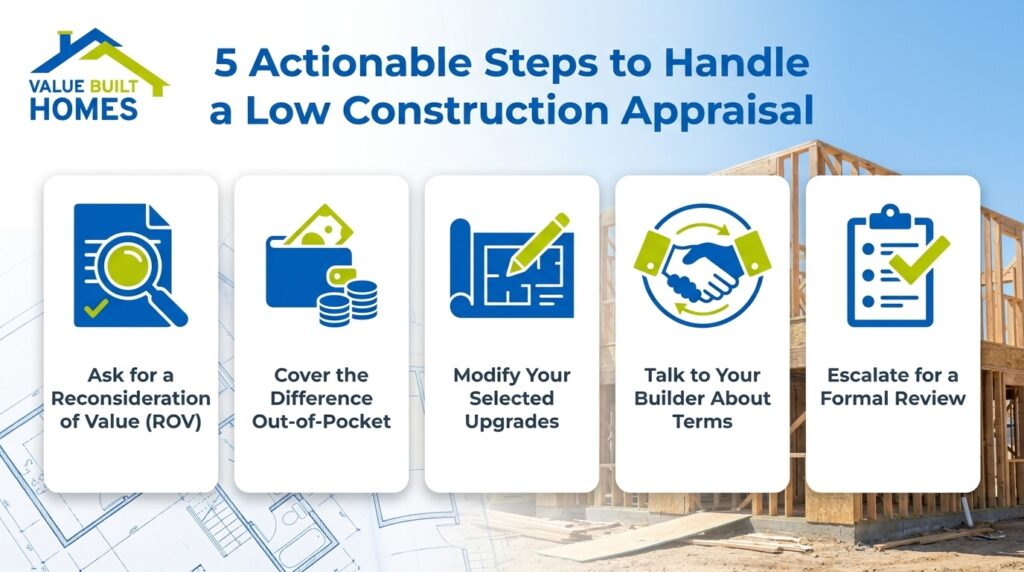
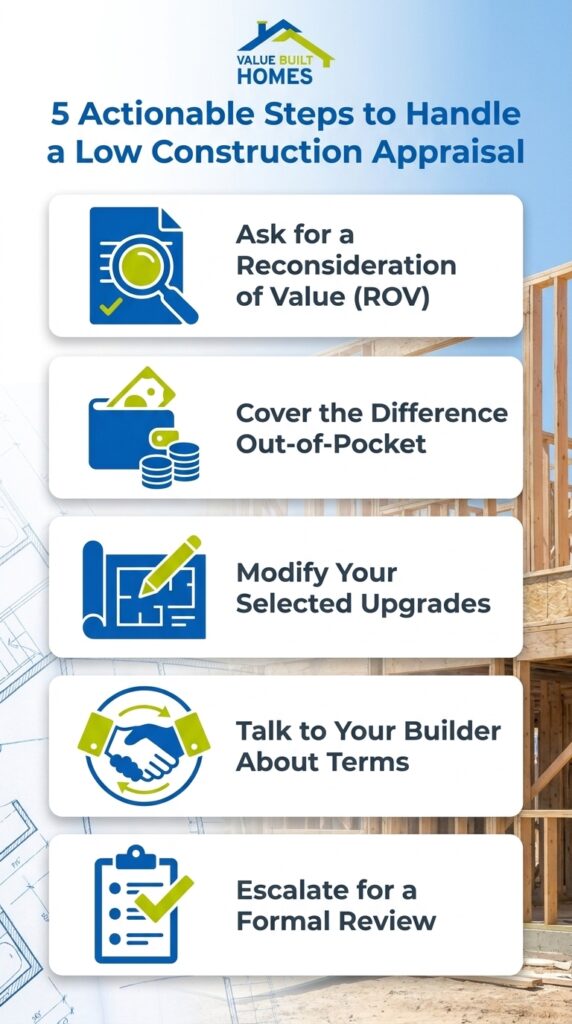
A low appraisal does not automatically cancel your build. It changes the math, and you generally have five options: request a reconsideration of value, bring additional cash to closing, adjust your selections, ask about builder terms, or escalate to an appraisal review. The right move depends on why the value came in low and how far along the build is.
| Option | What it involves | When it fits best | Keep in mind |
|---|---|---|---|
| Request a reconsideration of value (ROV) | Ask your lender, not the appraiser, to have the report re-reviewed with better data. | There are stronger recent comps, a factual error such as the wrong square footage, or an overlooked feature. | It ensures a review, not a guaranteed change. Lead with verifiable data. |
| Bring additional cash to closing | Cover the gap between the appraised value and the project cost with additional funds. | You have the funds available and want to proceed as planned. | It raises your out-of-pocket amount. |
| Adjust the plan or scale back selections | Reduce certain upgrades or finishes to bring the project cost closer to the appraised value. | Optional upgrades pushed the cost above the appraised value. | A standardized, cost-engineered plan leaves less room for over-improvement to begin with. |
| Ask about builder terms | The builder may adjust the price or absorb certain costs, or terms may be renegotiated. | The contract and build stage allow it. | Builder dependent and not guaranteed. |
| Escalate to an appraisal review | Another qualified appraiser reviews the report, and a second appraisal may follow. | The ROV is exhausted and you still believe the value is unsupported. | It may add cost and time, with no guaranteed outcome. |
The first step is usually a reconsideration of value, or ROV. Borrowers can challenge an appraisal they believe is inaccurate through this process, and federal guidance finalized in 2024 expects lenders to keep a clear ROV process that lets you submit information the appraiser may not have had. One rule is worth remembering: an ROV goes through your lender, not directly to the appraiser, because of appraiser independence.
An ROV guarantees your request will be reviewed, not that the value will change. “The most effective ROV requests focus on verifiable data,” says Cristy Conolly, EVP of Quality Control at Class Valuation, rather than emotion or a preference for how the deal should turn out. The strongest requests also spell out exactly what in the original report deserves a second look.
Beyond an ROV, you can bring additional cash to cover the gap between the appraised value and the project cost, scale back optional selections, or ask whether the builder can adjust terms. Which path fits depends on why the value came in low and how far along the build is. If you want to see how these costs fit together from the start, our new home construction budget breakdown lays out the full picture.
Frequently Asked Questions About New Construction Appraisals
Who pays for the appraisal on a new construction home?
The buyer typically pays for the appraisal as part of the loan and closing costs. Your lender orders it through a third party, so you cannot choose the appraiser, but the cost is generally yours. Building it into your budget early keeps it from feeling like a surprise later.
Can you dispute a new construction appraisal?
Yes. If you believe the appraisal is inaccurate, you can request a reconsideration of value through your lender. The request should rest on verifiable information, such as recent comparable sales or a factual correction like the wrong square footage. An ROV ensures a review; it does not guarantee a higher value.
Do appraisers use other homes from the same builder as comparable sales?
They can. Appraisers look for the most similar recent sales, and homes built from the same or similar plans in the same area often make strong comparables. In a newer subdivision where few homes have sold, the appraiser may still need to widen the search to nearby neighborhoods to find enough support.
Does a finished basement count toward my home’s appraised value?
A finished basement adds value, but it is generally valued separately and not included in the home’s gross living area. A basement is an available option at Value Built Homes rather than a standard inclusion, so if you add one to your plan, expect the appraiser to account for it on its own rather than folding it into the above-grade square footage.
Build With Confidence in Southern Indiana
Building your forever home in Southern Indiana does not have to feel uncertain, and the appraisal is just one more step that makes sense once you see how it works. If you have questions about the process, your financing, or which plan fits your budget, the Value Built Homes team is happy to walk you through it. Contact us to get started.