
If you’re weeks away from signing on a new home, you’ve probably heard the warning that new construction homes lose value the moment you close. It’s the question that drives the most search traffic for new buyers: do new construction homes hold their value? The data tells a more interesting story, especially for buyers in Southwestern Indiana and the tri-state area.
Key Takeaways
- New homes are not automatically a worse investment than existing homes. Nationally, the median new home sold for $9,600 less than the median existing home in Q4 2025, the third straight quarter the gap has flipped.
- The Midwest follows a different pattern. New homes in the Midwest still sold for about $60,700 more than existing homes in Q4 2025, but the region remains one of the most affordable places in the country to build.
- Indiana home values have continued to rise. The state’s FHFA All-Transactions House Price Index increased approximately 4.4% from Q4 2024 to Q4 2025, a steady pace compared with coastal and Sun Belt swings.
- Existing home prices have set 34 consecutive monthly records. The NAR median existing-home price hit $417,700 in April 2026, the 34th straight month of year-over-year increases. New construction is competing in that same appreciating market.
- Lower carrying costs strengthen resale value. Energy-efficient new builds tend to use less energy, need fewer repairs, and can command sale price premiums of up to 6% compared with comparable older homes per ENERGY STAR.
- Warranties, fewer surprises, and modern systems matter at resale. A new home that comes with a 2-10 Home Buyers Warranty offers structural and systems coverage that buyers of older homes typically can’t match.
The “Instant Negative Equity” Myth and What the Data Actually Shows
The idea that a new construction home loses value the second you close is mostly a myth. The largest study of recent prices shows new and existing homes are now priced almost identically nationally, and new home pricing has declined nearly 15% since late 2022 as builders cut prices, build smaller, and shift to lower-cost regions like the Midwest.
The objection comes from a real concept called the new-build premium. Buyers historically paid more for brand-new finishes, and some of that premium did fade in the first year of ownership. But the 2026 market does not look like the market that produced that rule of thumb. Builders have responded to affordability pressure with smaller homes, lower price points, and incentives.
The new-build premium has shrunk dramatically over the past decade. Here is how the gap between new and existing home prices has changed:
- 2010 to 2019: new homes cost an average of $66,000 more than existing homes.
- 2020 to 2025: that gap shrank to an average of $23,300.
- Today: in many markets the gap has flipped entirely, with existing homes now selling for more than new ones nationally.
That doesn’t mean every new home appreciates. It means the starting point looks very different from what the Reddit threads describe. If you’re still weighing the bigger decision, our guide on building versus buying a home walks through the tradeoffs in more detail.
How New and Existing Home Prices Compare in 2026
In Q4 2025, the median new home sold for $405,300 nationally while the median existing home sold for $414,900. That makes Q4 2025 the third consecutive quarter where existing home prices have exceeded new home prices, a historic shift in a market where new homes have almost always carried the higher sticker price.
A few forces are driving the change. Builders have cut prices, reduced typical home sizes, and shifted construction toward lower-cost regions. At the same time, existing home inventory has stayed tight, and existing home prices have kept rising, with NAR reporting the 34th consecutive month of year-over-year price increases in April 2026.
Here’s how the most recent national figures line up:
| Metric (Q4 2025) | National | Midwest |
| Median new home price | $405,300 | $377,900 |
| Median existing home price | $414,900 | $317,200 |
| Difference (new minus existing) | −$9,600 (new is cheaper) | +$60,700 (new is more expensive) |
Source: NAHB Eye on Housing, Comparing New and Resale Prices 4Q25.
The national headline (new homes cost less than existing homes) is true. But it doesn’t describe every region. In the Midwest, new homes still carry a higher price than existing homes, just not by as much as they did a decade ago.
What the Midwest Picture Looks Like for Indiana Buyers
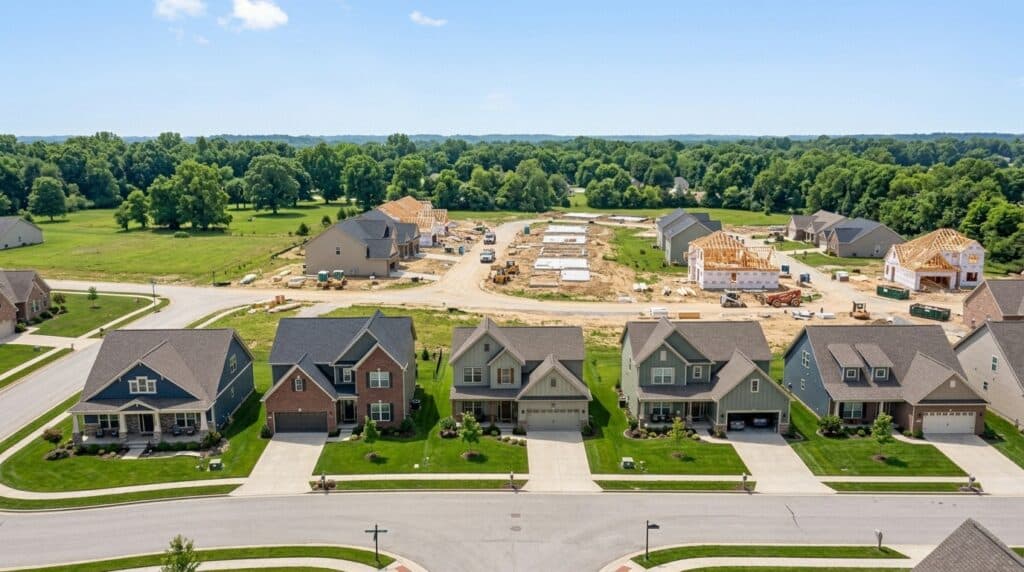
In the Midwest, new homes still sell for more than existing homes, but the region is one of the most affordable places to buy or build in the country. The Midwest had the lowest median existing home price of any U.S. region at $317,200 in Q4 2025, with new homes at $377,900.
For Southwestern Indiana, Kentucky, and Illinois buyers, that has a few practical implications:
- Lower entry prices: Buyers in the Midwest start with a lower price floor for both new and existing homes than buyers on the coasts or in much of the Sun Belt.
- A smaller new-build premium than the national 2010 to 2019 average: The $60,700 Midwest gap is well below the $66,000 historic national average, and far below the premiums seen during the 2020 to 2022 building boom.
- Steadier appreciation: Indiana home prices have grown at a more even pace than the boom-and-bust markets that drive most national headlines, which has implications for long-term resale.
How Indiana Home Values Have Appreciated
Indiana home prices rose approximately 4.4% year over year from Q4 2024 to Q4 2025, with the state’s All-Transactions House Price Index moving from 503.52 to 525.79. That’s a steady single-digit gain consistent with the state’s long-running pattern of moderate, low-volatility appreciation.
That kind of growth doesn’t generate national headlines. It also doesn’t generate the kind of corrections that wipe out value in markets where prices rose 20% in a year. For a buyer who wants to put down roots and watch the home grow with the family, that’s a feature, not a flaw.
A few characteristics of Indiana’s housing market support long-term value retention:
- Moderate price growth: Year-over-year appreciation in the low-to-mid single digits is the long-run norm, not boom-and-bust swings.
- Strong existing-home demand: Data showing 34 consecutive months of year-over-year price increases nationally reflects a market where buyers still need homes, including resale homes, at every price point.
- Local economic stability: Manufacturing, healthcare, agriculture, and logistics employment in Southwestern Indiana and the tri-state area give the housing market a steady demand base.
Why New Construction’s Lower Carrying Costs Strengthen Resale Value
Resale value isn’t only about appreciation. It’s also about what the next buyer is willing to pay for a home that costs less to own. New construction generally wins on energy efficiency, system age, and warranty coverage, all of which factor into buyer demand and appraisal comps.
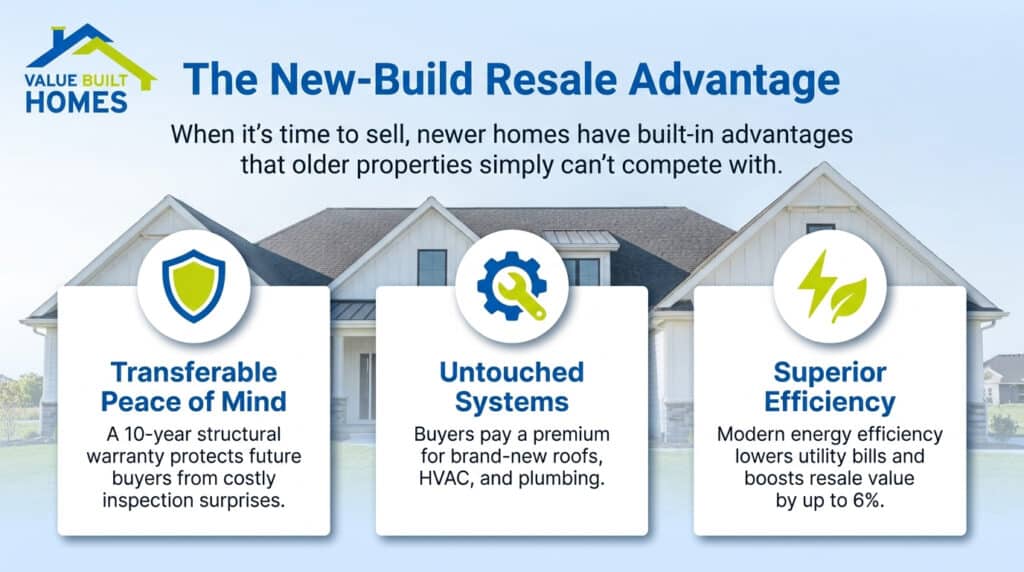
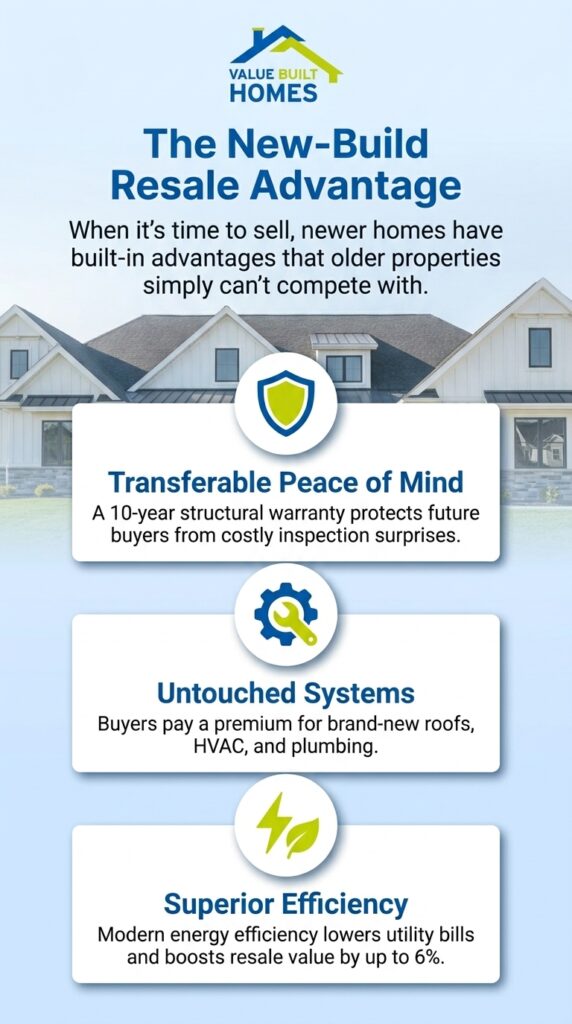
Certified new homes are designed to exceed minimum energy code requirements by at least 10% per ENERGY STAR, and certified and similarly efficient homes can command resale price premiums of up to 6% compared with comparable less-efficient homes. Value Built Homes does not claim ENERGY STAR certification, but those third-party benchmarks describe what efficient new construction can deliver in general.
Beyond energy use, a new home arrives with:
- Newer mechanical systems: HVAC, plumbing, and electrical systems on day one have decades of useful life ahead, instead of needing replacement during your ownership.
- Modern building practices: Current insulation techniques, house wrap, and roofing systems perform better than the older counterparts in many existing homes.
- Warranty coverage: A 10-year structural warranty and shorter-term systems and workmanship coverage protect against the kinds of repair surprises that tend to come up during home inspections at resale.
We’ve covered the ongoing-ownership side of this in more depth in our total cost of ownership breakdown for new construction. For resale, the takeaway is simpler: buyers pay more for homes that cost less to live in.
How Value Built Homes Approaches Long-Term Value
Value Built Homes builds traditional site-built homes in Southwestern Indiana and the tri-state area using a cost-engineered model that’s designed to keep prices down without compromising the structural quality that supports long-term value. Three pieces of that model matter most for buyers thinking about resale.
Standardized floor plans (simpler decisions, predictable quality)
Value Built Homes works from a set of pre-engineered floor plans rather than custom one-off designs. That choice keeps the build process efficient, eliminates decision fatigue, and produces homes that fit the kind of square footage and bedroom count today’s buyers actually search for. The current floor plans range from 2 to 5 bedrooms and roughly 933 to 2,514 square feet.
Free construction financing (lower cost basis)
Value Built Homes covers the construction loan interest during the build phase through its Free Construction Financing program. That keeps thousands of dollars in the buyer’s pocket up front, which lowers the effective cost basis of the home and improves the math on long-term value retention.
2-10 Home Buyers Warranty (third-party coverage)
Every Value Built Homes home is backed by a 2-10 Home Buyers Warranty, which provides 10-year structural protection and additional coverage on systems and workmanship. Workmanship terms vary by state (2 years in Indiana and 1 year in Kentucky), but the structural protection travels with the home and shows up in any future appraisal or buyer inspection.
Together, those three pieces (a streamlined process, lower carrying costs during construction, and durable structural coverage) describe how affordable new home construction can compete on long-term value, not just monthly affordability. For many of our customers, building this way is what makes a forever home actually possible.
Frequently Asked Questions About New Construction Home Resale Value
Do new construction homes have good resale value?
Most new construction homes hold their value well, especially in markets with steady appreciation like Indiana. The state’s FHFA index rose approximately 4.4% from Q4 2024 to Q4 2025, and new homes typically benefit from buyer demand for modern systems, energy efficiency, and warranty coverage. Location, build quality, and how the home was priced at purchase all factor in.
Do new homes depreciate faster than existing homes?
No, not in the broad sense. The idea comes from an old new-build premium, where buyers paid more for brand-new finishes that depreciated quickly. That premium has narrowed sharply, and new home pricing has declined nearly 15% since late 2022 as builders adjusted to affordability pressure. Today, new and existing homes appreciate based on the same regional market forces.
Are new construction homes a good investment?
They can be, particularly for buyers planning to stay in the home long term. New construction usually comes with lower repair costs, modern energy performance, and structural warranties, all of which preserve equity and reduce out-of-pocket surprises. Buyers focused on short-term flipping or speculative gains may find different markets more attractive.
Do new build homes appreciate as fast as existing homes?
It depends on the region. Nationally in 2026, new homes are actually priced below existing homes, while the existing-home median has set 34 consecutive months of year-over-year increases. In the Midwest, new homes still sell at a premium, and they appreciate alongside the broader regional market, which has run at a steady, moderate pace.
What is the new-build premium?
It’s the price difference between a new construction home and a comparable existing one. Historically, new homes carried a premium of around $66,000 nationally from 2010 to 2019. That gap shrank to roughly $23,300 between 2020 and 2025 and recently flipped at the national level, though it remains positive in the Midwest.
Why are new construction homes cheaper to maintain?
Every major system in a new home is at the start of its useful life. Roofs, HVAC, plumbing, electrical, and appliances are all under warranty and require fewer repairs than in older homes. Modern energy code standards also mean lower utility bills, which keeps the total cost of owning a new home down over time.
What are the disadvantages of buying a new construction home?
The main tradeoffs are timing (construction takes time, typically 5 to 7 months for a Value Built Homes home), the possibility of buying in an active development that’s still being built out, and limited customization in homes built from standardized plans. For buyers, those tradeoffs are part of how Value Built Homes keeps new construction affordable.
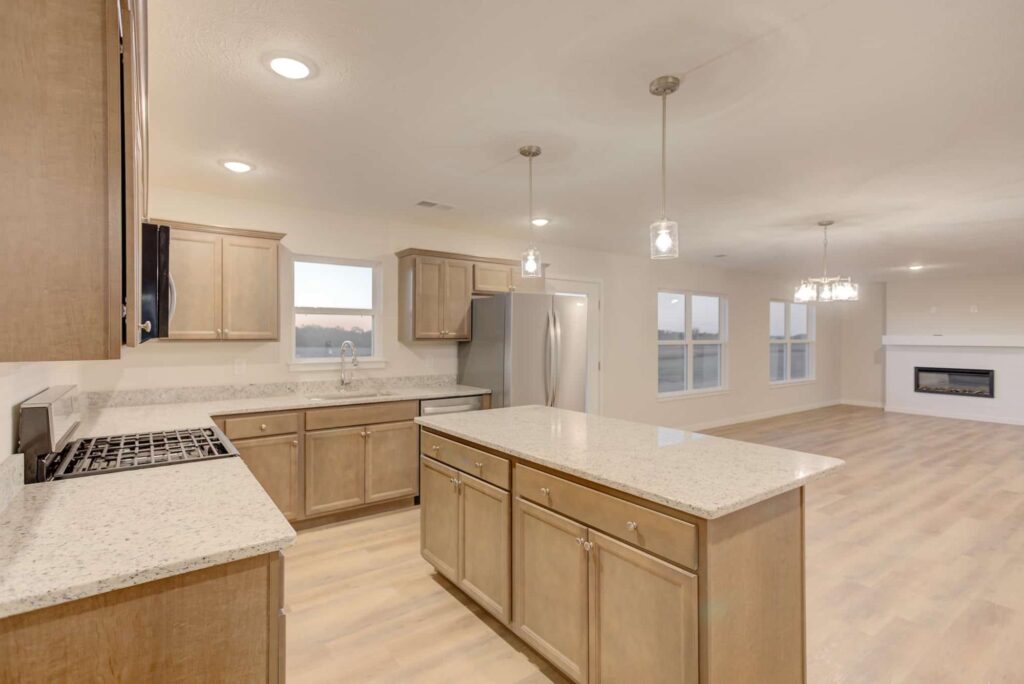
Build a Home That Holds Its Value
A new home in Southwestern Indiana can be a strong long-term investment when it’s built well, priced fairly, and designed for the buyers most likely to want it next. Browse Value Built Homes’ floor plans to see what’s available, or contact the Value Built Homes team to talk through your options for a new home that’s built to last.


