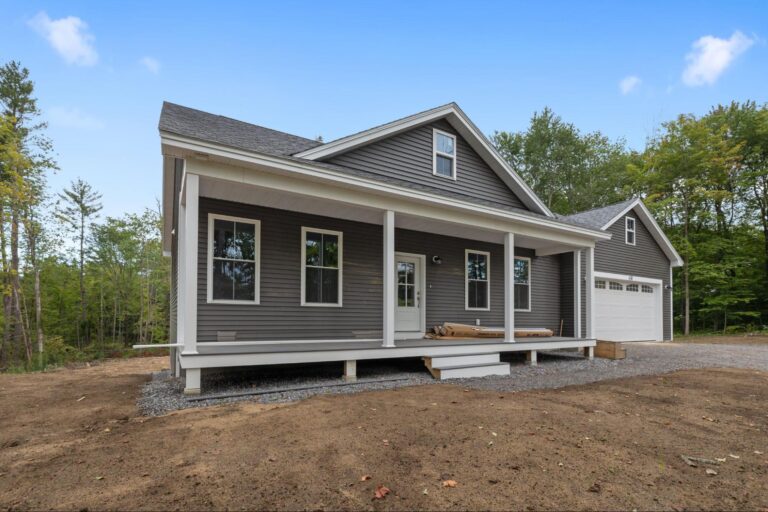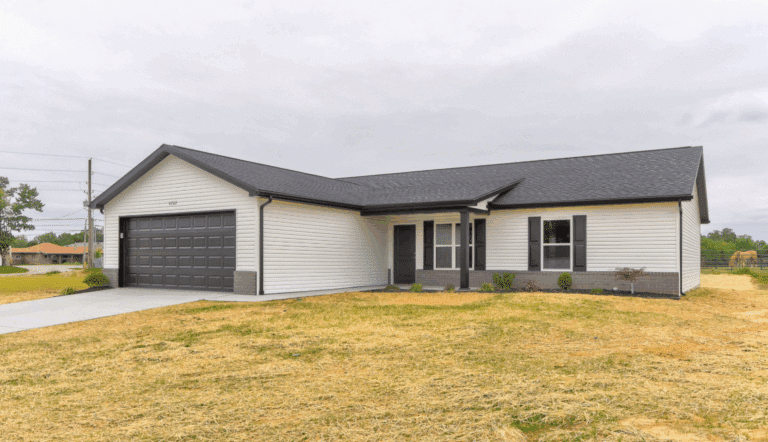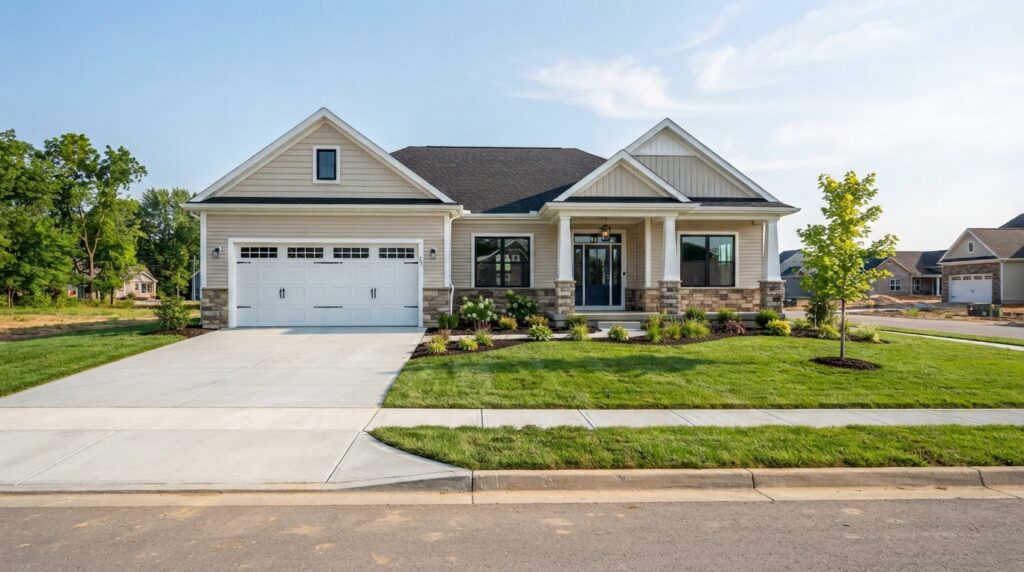
If you’re planning to build a home in Southern Indiana and you don’t qualify for a USDA or VA loan, an FHA construction loan is often the next financing route worth understanding. It rolls the land, the build, and your permanent mortgage into a single loan with one closing, and it asks for a smaller down payment than most conventional financing. The catch is that the FHA’s own rules and what an individual lender will actually require are two different things, and most online guides blur the two together.
Key Takeaways
- An FHA construction loan (the FHA one-time close, also called a construction-to-permanent loan) bundles the land, the construction, and the permanent mortgage into a single loan with one closing.
- The FHA insures the loan while a private lender makes it. Value Built Homes is the builder, not the lender, so rate, approval, and qualification questions go to your lender.
- FHA allows a down payment as low as 3.5% of the price, which works out to roughly $4,550 to $8,350 on a Value Built Homes plan. Mortgage insurance is required, both upfront and annually.
- FHA credit standards are more lenient than a conventional loan, but individual lenders often set higher minimums of their own (called overlays). That is why the “required” credit score differs from one source to the next.
- The 2026 FHA one-unit loan limit floor is $541,287, which sits far above every Value Built Homes price, so the FHA limit never caps a build here.
- Free Construction Financing is a separate Value Built Homes program that covers your construction-loan interest during the build. It is not part of any FHA loan.
FHA Construction Loan: The FHA Program Rule vs. What a Lender May Require
The single biggest source of confusion online is that national lender sites quote their own requirements as if they were the FHA’s. They are not. The table below separates what the FHA program sets from what a lender may add on top, and what each line means for someone building with Value Built Homes.
| Factor | FHA program rule | What a lender may add (overlay) | What it means for a Value Built Homes buyer |
|---|---|---|---|
| Down payment | As low as 3.5% of the price (CFPB) | May require cash reserves on top of the down payment | About $4,550 to $8,350 on a Value Built Homes plan ($129,900 to $238,500) |
| Credit score | More lenient than a conventional loan; FHA allows lower scores (CFPB). Exact tiers governed by HUD Handbook 4000.1 | Frequently sets a higher minimum than the FHA floor | Ask the lender for their specific minimum; the FHA floor is not the whole story |
| Loan limit | Varies by county; 2026 one-unit floor is $541,287 (HUD) | Not applicable | Every plan is far under the floor, so the FHA limit never caps a Value Built Homes buyer |
| Mortgage insurance | Required on all FHA loans, upfront and annual (CFPB); current rates set by HUD | Not applicable | Build the mortgage insurance into the monthly-payment estimate |
| Occupancy and property | Primary residence; home must meet FHA minimum property standards | May add its own conditions | Value Built Homes builds primary residences to state code, a clean fit |
| Builder and structure | One closing (construction-to-permanent); the builder must be a licensed general contractor (HUD) | May require the builder to be pre-approved, and a lender may not permit a self-build | Value Built Homes is a licensed Indiana builder, so the licensed-contractor rule is a fit, not a barrier. |
| Interest during the build | Interest-only on funds drawn as the home is built | Handles the draw schedule | Value Built Homes covers construction-loan interest under its own Free Construction Financing program (a builder program, not an FHA product) |
Sources: down payment and mortgage insurance, CFPB; 2026 one-unit floor and the licensed-contractor requirement, HUD. The down-payment dollar range is 3.5% of Value Built Homes’ current plan prices.
What Is an FHA Construction Loan?
An FHA construction loan is a single mortgage, insured by the Federal Housing Administration, that covers the lot, building the home, and the permanent mortgage that follows, all under one closing. It is commonly called the FHA one-time close loan or an FHA construction-to-permanent loan.
The FHA does not lend the money itself. It insures loans made by private lenders, which is what lets those lenders offer a lower down payment than a conventional loan. This is the FHA-insured version of construction-to-permanent financing. The structure matters for a build because you lock everything in once, instead of taking out a construction loan and then re-qualifying for a separate mortgage later.
Where the builder fits: Value Built Homes is a licensed Indiana builder that constructs standardized, site-built homes across Southwestern Indiana and the tri-state area. You build on your lot or one in a Value Built Homes subdivision, the lender finances it through the FHA program, and the builder handles construction. The builder does not originate the loan or set its terms.
How Does an FHA One-Time Close Construction Loan Work?
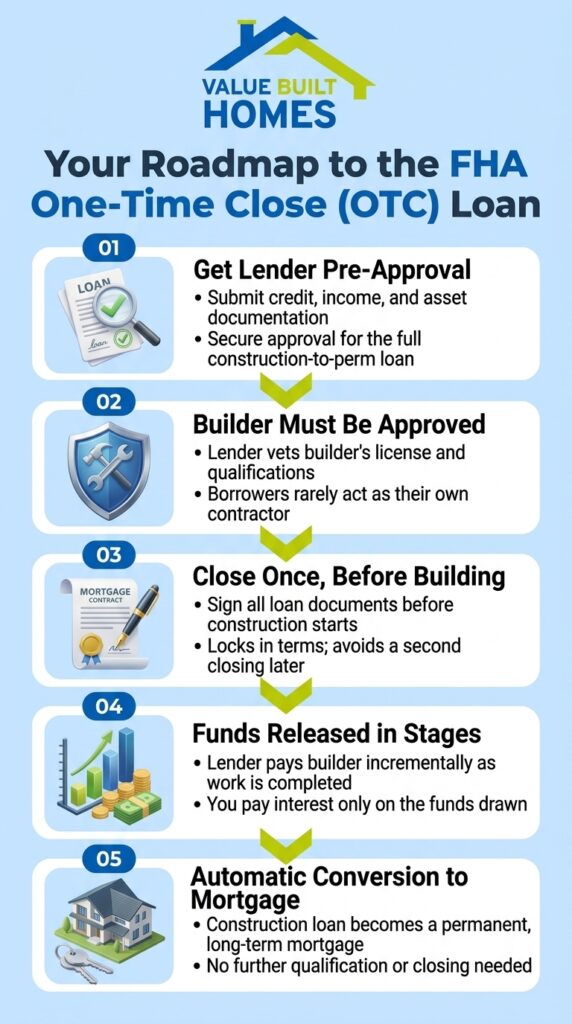
An FHA one-time close loan works in five basic stages, from application to the day your construction loan converts into a regular mortgage. The defining feature is the single closing: you qualify and close once, before construction starts, rather than closing a second time when the home is done.
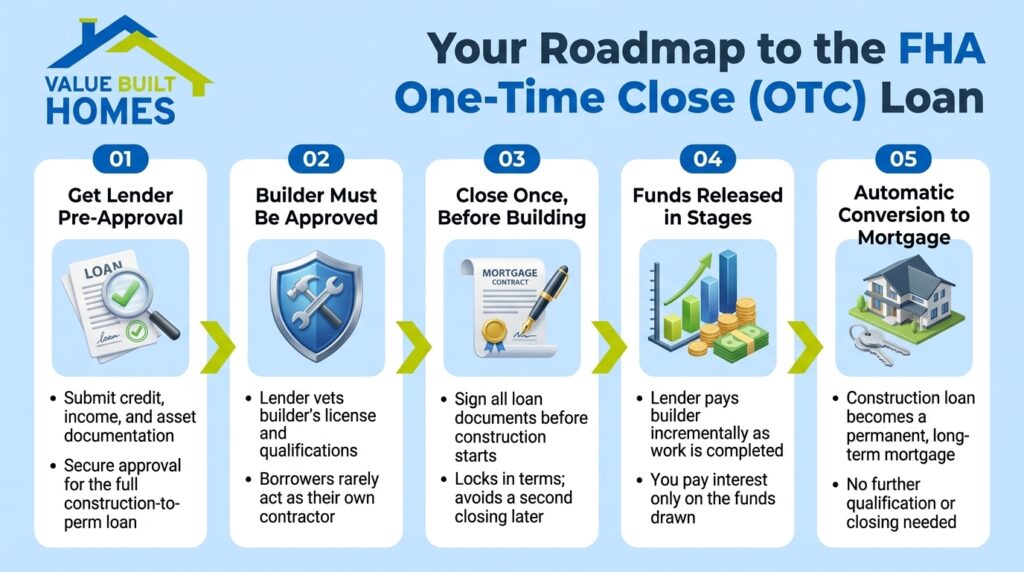
Here is the typical path:
- Apply and get approved. You apply with an FHA-approved lender, who reviews your credit, income, and down payment and approves the full construction-to-permanent loan.
- The lender vets the builder. The FHA program requires the builder to be a licensed general contractor, and the lender confirms the builder qualifies. You can act as your own general contractor only if you are a licensed one yourself, and a lender may decline a self-build even then.
- You close once. You sign at a single closing before the build begins, which locks in your loan and avoids a second round of qualifying.
- Funds are drawn during the build. The lender releases money in stages as the home goes up, and you typically pay interest only on the funds drawn so far.
- The loan converts to a permanent mortgage. When the home is finished, the construction loan becomes your long-term mortgage with no separate closing.
If you want to see how this single-closing structure compares to the two-closing alternative, that trade-off is covered in our breakdown of one-time close versus two-time close construction loans.
How to Find an FHA Construction Loan Lender
Not every FHA-approved lender offers the one-time close construction product, so the search is more specific than shopping for a standard FHA purchase loan. Start by asking lenders directly whether they offer the FHA one-time close (construction-to-permanent) loan, since not all offer it for new construction.
A few things worth confirming with any lender you consider:
- They offer the FHA one-time close construction loan specifically, not just standard FHA purchase loans.
- They will work with your builder, and they can explain their builder-approval step.
- Their credit minimum and any cash-reserve requirements, so you can compare overlays from one lender to the next.
Value Built Homes builds the home; your lender finances it. Lining up an FHA construction lender who is comfortable with a one-time close, and with your builder, keeps everything moving once you choose a plan.
FHA Down Payment and Credit Score Requirements in Indiana
FHA sets a down payment as low as 3.5% of the price and allows lower credit scores than most conventional loans. On a Value Built Homes plan, which currently ranges from about $129,900 to $238,500, a 3.5% down payment is roughly $4,550 to $8,350.
The credit score is where online guides contradict each other, and the reason is overlays. Here is the distinction that matters:
- The FHA rule: FHA’s minimum credit standards are more forgiving than a conventional loan.
- The lender overlay: individual lenders frequently set a higher minimum than the FHA floor, based on their own risk tolerance.
So the score one lender requires can be higher than another’s for the exact same FHA loan. The practical move is to ask a lender for their specific minimum rather than assuming the lowest number you found online applies to you. Your lender is also the right source for current rates and mortgage insurance costs.
Two more cost points to plan for:
Mortgage insurance is required on all FHA loans, paid both upfront and annually. Build it into any monthly-payment estimate.
If you already own your lot, the equity in that land can often count toward your down payment. We cover how that works in our guide to using land equity for a construction loan down payment.
Do You Pay Interest During Construction on an FHA Loan?
Yes. On an FHA construction loan, you typically pay interest only on the funds the lender has drawn as the home is built, not on the full loan amount at once. Those interest-only payments are a normal part of the construction phase, and they end when the loan converts to your permanent mortgage. Our overview of interest-only payments during home construction walks through what to expect month to month.
A separate builder program: this is where Value Built Homes’ Free Construction Financing comes in, and it is worth keeping separate from the FHA loan itself. Under Free Construction Financing, Value Built Homes covers the interest on your construction loan while your home is being built. That is a builder program, not an FHA benefit. The FHA program does not pay your construction interest, so do not count on the two being the same thing.
FHA Loan Limits in Indiana
The 2026 FHA loan limit for a one-unit home starts at a floor of $541,287, and that floor applies in the lower-cost Indiana counties where Value Built Homes builds. Because every Value Built Homes plan sits far below that number, the FHA loan limit does not cap what you can build here.
The bottom line for Indiana buyers: in this price range, the loan limit is one FHA rule you do not need to worry about. Your lender can confirm the exact limit for your county, but the takeaway holds across the service area.
FHA vs. USDA vs. VA Construction Loans for an Indiana Build
FHA is not the only government-backed way to build in Indiana, and it is often not the cheapest if you qualify for USDA or VA. The quick version: USDA and VA can reach 0% down for buyers who qualify, while FHA is the more widely available option when you do not.
Here is how the three compare for a build:
- FHA construction loan: 3.5% down, more flexible credit than conventional, and mortgage insurance required. The broadest eligibility of the three, with no military-service or rural-area requirement.
- USDA construction loan: 0% down for eligible buyers, but your household income cannot exceed 115% of the area median income, and the home must be in an eligible rural area and be your primary residence. Much of Southern Indiana outside the cities qualifies. Details are in our guide to USDA loans for new home construction in Indiana.
- VA construction loan: typically 0% down and no monthly mortgage insurance for eligible service members and veterans, with a one-time VA funding fee instead (2.15% of the loan on a first use with less than 5% down, and waived for eligible service-connected disabled veterans). See our guide to building with a VA construction loan in Southern Indiana.
If you qualify for USDA or VA, start there. FHA is the strong fallback when income, location, or military-service rules put those two out of reach.
What Can Go Wrong: FHA Construction Loan Risks to Plan For
FHA construction loan problems tend to come from three predictable places, and all three are manageable if you know about them upfront. Planning for them early keeps your build and your financing on schedule.
- The builder must qualify. The FHA program requires a licensed general contractor, your lender approves the builder, and a lender may not let you act as your own contractor. Working with a licensed Indiana builder removes this hurdle from the start.
- The appraisal can come in low. If the finished-home appraisal lands below the loan amount, it can affect your financing. Our explainer on new construction appraisals in Southern Indiana covers how they work and what a low one means.
- Lender overlays can raise the bar. A lender may require a higher credit score or extra cash reserves beyond the FHA minimum. Ask each lender what they require so there are no surprises.
None of these is unique to Value Built Homes buyers, and none is a reason to avoid the FHA route. They are simply the checkpoints to confirm before you commit.

Frequently Asked Questions About FHA Construction Loans
Can I be my own contractor on an FHA construction loan?
For most buyers, no. The FHA program requires the builder to be a licensed general contractor, and you can act as your own general contractor only if you are a licensed one yourself. In practice, a lender may decline a self-build even then. This is a fit for building with Value Built Homes, since you would be working with a licensed, professional builder rather than acting as your own contractor, and your lender confirms the builder meets the requirement.
What credit score do I need for an FHA construction loan?
There is no single number that applies everywhere. FHA’s minimum credit standards are more lenient than a conventional loan, but individual lenders set their own higher minimums, so the score you need depends on the lender. Ask any lender you are considering for their specific FHA minimum rather than relying on a figure from a national website.
Can I use land I already own toward an FHA construction loan down payment?
Often, yes. If you already own your lot, the equity in that land can typically count toward your down payment, which can reduce or even cover the cash you need at closing. Your lender will confirm how much of your land equity applies to your specific loan.
Are FHA construction loans only for primary residences?
Yes. FHA construction loans are for primary residences that you intend to live in, not investment properties or vacation homes. Since Value Built Homes builds primary residences to state code, this requirement is a natural fit rather than a barrier.
Ready to Build in Southern Indiana?
An FHA construction loan can be a practical way to build a new home in Indiana when USDA and VA are not options, and Value Built Homes handles the build while your lender handles the loan. If you’re weighing your financing and want to talk through floor plans, timelines, and what building on your lot looks like, contact the Value Built Homes team to get started.