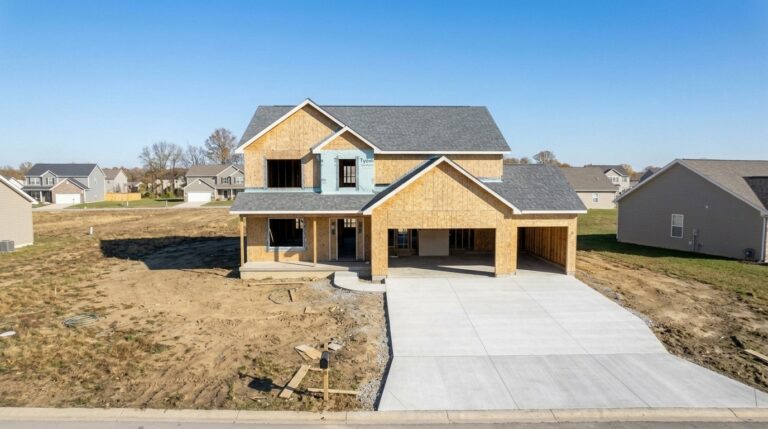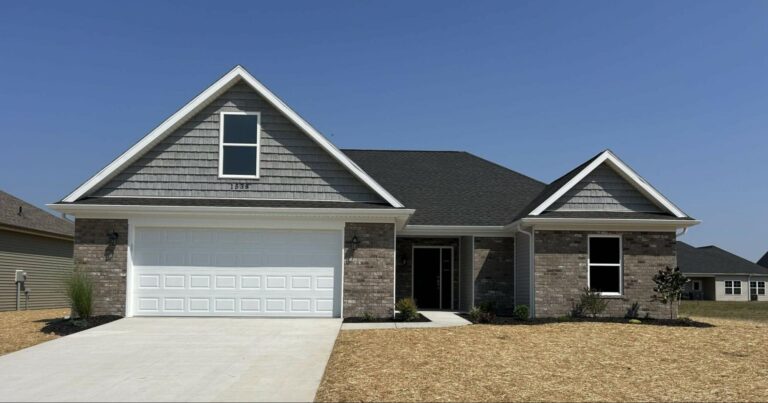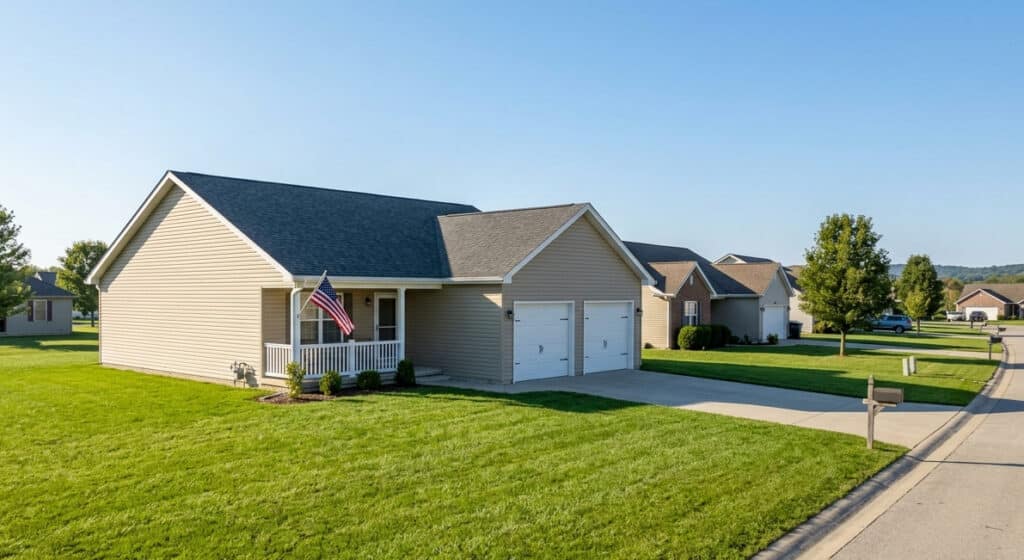
If you have earned your VA home loan benefit and you would rather build than buy something that already exists, a VA construction loan can put a brand new home within reach, often with no down payment. The rules changed in 2025, and the path looks a little different when you build in Southwestern Indiana and the tri-state area than the national guides suggest. Here is how the financing works, what is new, and how a build with Value Built Homes fits the picture.
Key Takeaways
- The VA backs loans to build a new home, not just to buy one that already exists, and most eligible veterans with full entitlement can build with no down payment and no private mortgage insurance.
- A VA-issued builder identification number is no longer required to process a loan on new construction as of March 31, 2025, though builders must still meet state and local licensing requirements.
- The VA funding fee still applies, starting at 2.15% of the loan for first-time use with less than 5% down, and veterans receiving compensation for a service-connected disability are generally exempt.
- A VA one-time close construction loan combines the construction phase and the permanent mortgage into a single loan with one closing, which avoids a second closing and a separate refinance.
- The VA will not issue its loan guaranty until a clear final compliance inspection confirms the finished home meets VA standards.
- Value Built Homes is your builder, not your lender: you secure VA financing through a participating VA lender, and Value Built Homes builds your home in Southwestern Indiana and the tri-state area.
Can You Use a VA Loan for New Construction?
Yes. The VA backs construction loans that let eligible veterans and service members build a brand new home, not just buy one that already exists. A VA construction loan finances the build itself, and it comes with stricter qualifications and greater documentation than a standard mortgage.
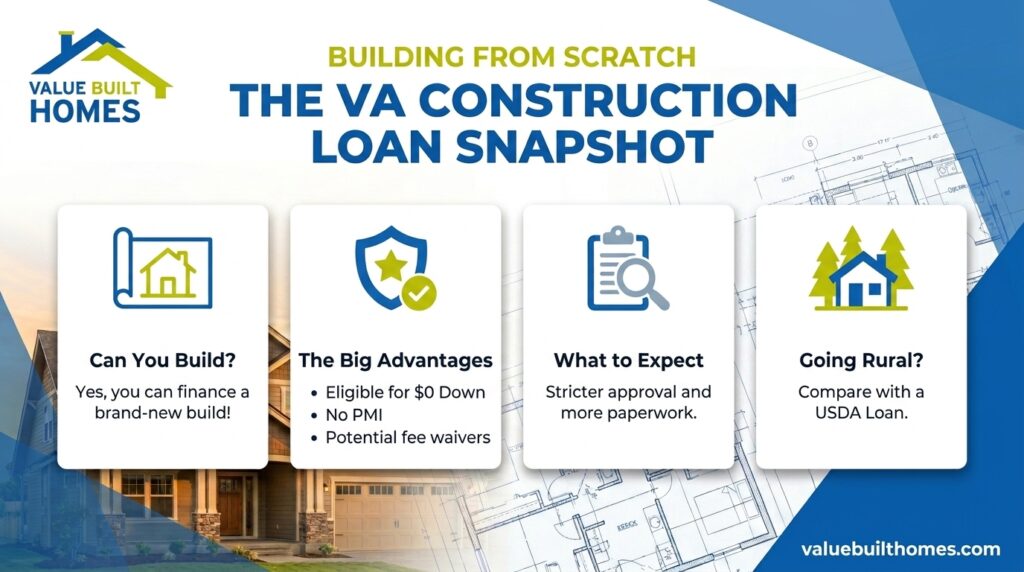
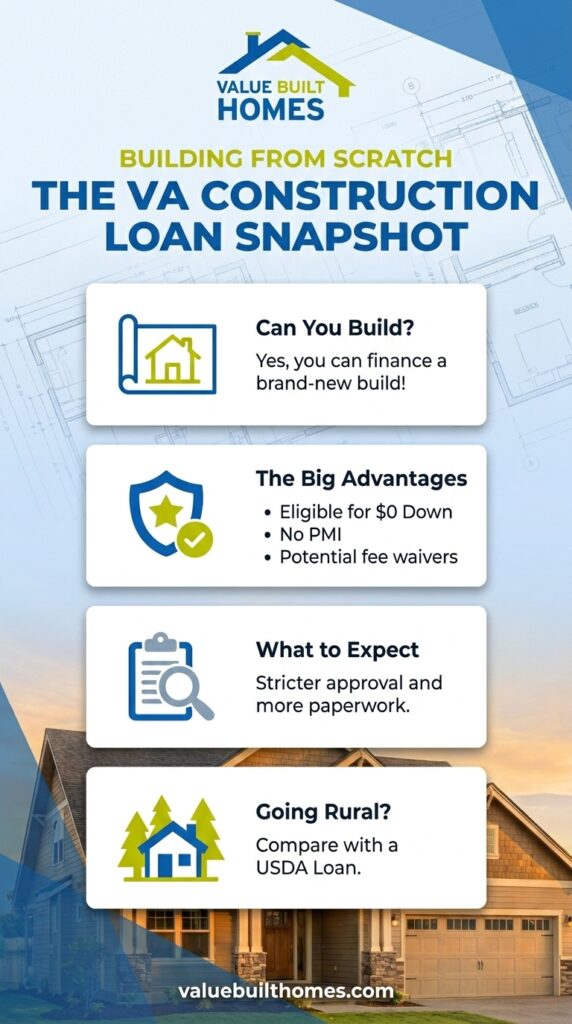
For most eligible borrowers, a VA construction loan carries the same advantages as any VA-backed purchase loan:
- No down payment: no down payment is required with full entitlement, as long as the appraisal supports the loan amount.
- No private mortgage insurance: which keeps your monthly payment lower than many low-down-payment conventional loans.
- A possible funding fee exemption: for veterans receiving VA compensation for a service-connected disability.
A VA loan is not the only government-backed route to a new build. If a rural property fits your plans, the USDA loan path for new construction in Indiana works in a similar spirit and is worth comparing alongside the VA option.
VA One-Time Close vs. Two-Time Close Construction Loans
A VA construction loan comes in two structures. A one-time close, also called a single-close or construction-to-permanent loan, wraps the construction phase and the permanent mortgage into one loan with one closing. A two-time close uses a separate construction loan first, then a second closing to refinance into a permanent VA loan.
Here is how the two structures compare:
| Feature | One-Time Close (Single-Close) | Two-Time Close |
| Closings | One | Two |
| Loans | One loan that converts to your mortgage | A construction loan, then a separate VA refinance |
| Rate lock | Locked once, before construction begins | Reset at the second closing |
| Closing costs | Paid one time | Potentially paid twice |
| If rates rise during the build | Your rate is already locked | You are exposed until the refinance closes |
Most veterans prefer the one-time close. One loan means one set of closing costs and a rate locked before construction begins, so a jump in rates during the build does not raise your permanent payment. The two-time close answers a common question: is it better to build with a conventional construction loan and then refinance into a VA loan? It can work, but you take on a second closing and the risk that rates move before the refinance is final.
For a closer look that applies to any construction loan, not just VA financing, compare one-time close and two-time close construction loans. The single-close structure is the same idea behind construction-to-permanent financing, which converts your construction loan into a mortgage automatically once the home is finished.
Do VA Construction Loans Require a Down Payment?
No. For most eligible veterans with full entitlement, a VA construction loan requires no down payment, as long as the home’s appraised value supports the loan amount. There is also no private mortgage insurance, a recurring cost on many low-down-payment conventional loans.
Full entitlement also affects how much you can borrow. For loans closed on or after January 1, 2020, the VA removed its loan limits for borrowers with full entitlement, so there is no cap on the amount you can finance with no down payment, only what your lender approves and the appraisal supports.
What Is the VA Funding Fee for a Construction Loan?
A VA construction loan carries the same VA funding fee as other VA-backed purchase loans. For first-time use, the fee is 2.15% of the loan amount with less than 5% down, 1.5% with 5% to 9.99% down, and 1.25% with 10% or more down. These rates have been in effect since April 7, 2023.
A couple of details are worth knowing:
- First use versus subsequent use: if you have used your VA loan benefit before, the fee is higher, starting at 3.3% with less than 5% down.
- The disability exemption: veterans receiving VA compensation for a service-connected disability are generally exempt from the funding fee entirely.
Does the VA Require a Builder to Be Registered? What Changed in 2025
Not in the way it used to. As of March 31, 2025, a VA-issued builder identification number is no longer required to issue the notice of value or process a VA loan on a new or proposed construction home. Builders are still expected to meet all applicable state and local licensing requirements.
Before this change, a builder had to register with the VA and obtain a builder ID before a veteran could finance a home that builder constructed. The 2025 circular removed that step for VA-guaranteed purchase loans, which simplifies the process for both buyers and builders.
Two things did not change:
- State and local licensing still applies. Your builder must meet the licensing and code requirements that govern construction in your area.
- The builder ID still applies to two programs. Specially Adapted Housing grants and the Native American Direct Loan program still use the builder identification requirement.
What this means on the ground in Indiana: you can build with a qualified local builder without waiting on a VA registration step. Value Built Homes builds homes throughout Southwestern Indiana and the tri-state area and works within the state and local requirements for each community it builds in.
Can You Use a VA Loan to Build a House on Your Own Land?
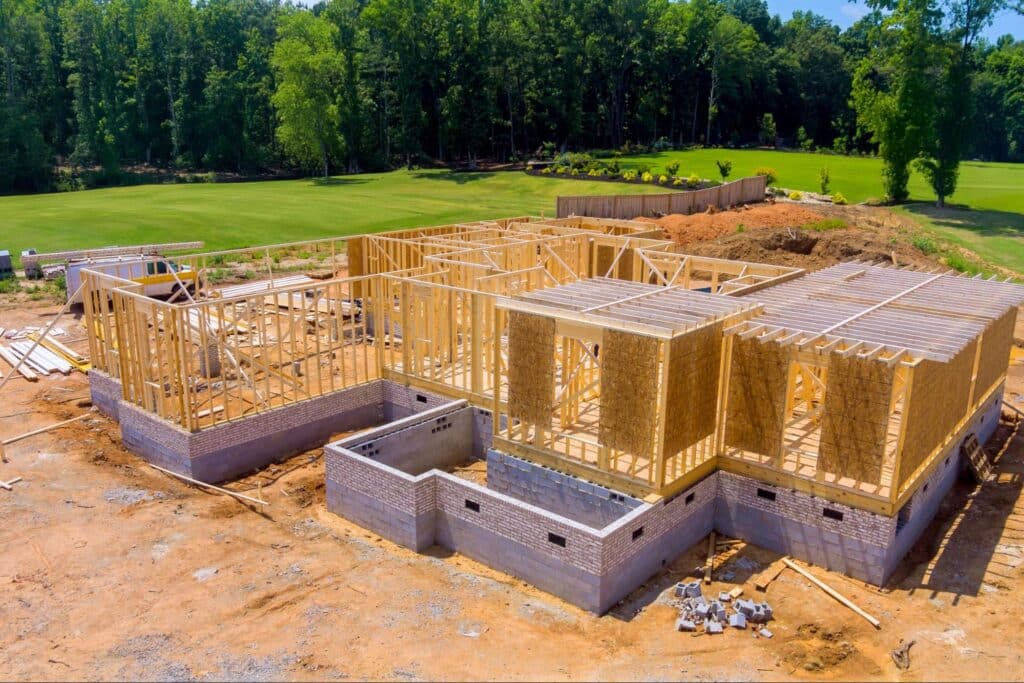
Yes. You can use a VA loan to build on land you already own, and the value of that land can often count toward your costs instead of a cash down payment. The VA backs building a home on a qualifying lot as long as the finished home meets VA standards and will be your primary residence.
If you already own a lot, the land’s equity may reduce or replace the cash you would otherwise bring to the table. Before you build, the site itself needs a closer look. The guide to building a house on your own land in Southern Indiana walks through drainage, slope, power, water, and septic, the practical questions that determine whether a lot is build-ready.
Don’t have land yet? Value Built Homes builds in established communities across the region, and you can browse available lots for sale to find a spot that fits your plans.
VA Minimum Property Requirements and the Final Inspection
VA minimum property requirements, or MPRs, are the VA’s baseline standards a home must meet to be safe, structurally sound, and sanitary. For new construction, the VA will not issue its loan guaranty until the completed home passes a clear final compliance inspection confirming it meets those standards.
New construction usually starts ahead on MPRs. A brand new home is built to current code with new systems, so it rarely carries the wear, outdated wiring, or moisture problems that can hold up an MPR appraisal on an older house.
Build quality matters here, because the inspection is the gate to your guaranty. Every Value Built Homes home is backed by a 2-10 Home Buyers Warranty, which includes 10-year structural coverage along with shorter-term systems and workmanship protection, giving you documented assurance beyond the VA’s own inspection.
Building Your New Home With Value Built Homes in Southern Indiana
Value Built Homes is the builder you build with, not the company that issues your loan. You secure your VA financing through a participating VA lender, and Value Built Homes builds your home on a cost-engineered, standardized floor plan in Southwestern Indiana and the tri-state area. That division of roles keeps things clear: your VA lender handles the loan, and Value Built Homes handles the home.
Every home is a complete, turnkey package. One Value Built Homes homeowner shared that the team handled everything from running power and water to the septic system and even the driveway, with their dedicated project contact keeping them updated throughout the build.
A few things set the build apart:
- Standardized, cost-engineered floor plans: Value Built Homes builds from a set of proven plans using a cost-engineered approach to new construction that controls cost and shortens the timeline, which can save most buyers between 20% and 30% compared with building elsewhere. You can browse the full set of floor plans to find a layout that fits your family.
- Interest covered during construction: through its Free Construction Financing program, Value Built Homes pays the interest on your construction loan while your home is being built, so you are not carrying those payments before you move in.
- A clear view of progress: you can track each stage of your build in real time through the Buildertrend portal. One homeowner noted how nice it was to follow the photos and updates as the work moved along.
There is also a broader shift working in a veteran buyer’s favor. Newly built homes are now often priced at or below comparable existing homes, based on the National Association of Home Builders’ reading of Census Bureau and National Association of Realtors data. As the association’s chairman put it, builders are “stepping up to make homes attainable.”
Frequently Asked Questions About VA Construction Loans
How do I find a lender that offers VA construction loans?
Not every VA-approved lender offers construction financing, so ask specifically for a VA construction loan program when you start shopping. For the builder side, the VA suggests beginning with your local home builders’ association, which keeps a list of builders that meet state and local requirements.
Can I be my own general contractor with a VA construction loan?
Usually not. Most VA construction lenders require you to build with a licensed, insured builder rather than acting as your own general contractor, so owner-builder projects are rarely eligible for VA financing. Building with an established local builder also keeps the VA’s inspection and documentation requirements far more manageable.
What is the credit score requirement for a VA construction loan?
The VA itself does not set a minimum credit score. Individual lenders set their own minimums, and many apply slightly stricter requirements on construction loans than on a standard VA purchase loan because of the added risk during the build. Talk with your lender early so you know where you stand before you start.
Are VA construction loans harder to get than standard VA loans?
They involve more steps, not necessarily a harder approval. A VA construction loan comes with tighter qualifications and more documentation than a standard VA purchase loan, since the lender is financing a home that does not exist yet. Working with a builder who knows the local process, and reviewing the typical Indiana construction loan requirements ahead of time, makes the paperwork much easier to handle.
Build Your Forever Home With Your VA Benefit
Building new is one of the most rewarding ways to put your VA benefit to work, and you don’t have to sort out the financing and the build on your own. Value Built Homes builds quality, affordable homes across Southwestern Indiana and the tri-state area and can walk you through how a build fits alongside your VA financing. Contact the Value Built Homes team to talk through your options and take the first step toward your forever home.