Building a house in Indiana doesn’t have to feel overwhelming. Whether you’re building a home in Indiana from the ground up or buying a new construction home in Indiana, the process follows a clear, predictable path. This guide walks you through all 8 steps of building a house with a builder across Southwestern Indiana and the tri-state area, from your first decision to move-in day.
Key Takeaways
- 8 clear buyer steps: evaluating fit, selecting a floor plan, securing financing, confirming your lot, signing the contract, monitoring construction, completing the walkthrough and closing, and moving in.
- Value Built Homes typically completes homes in approximately 5 to 7 months, compared to the national average of 9.1 months for new single-family homes.
- Every Value Built Homes base price includes the site-built home, foundation, water and electric, a standard sewer connection, and a rock construction drive. Garages, porches, and patios are included when they’re part of your floor plan, and items like a basement, finished driveway, sidewalks, or septic system are priced separately as add-ons, so you know your scope before you sign.
- Free Construction Financing means Value Built Homes pays the interest on your construction loan during the build phase, saving most buyers thousands of dollars upfront.
- Every home is backed by a 2-10 Home Buyers Warranty (10-year structural, 2-year systems, and 1-year workmanship and materials), plus Value Built Homes’ own workmanship warranty, which runs 2 years in Indiana and 1 year in Kentucky.
- Building with a standardized production builder means fewer decisions and a faster timeline than a fully custom build, without sacrificing quality or a home that truly fits your family’s life.
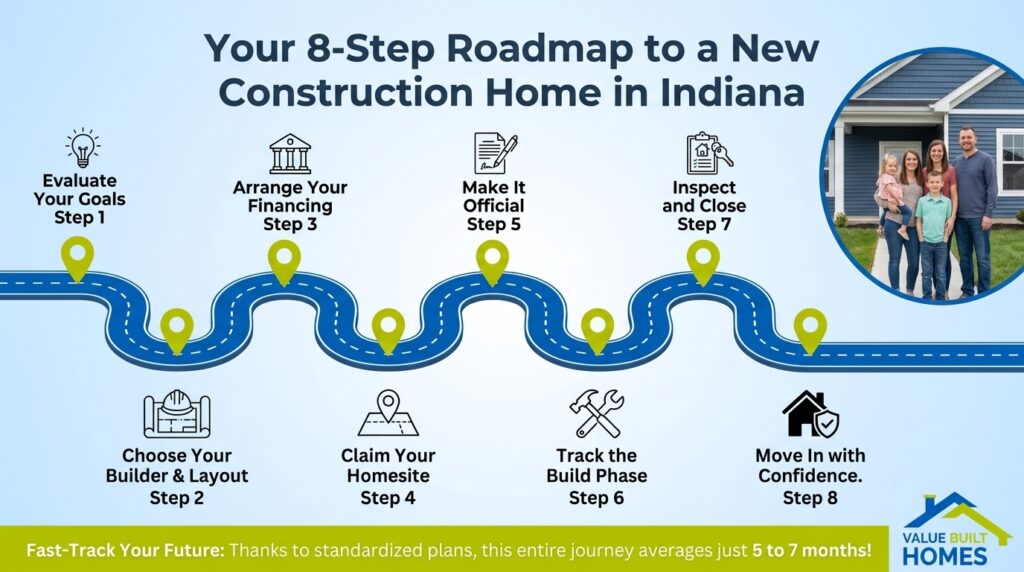
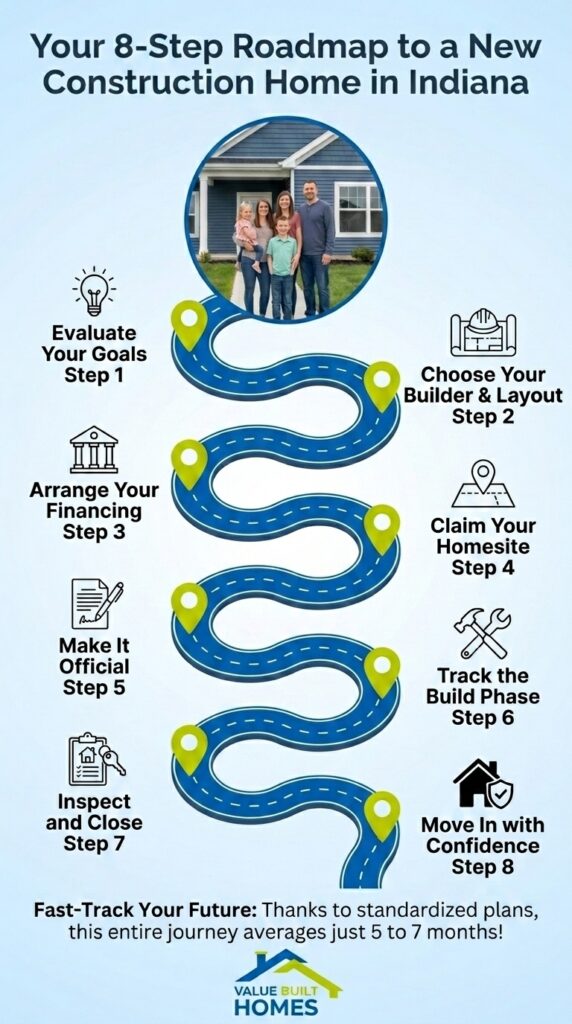
Step 1: Decide Whether New Construction Is the Right Move
The first step in the home building process isn’t picking a floor plan. It’s deciding whether new construction fits your situation, your budget, and what you’re actually looking for in a home.
New construction makes a lot of sense for buyers who want to skip bidding wars, move into a home with no deferred maintenance, and choose a layout designed for how they live. Building with a standardized production builder is especially worth considering if you want a predictable process without the complexity of a fully custom design.
What ‘Standardized Production Builder’ Actually Means
Value Built Homes builds traditional site-built (stick-built) homes using standardized floor plans. Site-built means the home is constructed entirely on your lot, not assembled from prefabricated modules. Standardized floor plans mean you’re choosing from a catalog of refined, cost-engineered designs rather than starting from a blank page with an architect.
The key question at this stage is not “can I afford to build?” It’s “does this model fit what I want?” If the answer is yes, the path forward is straightforward.
Building New Versus Buying a New Construction Home in Indiana
If you’re weighing buying a new construction home in Indiana against building one, the difference comes down to choice and timing. A move-in ready home gets you settled sooner, while building lets you pick your floor plan and lot. Either way, Value Built Homes handles the process for you across Southwestern Indiana and the tri-state area.
Step 2: Choose a Builder and Select Your Floor Plan
Once new construction feels like the right direction, you’ll select a builder and choose the floor plan that works for your family. This is one of the most consequential decisions in the process, because your floor plan determines your layout, your square footage, and your starting price.
Value Built Homes offers floor plans ranging from 2 to 5 bedrooms and from 870 to more than 2,500 square feet. Because the plans are standardized, you’re choosing from options that have been built many times and refined over years, not collaborating with a designer to create something from scratch.
Working from a standardized plan offers three practical advantages for buyers:
- Fewer decisions: You’re not choosing every fixture, finish, and trim package from thousands of options.
- Predictable pricing: Your cost is tied to the plan you select, not to an open-ended design process that can expand in any direction.
- Faster timeline: Without a custom design and approval phase, your project moves to financing and lot selection much sooner.
If you’re working through how to match a plan to your household’s actual needs, the post Choosing a Floor Plan: A Practical Guide for Your Dream Home walks through the decision in practical terms.
Step 3: Secure Your Financing
Most buyers building a new home need two types of financing: a construction loan to fund the build as it progresses, and a permanent mortgage to replace it once the home is complete.
A construction loan is a short-term loan that releases funds in stages as construction phases are completed, rather than as a lump sum up front. Once your home is finished, your permanent mortgage pays off the construction loan, often through a single closing that handles both transactions at once.
What to Have Ready Before Talking to a Lender
Before your first lender conversation, it helps to gather documentation on your income, debts, and assets. Your lender will use this to determine your approved amount, which in turn informs which floor plans and lots are realistic for your budget. The earlier you start this step, the smoother the rest of the process tends to go.
Value Built Homes offers Free Construction Financing that sets it apart from most builders. During the build phase, Value Built Homes pays the interest on your construction loan. For most buyers, that saves thousands of dollars that would otherwise come out of pocket before you’ve ever set foot in the finished home.
Already Own Land? Here Is What to Know
If you already own land, you may be able to apply the equity toward your construction loan down payment. The post How to Use Land Equity for a Construction Loan Down Payment explains how that works for buyers who own their parcel outright or carry significant equity in it.
The low-friction process is something Value Built Homes buyers consistently mention. As one homeowner described it: “My Value Built Homes home is very energy efficient, low/no maintenance, and just perfect for my lifestyle. After the initial ordering of my Value Built Homes home I was able to concentrate on moving and packing. The building process was managed and I was called when it was done and able to move right in with no problems.”
Step 4: Choose or Confirm Your Lot
Your lot is the foundation, literally and practically, for everything that follows. If you already own land, this step is largely about confirming your parcel meets the requirements for the floor plan you’ve chosen. If you don’t yet own land, Value Built Homes has lots available in several active Southwestern Indiana communities.
Current subdivisions include:
- Baldwin Estates in Princeton
- Fairview Heights in Gibson County
- Farmington Ridge in Poseyville
- The Meadows at Parkview
- Poulton Place in Boonville
- Waterfront Villas in Vincennes
- Willow Crossing in Evansville
You can browse available lots for sale to see what’s currently open in each community. If you’re building on your own land, your Value Built Homes contact will walk you through site requirements, utility access needs, and any preparation the parcel may need before construction can begin.
Step 5: Sign the Contract and Lock In Your Start Date

After selecting your floor plan, securing financing, and confirming your lot, you’ll sign your purchase contract with Value Built Homes. The contract formalizes the plan you’ve chosen, your lot, the pricing, and the project schedule.
Once the contract is signed and financing is confirmed, Value Built Homes schedules your build start date and initiates the permitting process. For most buyers, this is the point where the process stops feeling abstract. The major decisions are behind you. Your team is in place. Now the build can begin.
For a regional overview of what permitting looks like in Southwestern Indiana, Southeastern Illinois, and Western Kentucky, the post Building Permits: A Guide for SW Indiana, SE Illinois, W Kentucky provides helpful context on what to expect.
Step 6: Watch Your Home Get Built
During the construction phase, your primary role as a buyer is to stay engaged and informed, not to manage the crew or make daily calls. Value Built Homes uses Buildertrend, a real-time project management portal, to keep you updated with photos and progress notes throughout the build. You can track milestones, see what’s been completed, and reach your contact directly, all without having to drive to the job site to know what’s happening. One Value Built Homes buyer found that level of visibility made a real difference throughout the process:
“Our contact kept up with pictures and updates on the BuilderTrend app. It was a nice way to see what had been done. We had a good experience with our home and would recommend Value Built.”
How Long Does It Take to Build a House in Indiana?
Most Value Built Homes homes take about 5 to 7 months to build, from breaking ground to move-in. Your exact timeline depends on the floor plan you choose, site preparation, and the weather. By comparison, the national average for new single-family homes is 9.1 months. That faster timeline is a direct result of building from standardized plans with an established, repeatable process.
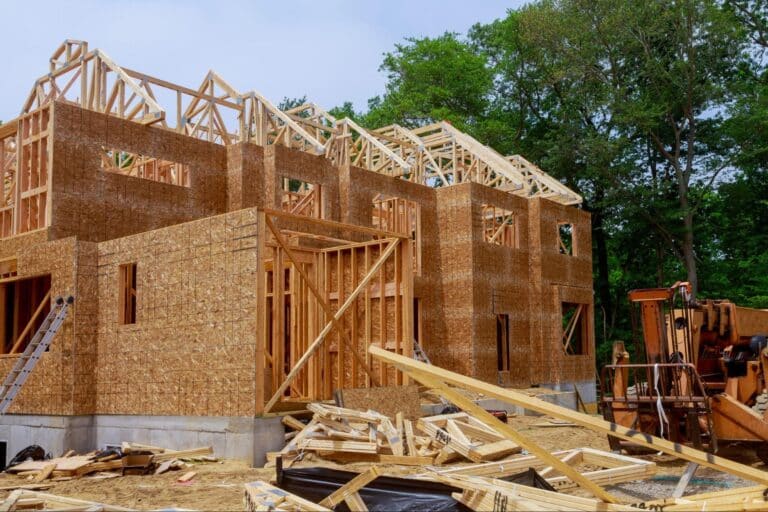
The construction phase covers everything from site preparation and foundation to framing, rough-in utilities, insulation, drywall, interior finishes, and final exterior work. For a detailed look at what happens on-site during each phase, The 6 Stages of Home Construction: What Happens at Each One covers each stage thoroughly. For a month-by-month look at what to expect, Master Your Home Building Timeline: Unlock Success maps out the scheduling milestones in detail.
Step 7: Final Walkthrough, Inspection, and Closing
As your home nears completion, you’ll do a final walkthrough with your Value Built Homes contact to review the finished home. The walkthrough is your opportunity to go through every room and system, ask questions, and note anything that needs attention before the keys change hands. Any items identified during this review produce a punch list that the builder addresses before closing.
A few things worth checking during the walkthrough:
- All fixtures, outlets, switches, and appliances are working as expected
- Doors, windows, and cabinetry open, close, and latch properly
- Flooring, tile, and trim are installed without visible gaps or defects
- Exterior work, including grading and any driveway, sidewalk, porch, or patio you added to your plan, is complete
After the walkthrough and punch list work, you’ll move to final inspection and closing. Closing on a new construction home follows the same general process as closing on an existing home: you’ll sign loan and transfer documents, pay closing costs, and receive your keys. Your lender will confirm the permanent mortgage is in place to take over from the construction loan.
Step 8: Move In and Know What’s Covered Under Your Warranty
Every Value Built Homes home comes backed by the 2-10 Home Buyers Warranty, and your coverage begins the day you close. This warranty provides structured protection across multiple categories, starting from the moment you move in.
Coverage includes:
- 10 years of structural defect protection covering load-bearing components including the foundation, framing, and roof system
- 2 years of coverage for systems defects in wiring, piping, and ductwork
- 1 year of workmanship and materials coverage
On top of the 2-10 coverage, Value Built Homes backs its own workmanship with a builder warranty that runs 2 years for homes built in Indiana and 1 year for homes built in Kentucky. Appliances and other products are covered by their manufacturers’ warranties.
Having that protection in place from day one is part of what makes building new a lasting investment rather than just a transaction. As one Value Built Homes homeowner shared: “We examined every home brand available in Indiana and Value Built Homes had the best. We really like the cabinetry.”
Frequently Asked Questions About Building a House
What is the first step in building a new home?
The first step is evaluating whether new construction is the right fit for your situation, budget, and timeline. Before choosing a floor plan or meeting with a lender, it’s worth deciding whether a standardized production builder’s approach aligns with what you’re looking for. If it does, the process from there is clear and manageable.
How long does it take to build a house in Indiana?
Most Value Built Homes homes take about 5 to 7 months, from breaking ground to move-in. The exact timeline depends on your floor plan, site preparation, and the weather. The national average for new single-family homes is 9.1 months. The shorter timeline at Value Built Homes comes directly from building with standardized floor plans, which eliminates the design and permitting delays that slow down custom builds.
What is included in a Value Built Homes home package?
Value Built Homes prices from standardized plans, so if it’s part of your floor plan, it’s included, and if it isn’t, it’s an optional add-on. Your base price covers the site-built home, foundation, water and electric, a standard sewer connection, and a rock construction drive. A garage, porch, or patio is included when it’s built into your plan. Basements, finished driveways, sidewalks, and septic systems are always priced separately, though Value Built Homes handles that work too, so you’re not coordinating separate contractors.
Do I need to own land before I can build with Value Built Homes?
No. Value Built Homes has active lots available across six Southwestern Indiana communities: Princeton, Gibson County, Poseyville, Boonville, Vincennes, and Evansville. Building on your own land is also an option, subject to site requirements. Your Value Built Homes contact can walk you through what your parcel will need before construction can start.
Is building a house with a production builder different from going fully custom?
Yes, and intentionally so. A production builder like Value Built Homes works from standardized floor plans rather than creating a unique design for each home. That means fewer decisions for the buyer, predictable pricing, and a faster timeline than a fully custom build. It’s not a compromise on quality. It’s a different model that works well for buyers who want a well-built new home without the complexity and cost of a custom design process.

Take the First Step Toward Your New Home
Now that you know the steps to building a house with a production builder, the process probably looks a lot less daunting than it did before. For buyers in Southwestern Indiana and the tri-state area ready to build their forever home, Value Built Homes offers a clear path from first call to move-in. Most buyers save between 20% and 30% compared to building new homes elsewhere, and the Free Construction Financing program means you’re not paying construction loan interest out of pocket during the build.
Browse Value Built Homes’ new home construction options to learn more about how the process works, or contact the Value Built Homes team to start the conversation.