Most people who build a new home are picturing the next few years, but the smarter question is what the home will need to do for the next few decades. Aging in place home design answers that question by building accessibility and single-level comfort in from the start, so a house can stay your forever home as your needs change. For budget-minded buyers in Southwestern Indiana and the tri-state area, that planning is far easier (and far less expensive) to do during construction than to add later.
Key Takeaways
- Most older adults want to stay put. About 75% of adults 50 and older want to remain in their current homes as they age, which makes a single-level forever home a practical long-term choice.
- Building accessibility in costs less than retrofitting. Adding no-step entries, wider doorways, and a first-floor primary suite during construction avoids the demolition and rework that drive up the cost of changing a finished home later.
- Most existing homes are not built for aging in place. Fewer than 4% of U.S. homes offer single-floor living, a no-step entry, and wide hallways and doorways, so new construction is the clearest path to all three.
- The core features are specific, not vague. A no-step covered entry, hallways at least 36 inches wide, doorways with at least 32 inches of clear width, a first-floor primary suite, and a curbless shower cover most of what aging in place requires.
- Safety is a practical reason to plan ahead. Falls are the leading cause of injury among adults 65 and older, which is why single-level living and no-step entries matter.
- Affordable and accessible are not opposites. A standardized, single-level plan from Value Built Homes can include aging-in-place features without the cost of a fully custom design.
What Is Aging in Place, and Why Home Design Is the Starting Point
Aging in place means staying in your own home safely and comfortably as you grow older, rather than moving to assisted living or a senior community. Good home design is what makes it possible, because a home built for one stage of life often does not work for the next.
About 75% of adults 50 and older want to remain in their current homes as they age, and more than half (51%) say they need a home that supports independent aging. The catch is that most homes were never built for it.
That is why housing researchers point to new construction. Fewer than 4% of U.S. homes offer the three core accessibility features of single-floor living, a no-step entry, and wide hallways and doorways. The country is aging fast: adults 65 and older reached 18.0% of the U.S. population in 2024 and now outnumber children in nearly half of U.S. counties. Building new is the clearest path to a home that has all three from the start.
Aging in Place vs. Universal Design vs. Accessible Design
These terms overlap, but they are not the same. Aging in place is the goal; universal design and accessible design are how you reach it.
- Aging in place: Living independently in your own home for as long as possible.
- Universal design: Spaces that work for people of every age and ability, from a parent with a stroller to a grandparent with a walker.
- Accessible design: Removing barriers for people with disabilities, often guided by standards such as the Americans with Disabilities Act.
Universal design naturally supports aging in place, since the same wide doorways and no-step entries that help a wheelchair user also help anyone carrying groceries. The same ideas shape a multigenerational home built for several generations at once.
Why It Costs Less to Build Aging-in-Place Features In Than to Add Them Later
Building aging-in-place features into a new home almost always costs less than retrofitting them into a finished one. During construction, a wider doorway or a no-step entry is a design choice. After construction, it becomes a demolition-and-rebuild project.
The difference comes down to what has to be undone. Widening a hallway in a finished home means tearing out framing, wiring, drywall, and paint, then rebuilding all of it. Doing the same thing on paper, before the foundation is poured, costs only the incremental materials.
Here is where the savings come from:
| Feature | Build it in during construction | Retrofit it later |
| No-step entry | Graded and framed flush from the start, with no steps to remove | Requires regrading, a ramp, or rebuilding the entry and threshold |
| Wider doorways and halls | Framed for 32-inch doors and 36-inch halls with no structural penalty | Means moving framing, rerouting wiring, and patching walls and floors |
| First-floor primary suite | Designed into the main-level footprint | Often requires an addition or major reconfiguration |
| Curbless shower | Drain and slope set during the rough plumbing stage | Requires breaking out the existing shower pan and floor |
For Southern Indiana buyers watching a budget, this is the heart of the case. Building new lets you fold these features in once, at the lowest possible cost, rather than paying twice. It also pairs well with how Value Built Homes keeps costs down: standardized, cost-engineered plans and free construction financing, where the builder pays the loan interest during the build.
“Most older adults want to stay in their homes, yet rising housing costs and limited options create serious barriers,” noted Rodney Harrell, PhD, of AARP. An affordable home you can grow old in is one way around those barriers.
Essential Aging-in-Place Features to Build Into a New Home
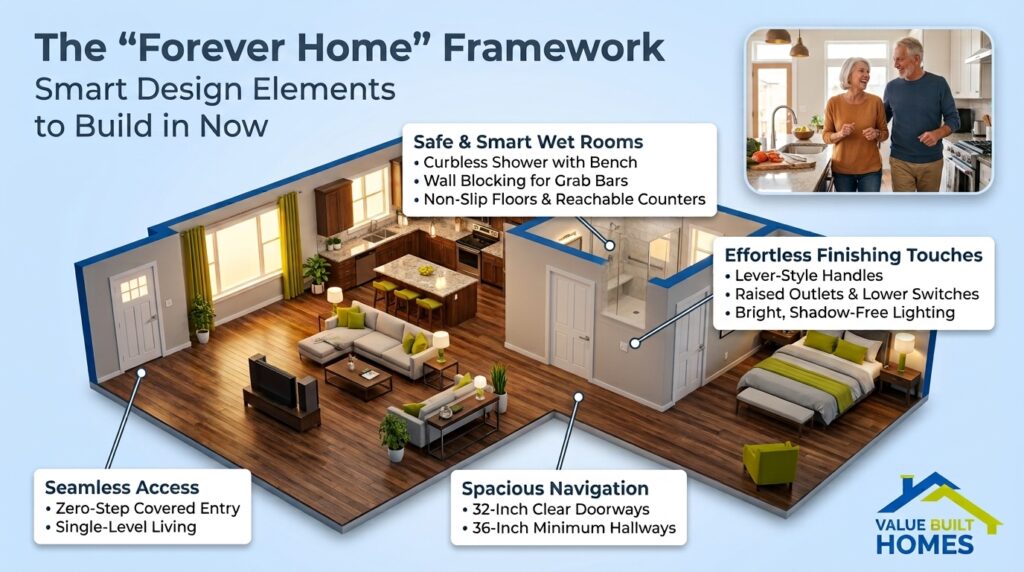
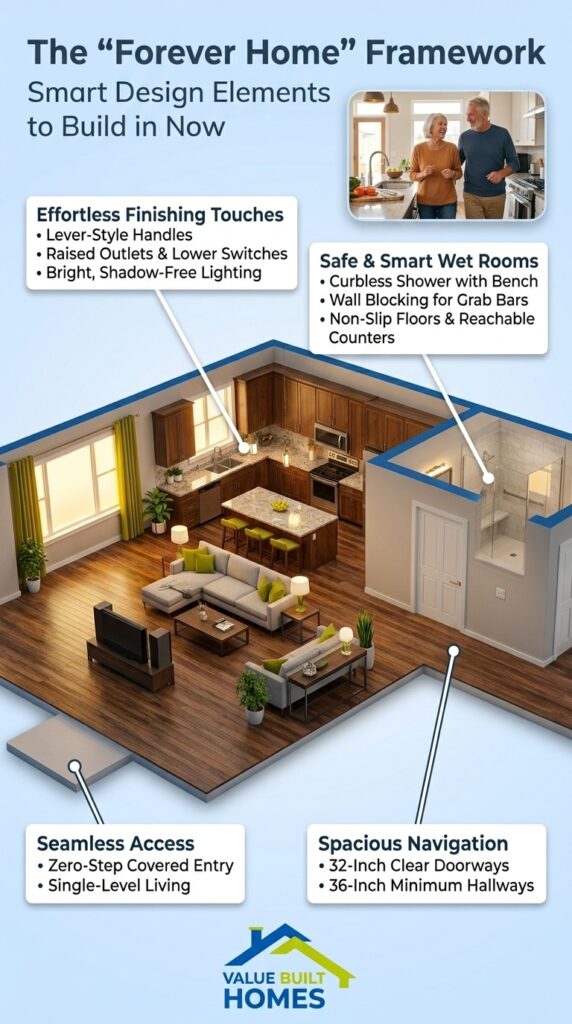
The features worth getting right during construction are structural: single-level living, a no-step entry, wider doorways and hallways, a first-floor primary suite, and curbless, slip-resistant bathrooms. The finishing touches matter too, but the bones of the home come first.
Start With Single-Level Living and a No-Step Entry
Single-level living and a no-step entry remove the biggest obstacle in most homes: stairs. Keeping daily life on one floor, with at least one covered entrance that has no steps, makes a home easier to navigate at every age.
This matters for safety as much as convenience. Falls are the leading cause of injury among adults 65 and older, and about one in four (over 14 million) report falling each year. Fewer stairs and level transitions mean fewer chances to fall.
- No-step covered entry: At least one entrance should be covered and step-free, with the threshold kept as flush as possible.
- Single-floor living: Keeping the primary bedroom, kitchen, laundry, and a full bathroom on the main level means you never have to climb stairs for daily needs.
Still weighing layouts? Our breakdown of the real cost to build a one-, 1.5-, or two-story home compares them in detail.
Plan Wider Doorways, Hallways, and a First-Floor Primary Suite
Wider passages and a main-floor primary suite keep a home livable if mobility ever changes, and they cost almost nothing extra to frame during construction. Industry guidance gives concrete targets:
- Wider doorways: Frame interior doors for at least 32 inches of clear width, which accommodates a walker or wheelchair and still feels generous for everyday use.
- Wider hallways: Aim for hallways at least 36 inches wide (wider is even better), which reads as open and comfortable rather than clinical.
- A first-floor primary suite: A main-level bedroom and full bath means the home works without anyone ever needing to use the stairs.
Design Bathrooms and Kitchens for Safety and Ease
Bathrooms and kitchens are where small design choices prevent big problems. A curbless shower, slip-resistant flooring, and reachable storage make these rooms safer without making them look like a hospital.
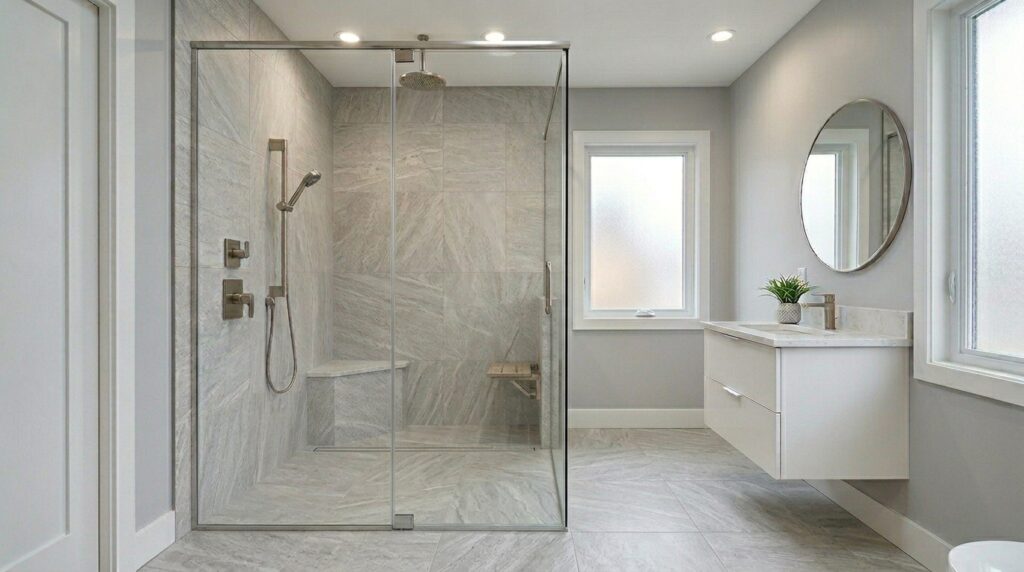
- Curbless (zero-threshold) shower: A shower you can walk or roll into, with a built-in bench and a handheld sprayer, removes a common fall risk.
- Slip-resistant flooring: Non-glare, slip-resistant surfaces in wet areas help prevent the kind of falls that send many older adults to the hospital each year.
- Reachable storage and counters: Varied counter heights and easy-to-reach storage cut down on bending and overhead reaching.
- Blocking for future grab bars: Adding wood blocking behind bathroom walls during framing means grab bars can be installed solidly whenever they are needed, with no demolition.
Add Lever Handles, Better Lighting, and Accessible Controls
The finishing details are inexpensive during construction and make a daily difference for anyone whose grip, balance, or eyesight changes over time.
- Lever door handles and faucets: Levers work with a closed fist or an elbow, unlike round knobs that require a firm grip.
- Generous, layered lighting: Brighter, even lighting reduces shadows and helps aging eyes, especially in hallways and entryways.
- Accessible switches and outlets: Placing controls within easy reach, and outlets a little higher than usual, means less bending and stretching.
Building an Affordable, Accessible Forever Home in Southern Indiana
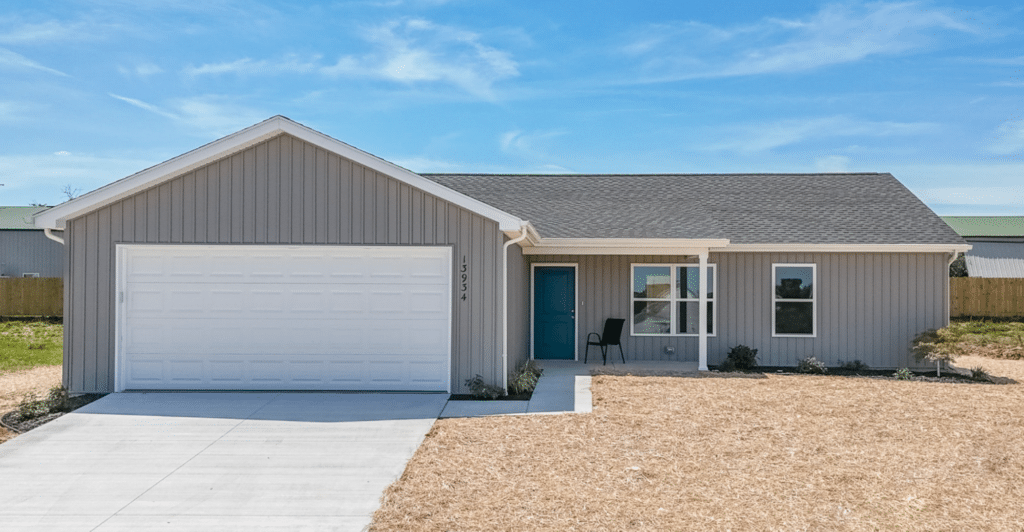
You do not need a custom luxury build to age in place. Value Built Homes is a family-owned builder in Haubstadt, Indiana, that constructs affordable, site-built homes across Southwestern Indiana and the tri-state area, using standardized, cost-engineered floor plans that keep both the price and the decisions manageable. That standardization is an advantage for aging-in-place buyers, not a limitation: instead of weighing thousands of custom choices, you start from proven layouts and focus on the features that matter most for a forever home. The result is a simpler process and a lower cost.
Value Built Homes builds affordable new construction designed for value, and the package is turnkey. A complete home includes the foundation, basement, garage, driveway, septic, water, electric, sidewalks, porches, and patios, so the major site work is handled for you. As one Value Built Homes homeowner shared, the team “took care of everything like running power, water, septic, poured wall basement, and even the driveway,” the kind of simplicity that helps when you are planning for the long term.
Several programs make the long-term math work:
- Free construction financing: Value Built Homes pays the interest on the construction loan during the build, which lowers your upfront cost.
- 2-10 Home Buyers Warranty: Every home comes with 10-year structural coverage plus systems and workmanship protection, which matters for a home you plan to keep.
- Real-time build tracking: The Buildertrend portal lets you follow your build from anywhere.
The savings add up. Value Built Homes typically saves most buyers between 20% and 30% compared with building elsewhere, and homes are usually move-in ready in about five to seven months.
One homeowner summed up the result: their home turned out “very energy efficient, low/no maintenance, and just perfect for my lifestyle.” For a forever home, low maintenance and efficiency are not extras. They are what keeps a house from getting harder to live in as the years pass.
When you are ready to plan a single-level forever home, you can browse Value Built Homes floor plans to find a layout that fits, see completed builds in the home gallery, or learn more about the family-owned team behind every home.
Frequently Asked Questions About Aging in Place Home Design
What features make a home good for aging in place?
The most important ones are single-level living, a no-step covered entry, doorways with at least 32 inches of clear width and hallways at least 36 inches wide, a first-floor primary suite, and a curbless shower. Lever handles, slip-resistant flooring, and bright, even lighting round out a home that stays comfortable as needs change.
Is it cheaper to build accessibility features in or add them later?
Building accessibility features in during construction is almost always cheaper than adding them later. During the build, a wider doorway or a no-step entry is a design choice with little or no added cost. After the home is finished, the same change means tearing out and rebuilding finished walls, floors, and fixtures.
Do you have to build a single-story home to age in place?
No, but keeping the essentials on one level is what matters most. A true single-story home is the simplest path, yet a home with a first-floor primary suite, kitchen, laundry, and full bathroom can work well too, since daily life never requires the stairs. The goal is main-floor living, whether or not a second floor exists.
Can an affordable home still have aging-in-place features?
Yes. Aging-in-place features are about smart design, not luxury upgrades, and many of the most important ones (a no-step entry, wider doorways, a first-floor primary suite) cost little or nothing extra when built in from the start. A standardized, value-focused plan can include them without the price of a fully custom home.
When should you start planning a home for aging in place?
The best time is before construction begins, when accessible features are still design choices rather than renovations. Building them into a new home from the start is the least expensive and least disruptive approach, and it means the home is ready whenever your needs change.
Plan a Forever Home That Grows With You
Building aging-in-place features into a new home is the most affordable way to make sure your house still fits years from now. If you are thinking about a single-level forever home in Southwestern Indiana or the tri-state area, reach out to the Value Built Homes team to talk through your options and get started.