Saving up the cash to buy is the hurdle that keeps many Southern Indiana families renting longer than they’d like. Indiana down payment assistance can lower that hurdle: the state’s First Step program currently provides 5% of the home price, Next Home provides up to 3.5%, and both can be used to buy a newly built home. Here’s how the programs actually work in 2026, based on IHCDA’s current published terms, and how they fit if you’re planning to build.
Key Takeaways
Here’s what matters most about Indiana’s down payment assistance programs right now:
- The Indiana Housing and Community Development Authority (IHCDA) runs two active down payment assistance programs. First Step provides 5% of the home price for first-time buyers, and Next Home provides up to 3.5% for first-time and repeat buyers.
- Both programs are non-forgivable second mortgages: the assistance is repaid when you sell, refinance outside an IHCDA program, or stop living in the home. It is not forgiven after a set number of years.
- IHCDA assistance can be used to purchase new and existing homes in all 92 Indiana counties, so choosing new construction does not rule you out.
- Many articles still describe a 6% First Step benefit and an active First Place program. IHCDA’s current pages list 5% for First Step, and the state’s program guide shows First Place ended December 31, 2023.
- Baseline eligibility includes a 640 credit score, county income and acquisition limits, a homebuyer education course, a $250 reservation fee, and using the home as your primary residence within 60 days of closing.
- Your IHCDA participating lender makes the final call on program fit for any specific purchase, including a new build. Talk with one early in the process.
IHCDA First Step vs. Next Home: How the Two Programs Compare
IHCDA’s two active down payment assistance programs differ mainly in how much they provide and who can use them. First Step offers 5% of the home price to first-time buyers. Next Home offers up to 3.5% and is open to repeat buyers as well. Both pair with FHA or Conventional 30-year fixed-rate first mortgages.
The table below compares the two programs side by side, using IHCDA’s current 2026 published terms from its homebuyers page, programs page, and 02/2026 program guide:
| First Step | Next Home | |
| Assistance amount | 5% of the home price | Up to 3.5% (2.50% or 3.50%), based on the lesser of purchase price or appraised value |
| Who qualifies | First-time buyers (no ownership interest in a principal residence in the prior 3 years), OR any buyer in a targeted area, OR Eligible Veterans | First-time and repeat buyers |
| Loan pairing | FHA or Conventional 30-year fixed | FHA or Conventional 30-year fixed |
| Repayment | Non-forgivable second mortgage; due in full at sale, outside refinance, HELOC use, or loss of primary residence | Same non-forgivable structure |
| What DPA can pay for | Down payment, closing costs, pre-paid items, realtor compensation | Same |
| Other costs and rules | $250 reservation fee; county income and acquisition limits; homebuyer education; federal recapture tax possible on bond loans within 9 years | County income and acquisition limits; homebuyer education; property eligibility exceptions reviewed case by case |
| Fit for a new build | Applies to the purchase of a qualified dwelling with the 30-year first mortgage; program fit for any specific purchase is confirmed by the IHCDA participating lender | Same, with repeat-buyer availability for move-up builders |
One housekeeping note if you’ve been researching for a while: the First Place program, which many websites still describe as active, ended December 31, 2023. IHCDA’s Next Step program now exists as a one-time refinancing option for legacy First Place and First Step mortgages. Program terms can change without notice, so confirm current figures with IHCDA or a participating lender before you commit.
What Does Non-Forgivable Down Payment Assistance Mean?
Non-forgivable means the assistance is a real second mortgage that gets repaid, not a grant and not a loan that disappears after a few years. Some websites describe IHCDA’s assistance as forgiven after 5 to 7 years. That is not how the current programs work, and it’s a genuine trade-off to understand before you sign.
When the Second Mortgage Comes Due
Per IHCDA’s 02/2026 program guide, the second mortgage becomes due in full when any of these events happens:
- You sell the home: the balance is repaid at closing from your proceeds.
- You refinance outside an IHCDA program: replacing your first mortgage with a non-IHCDA loan triggers repayment. IHCDA’s own Next Step refinance is the exception.
- You take out a HELOC: a home equity line of credit on the property counts as a triggering event.
- The home stops being your primary residence: moving out and renting the home, for example.
For buyers planning a forever home, this structure is generally workable: stay in the home and keep the first mortgage in place, and repayment waits until you eventually sell.
The Federal Recapture Tax in Plain Language
Loans funded through state bond programs can carry a federal recapture tax, and it worries buyers more than it usually should. Per the program guide, recapture applies only if all three of these conditions are met:
- You sell the home within 9 years of buying it.
- You sell at a gain.
- Your household income has risen above that year’s limits.
If all three apply, the tax is capped at the lesser of 6.25% of the original loan amount or half of your gain, and it never applies after 9 years. This is general information, not financial or tax advice. Talk with a tax professional about your specific situation.

Who Qualifies for Indiana Down Payment Assistance?
Eligibility comes down to buyer status, income, credit, and the home itself. First Step requires first-time buyer status with two notable exemptions, while Next Home doesn’t require it at all. Both programs apply county limits and a few universal requirements.
The First-Time Buyer Rule and Its Two Exemptions
In IHCDA’s definition, a first-time homebuyer is someone with no ownership interest in a principal residence during the prior 3 years. You may qualify even if you owned a home years ago. The program guide also waives the first-time requirement in two cases:
- Targeted areas: buying in a targeted area removes the first-time requirement entirely.
- Eligible Veterans: applicants with verifiable military status can use First Step without first-time status.
Next Home skips the question altogether. It’s open to first-time and repeat buyers, which makes it the path for households moving up to a new build.
Income, Credit, and Occupancy Requirements
Beyond buyer status, IHCDA applies these baseline requirements:
- Credit score: a credit score of 640 or greater, per IHCDA’s consumer housing site. Your lender will confirm current requirements for your specific loan type.
- Income and purchase price limits: limits vary by county and household size and change periodically, so skip the numbers in articles and check your county directly on IHCDA’s Income and Acquisition Limits page.
- Occupancy: the home must become your primary residence within 60 days of closing.
- Homebuyer education: complete an approved course, with certificates from Fannie Mae HomeView or Freddie Mac CreditSmart.
If you’re still working out how much cash you’ll need overall, our guide to down payment insights for Indiana home buyers walks through the mechanics beyond assistance programs.
What the Assistance Can Pay For
IHCDA down payment assistance is more flexible than the name suggests. Per the program guide, the funds can cover:
- Down payment: the funds apply toward the down payment on your first mortgage, the use most buyers have in mind.
- Closing costs: the assistance can offset the fees due at closing, not just the down payment itself.
- Pre-paid items: amounts collected up front at closing can be covered as well.
- Realtor compensation: the guide lists realtor compensation among the allowable uses.
You can also add your own funds on top of the assistance. Two ground rules to know: there’s a $250 non-refundable reservation fee, and you can’t receive cash back at closing beyond your documented investment.
Can You Use Down Payment Assistance on a New Construction Home?
Yes. IHCDA’s programs can be used to purchase new and existing homes, in all 92 Indiana counties. What matters is the structure of the transaction: IHCDA programs finance the purchase of a qualified dwelling with a 30-year fixed-rate first mortgage, and they cannot replace existing financing. That detail shapes how the assistance fits a build.
The program guide’s acquisition-cost rules anticipate new construction directly, in two ways:
- Incomplete homes: a home’s acquisition cost includes the reasonable cost of completing an incomplete residence, so the rules contemplate buyers whose homes aren’t finished yet.
- Recently purchased land: if you’ve owned your land for less than 2 years, the land cost counts toward the acquisition cost as well.
Here’s where your builder’s financing structure matters. Value Built Homes pays the interest on your construction loan during the build through its Free Construction Financing program, and you complete the purchase of your finished home with your permanent mortgage. That finished-home purchase, funded by a 30-year fixed first mortgage, is the structure IHCDA’s programs pair with. If you’re comparing loan structures for a build, our guide to construction-to-permanent financing explains how the construction phase transitions into the permanent mortgage.
One honest caveat: whether an IHCDA program fits your specific purchase is decided by your IHCDA participating lender, not by a builder and not by an article. Loan structures for new builds vary, so bring your build plans to a participating lender early and have the fit confirmed before you count on the assistance. IHCDA does not endorse any builder, and nothing here is a guarantee of eligibility.
Layering Assistance and Other Ways to Lower Your Upfront Costs
IHCDA assistance doesn’t have to be your only source of help. The program guide allows combining it with other assistance, and buyers who already own land have another lever entirely. Three options worth knowing:
- Layering other assistance: combining IHCDA assistance with other down payment help is allowed if the lien order holds: the U.S. Bank first mortgage in first position, IHCDA’s second mortgage in second, and any other assistance in third. Your participating lender coordinates the order.
- Land equity: if you already own your lot, its equity can count toward your borrower contribution on a construction loan. Our guide to using land equity for a construction loan down payment shows how the numbers work, and it pairs naturally with the IHCDA guide’s 2-year land rule above.
- Government-backed construction paths: eligible buyers have zero-down federal options too. See our guides to USDA loans for new home construction in Indiana and building with a VA construction loan in Southern Indiana.
How to Apply for IHCDA Down Payment Assistance Before You Build
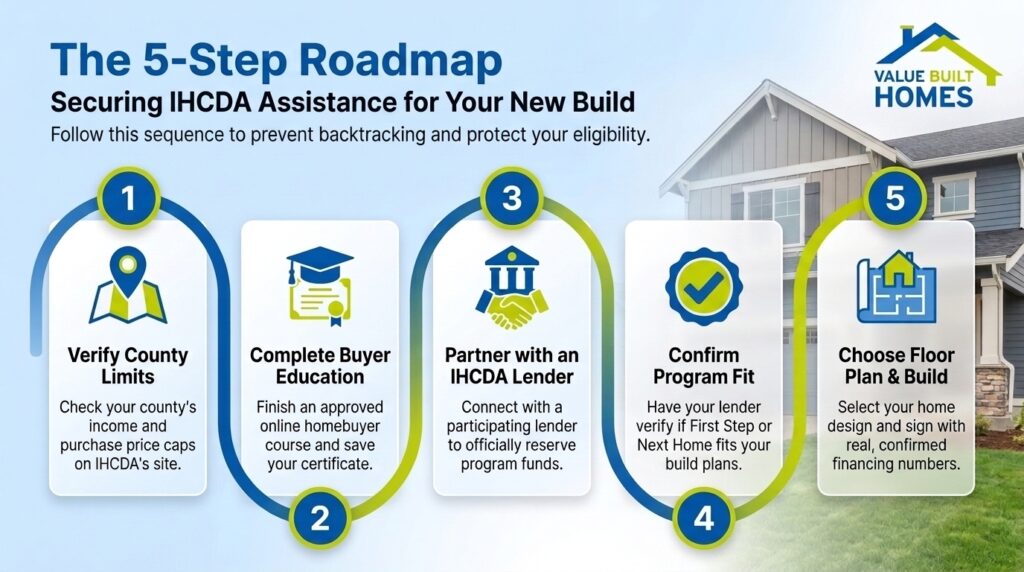
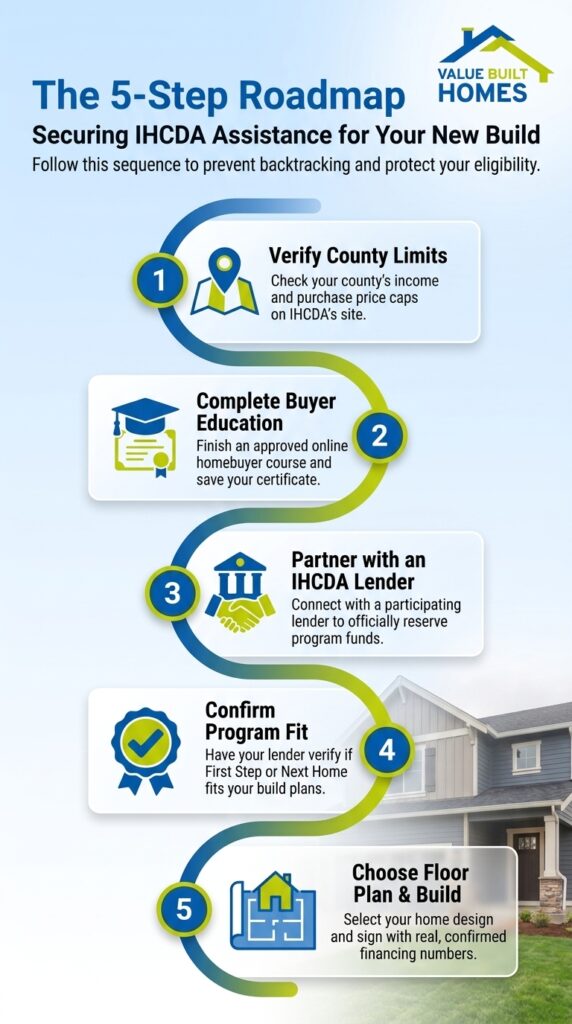
The application path runs through an IHCDA participating lender, and the smart move is to start before you’ve picked a floor plan. Here’s the order that saves buyers the most backtracking:
- Check your county’s limits: look up your county’s income and acquisition limits on IHCDA’s limits page to confirm you’re in range before investing more time.
- Complete homebuyer education early: finish the Fannie Mae HomeView or Freddie Mac CreditSmart course and keep the completion certificate the program guide requires so paperwork doesn’t hold up closing.
- Contact an IHCDA participating lender: IHCDA assistance is reserved through participating lenders, so this contact is not optional. IHCDA’s homebuyers page is the starting point for current program details and lender information.
- Get program fit confirmed: share your build plans and timeline, and have the lender confirm which program, if either, fits your purchase.
- Then choose your floor plan: with your budget and assistance confirmed, you can shop plans with real numbers instead of guesses.
What Assistance Means for an Affordable New Home in Southern Indiana
Down payment assistance helps most when the home itself is priced within reach. Two numbers frame the opportunity for Southern Indiana buyers:
- The national picture: 65% of U.S. households can’t afford a median-priced new home in 2026, with the median new home price at $413,595 and roughly 88.2 million households priced out at a 6% mortgage rate.
- The Southern Indiana picture: Value Built Homes’ published floor plans start at $129,900, well below the national median, and every home package includes the foundation, driveway, and site work in the price.
Affordability is what buyers remember. One Value Built Homes homeowner put it this way: “Our home was built fast and efficiently. We ended up spending the same amount for our stick built home as we were going to with the modular company. We are happy!” For families planning their forever home, pairing state assistance with a home priced for real budgets is often how the math finally works.
Frequently Asked Questions About Indiana Down Payment Assistance
Does Indiana’s First Step program offer 5% or 6% down payment assistance?
First Step currently provides 5% of the home price, per IHCDA’s live homebuyers page and its 02/2026 program guide. The 6% figure that still appears on many websites is outdated. Terms can change without notice, so confirm the current figure on IHCDA’s site or with a participating lender.
Is IHCDA down payment assistance forgiven after a few years?
No. First Step and Next Home assistance is a non-forgivable second mortgage, due in full when you sell, refinance outside an IHCDA program, take out a HELOC, or stop using the home as your primary residence. Descriptions of the assistance being forgiven after 5 to 7 years are inaccurate for the current programs.
Do you have to be a first-time homebuyer to get down payment assistance in Indiana?
Not always. Next Home is open to first-time and repeat buyers. First Step requires first-time status, defined as no ownership interest in a principal residence in the prior 3 years, but waives it for purchases in targeted areas and for Eligible Veterans.
What credit score do you need for IHCDA down payment assistance?
IHCDA’s consumer housing site lists a credit score of 640 or greater as a baseline eligibility marker. Requirements can vary by loan type and lender, so treat that number as the starting point and confirm specifics with an IHCDA participating lender.
Can you combine IHCDA assistance with other down payment help?
Yes. Layering is allowed if the lien order holds: the U.S. Bank first mortgage first, IHCDA’s second mortgage second, and other assistance third. Your participating lender coordinates this. And if you already own your lot, land equity can reduce what you need up front on the construction side.
Ready to Put Down Payment Assistance to Work on a New Home?
Building an affordable new home in Southern Indiana is more achievable than the national headlines suggest, especially when state assistance pairs with a builder that covers your construction loan interest during the build. Have questions about how the pieces fit together? Contact the Value Built Homes team to talk through floor plans, financing, and your timeline.