If you’ve been thinking about building a new home in Southwest Indiana, you’ve probably heard about tariffs and rising material prices. The real question you’re asking is a practical one: how do tariffs affect new home construction costs for a buyer like you, and does it change whether building right now makes sense? Here’s a straightforward look at what’s happening and what it means for buyers in this region.
Key Takeaways
- Building material costs have risen 40% since December 2020, and current tariff actions are adding pressure on top of that existing increase.
- The National Association of Home Builders estimates that recent tariffs add roughly $10,900 to the cost of a typical new home, based on an April 2025 builder survey.
- Lumber, steel, aluminum, and kitchen cabinets are the materials hit hardest. Canadian lumber now faces an approximately 45% effective tariff rate; steel and aluminum face 50%.
- A Brookings Institution analysis estimates current tariffs will add approximately $30 billion to the costs of residential construction nationwide, with roughly 90% of that falling on new homes.
- Builders whose model relies on standardized floor plans and bulk material purchasing have structural cost advantages that one-off custom builders cannot replicate.
- Value Built Homes builds from cost-engineered, standardized plans with bulk purchasing built into the model, providing a structural hedge against tariff-driven price volatility.
Which Building Materials Do Tariffs Hit Hardest?
Not all building materials face the same tariff exposure. The National Association of Home Builders tracks material-specific tariff rates as part of its ongoing advocacy work. Some categories are hit far harder than others, and understanding the breakdown helps you evaluate what’s actually at risk when you read about tariff-related price increases.
Here is where current tariffs are concentrated:
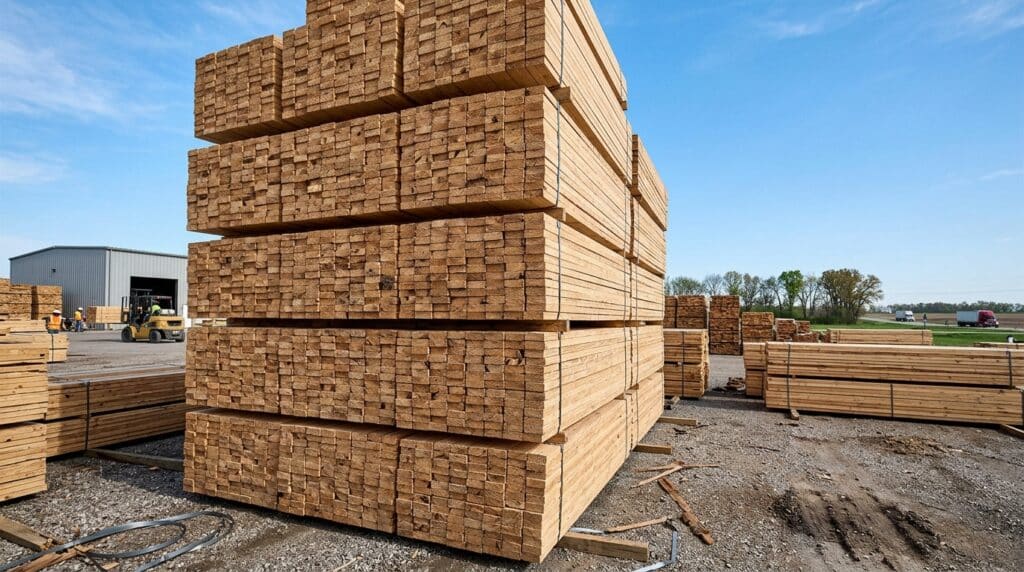
- Lumber: Canada supplies roughly 85% of all U.S. softwood lumber imports and nearly one-quarter of the total U.S. lumber supply. Commerce raised antidumping and countervailing duties on Canadian lumber from 14.5% to 35% in 2025, plus an additional 10% Section 232 tariff, bringing the effective price increase on Canadian lumber to approximately 45%.
- Steel and aluminum: Both are subject to a 50% Section 232 tariff, affecting structural connectors, ductwork, and mechanical systems throughout a home.
- Kitchen cabinets, vanities, and furniture: A 25% tariff remains in effect on these categories through January 1, 2027, affecting interior finishes during the final phase of a build.
- Imported goods overall: Of the $194 billion in goods used to build new housing in 2025, approximately $14 billion (about 7%) were imported. That is the portion of every build directly exposed to import duties.
How Much Are Tariffs Adding to the Cost of a New Home?
Recent tariffs are adding an estimated $10,900 to the cost of a typical new home, according to an April 2025 NAHB builder survey. More than 60% of builders surveyed reported seeing higher costs directly tied to tariffs.
Current tariffs will add roughly $30 billion to the costs of investment in residential structures nationally, with approximately 90% of that burden falling on new homes, according to a Brookings Institution analysis. Appliance prices in 2025 rose more than twice as fast as overall inflation, and furniture prices climbed more than 75% faster than the overall inflation rate, both driven in part by tariff pressure on imported goods.
Keep in mind that material costs were already elevated before tariffs took effect. Building material costs have risen 40% since December 2020, far outpacing overall inflation. Tariffs layer on top of a price environment that was already strained.
What This Means for Home Buyers in Southwest Indiana
If you’re planning to build in Southwestern Indiana, these numbers are worth understanding, but not worth panicking over. Here’s the practical picture.
Tariffs raise the cost of raw materials. Builders who rely on variable, market-rate purchasing pass those increases through to buyers. The timing of your contract, when materials were locked in, and how much customization is involved all affect how much of that exposure lands on your final price.
Not all builders respond to the same cost pressures the same way. The gap between a value-engineered, standardized builder and a fully custom builder widens when material prices are volatile. That’s when the structural differences in the business model show up most clearly.
How Value Built Homes’ Model Responds Differently to Tariff Pressure
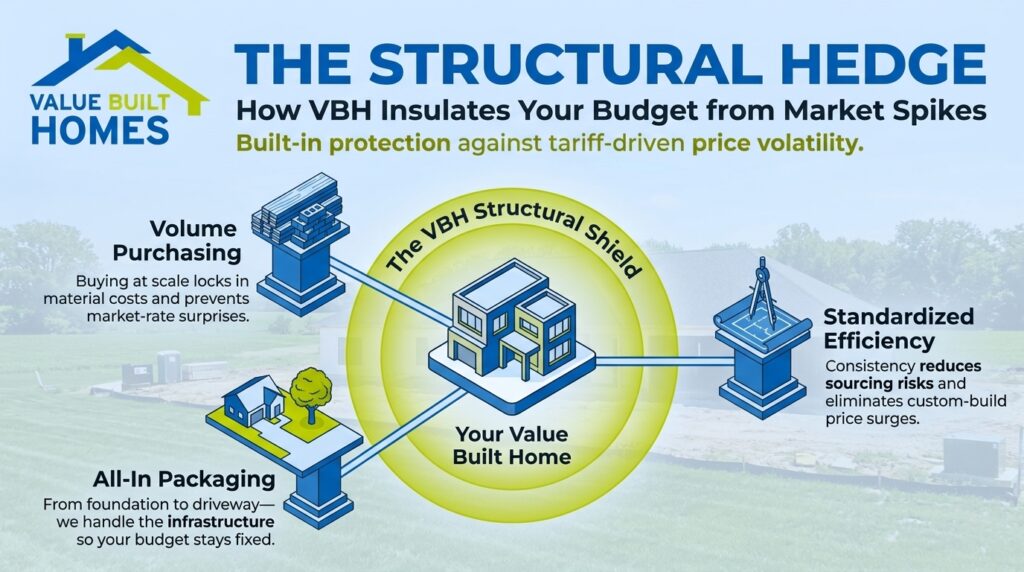
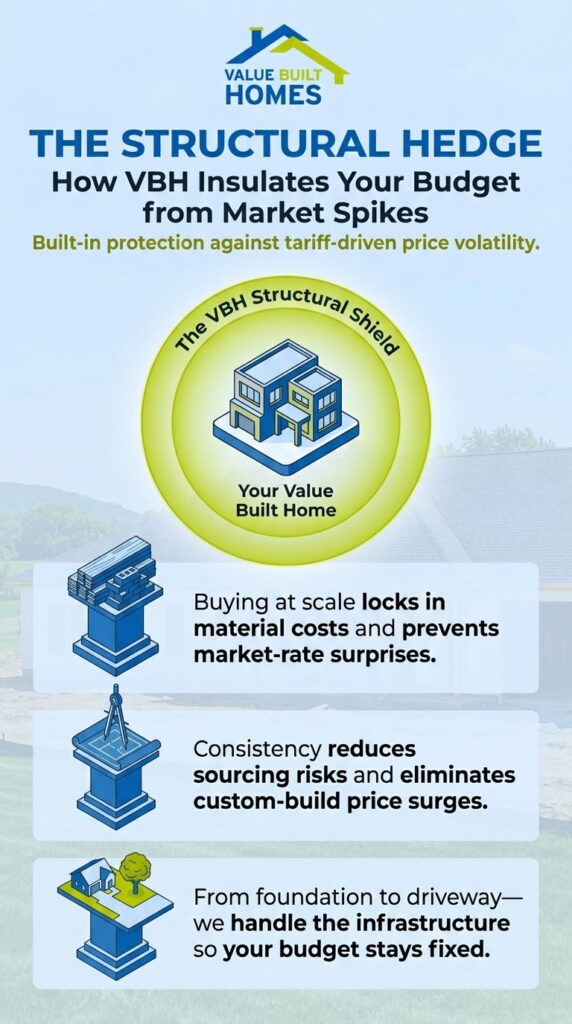
Value Built Homes builds from standardized, cost-engineered floor plans. That’s not a constraint; it’s the structural reason the model holds up differently when material costs spike.
A few things about how this works:
- Bulk purchasing: By building the same floor plans repeatedly across multiple subdivisions, Value Built Homes can buy materials in volume. Volume purchasing locks in pricing that isn’t available to custom builders pricing a one-off project.
- Reduced customization exposure: Custom builds require project-specific material sourcing at whatever the market rate is at that moment. Standardized plans reduce that exposure because the material list is known, consistent, and sourced in advance.
- Comprehensive packages: Every home includes the foundation, basement, garage, driveway, septic, water, electric, sidewalks, porches, and patios. There is no shopping around for individual subcontractors or materials after the contract is signed.
That all-in structure is something homeowners notice. As one Value Built Homes customer put it: “Value Built Homes was able to take care of everything. They took care of all the headache items like septic, foundation and water.”
You can read more about how this model is structured on the Value Built Homes new home construction page. Value Built Homes has historically helped most buyers save between 20% and 30% compared to building new homes elsewhere. That gap matters in any market, and it matters more when material prices are volatile.
Is It Still Worth Building a New Home Right Now?
This is the question that matters most. The honest answer: yes, for most buyers in Southwest Indiana, building now still makes sense, with some important context.
Material costs are elevated and may remain so depending on how trade policy evolves. But waiting carries its own costs. Rents continue to rise. Existing home inventory in Southwestern Indiana remains tight.
One cost you can control right now: Value Built Homes’ Free Construction Financing program means Value Built Homes pays the interest on the construction loan during the build phase. That removes one of the most common financial stressors for buyers building in a higher-cost environment.
The practical starting point for most buyers is to get real numbers. Browse current floor plan pricing on the Value Built Homes website, where prices are posted and current. That gives you an actual cost baseline for this builder’s standardized model, not a national average or a media estimate.
Frequently Asked Questions About How Tariffs Affect New Home Construction Costs
How do tariffs affect the cost of building a home?
Tariffs increase the price of imported building materials like lumber, steel, aluminum, and cabinets. Builders who purchase those materials at current market rates pass the increases through to buyers in the form of higher contract prices. The specific impact depends on which materials are used, when they were purchased, and whether the builder works from fixed or variable pricing.
What building materials are most affected by tariffs?
Lumber, steel, aluminum, kitchen cabinets, vanities, furniture, and appliances have all seen significant tariff-driven price increases. Lumber now faces an approximately 45% effective tariff on Canadian imports. Steel and aluminum face a 50% Section 232 tariff. Kitchen cabinets and furniture face a 25% tariff through early 2027. Appliance prices rose more than twice as fast as overall inflation in 2025 due to tariff effects.
Will construction costs go down in 2026?
That depends heavily on trade policy decisions that are still in flux. NAHB and the Brookings Institution both track material cost trends closely, and neither organization is forecasting a near-term return to pre-tariff price levels. For buyers in Southwest Indiana, the more useful question is whether a builder’s model gives you predictable, posted pricing rather than waiting for the market to move.
Is now a good time to build a home with tariffs in place?
For most buyers in Southwest Indiana, yes. Waiting doesn’t guarantee lower costs, and it extends the time you spend in housing that doesn’t meet your needs. Working with a builder whose model is built on standardized floor plans, bulk purchasing, and transparent posted pricing gives you more control over your budget than trying to time the market. Learn more about Value Built Homes and how the model is structured.
See What It Actually Costs to Build with Value Built Homes
Understanding the national tariff picture is useful context. Getting actual numbers is more useful. Value Built Homes posts current pricing for every floor plan on their website, so you can see what a new home in Southwest Indiana costs with this builder’s model, right now.
Browse the available floor plans with current pricing, or contact the Value Built Homes team to talk through your options for building in Southwest Indiana.