Leveraging land equity as part of your down payment can significantly lower your out-of-pocket costs. For Indiana property owners, using the existing value of your land can reduce the cash you need to secure a construction loan. Whether your land was inherited, bought years ago, or acquired recently, understanding how to tap into its equity can make your home-building process more affordable and streamlined.
In this guide, we will explain how lenders calculate land equity, outline the appraisal process for vacant lots and new construction, and detail the essential documentation you’ll need. We will also discuss common challenges that may affect your equity credit and present actionable steps to ensure you maximize your land’s value when applying for a construction loan.
How Land Equity Works for a Construction Loan Down Payment
Land equity is the value you already own in your lot—value you can often apply toward your construction loan down payment/borrower contribution. It’s different from home equity because it’s tied to vacant or minimally improved land, not a finished house.
Land Equity Formula
Usable land equity = Appraised land value − any land loan payoff amount
Example: If your land appraises at $80,000 and you owe $20,000, your usable land equity is $60,000.
When Land Equity Counts Toward Your Down Payment
Land equity can typically be credited toward your required borrower contribution when:
- Title is clear (no unresolved liens, judgments, or ownership disputes)
- The lender orders an appraisal and it supports the land’s value
- The lender’s program allows land equity to count as part of the down payment/borrower contribution (rules vary by lender)
What Land Equity Doesn’t Mean
Land equity does not guarantee you’ll avoid bringing cash to closing. You may still need cash for items like closing costs, reserves, contingencies, or to cover a gap if the appraisal comes in low.
Common Limits to Know (Before You Apply)
Even if you have land, lenders may limit how much equity they’ll credit due to:
- Seasoning rules: If you bought the land recently, the lender may use the purchase price instead of today’s market value.
- Liens/title issues: Tax liens, mechanic’s liens, or unresolved title defects can reduce—or block—equity credit.
- Appraisal shortfall: If the land appraises lower than expected, you may need to bring additional cash to meet the required contribution.
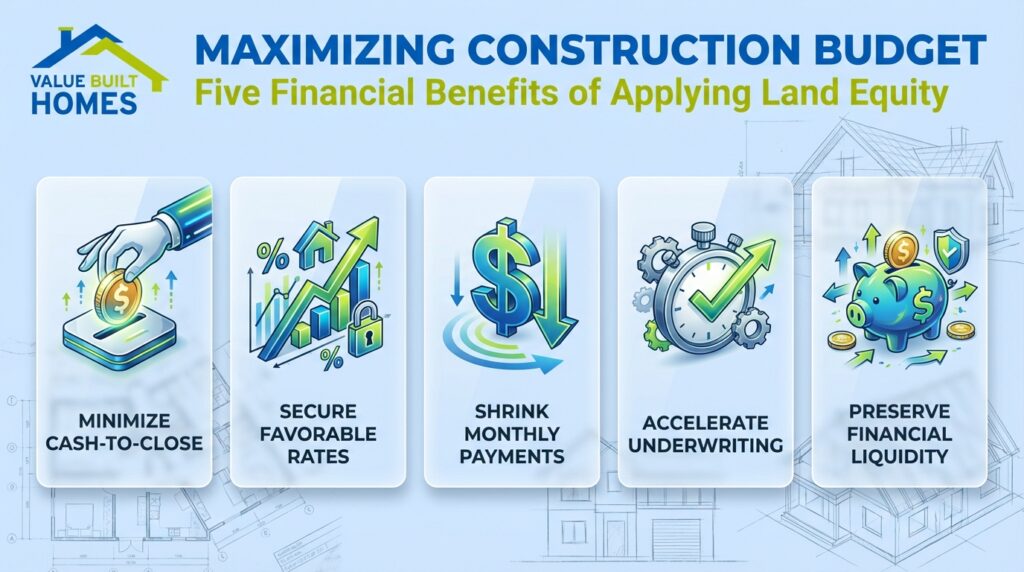
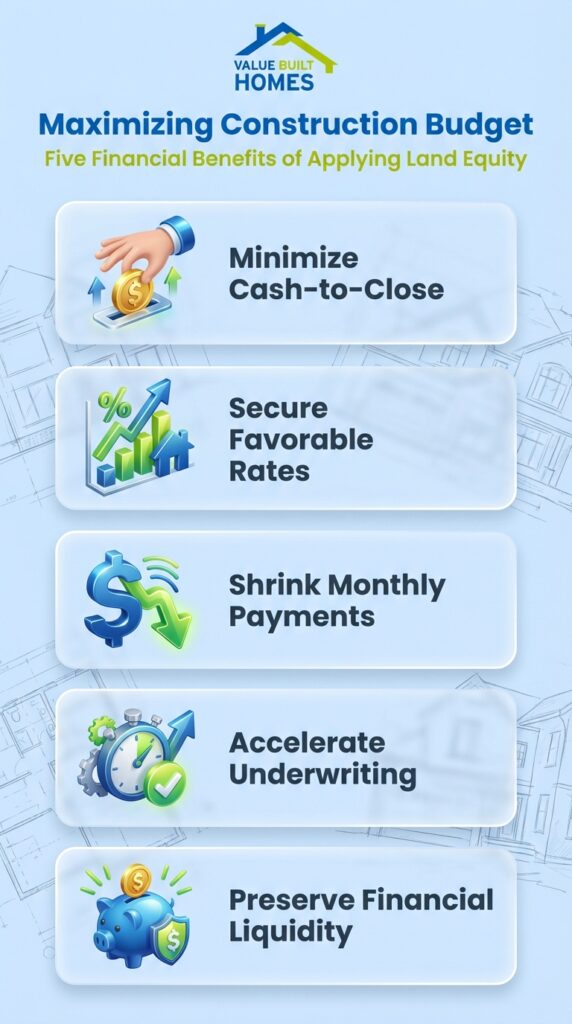
Benefits of Using Land Equity in Your Construction Loan
Leveraging land equity comes with several key benefits:
- Lower Upfront Costs: It can replace part or all of the required cash down payment.
- Improved Loan-to-Value Ratio: Significant equity may result in more favorable loan terms.
- Reduced Monthly Payments: A smaller financed balance can lead to lower monthly obligations.
- Streamlined Approval Process: Lenders may offer simplified procedures for borrowers with substantial equity.
- Liquidity Preservation: Using equity helps you retain cash for contingencies during construction.
The Lender Math: How Land Equity Reduces Your Cash-to-Close
Most lenders look at your total project cost and require a borrower contribution (often shown as a percentage of the project cost). Your land’s credited equity can apply toward that requirement—reducing how much cash you need to bring to closing. The example scenarios below show how this typically works in real numbers.
Scenario 1: Owning Land Free and Clear
If your land appraises for $40,000 and there’s no loan on it, that value may satisfy all or part of a down payment requirement.
- Example: If your project cost is $300,000 and the lender requires 10% down ($30,000), a $40,000 land value could fully cover that requirement—potentially leaving $0 down payment due in cash (closing costs and reserves may still apply).
Scenario 2: Land With an Existing Loan
If your land appraises for $55,000 and you owe $15,000, you may have $40,000 available to apply toward your borrower contribution. In many cases, the remaining land loan balance is addressed at closing (paid off or rolled into the new financing, depending on the lender and structure).
Scenario 3: Recently Purchased Land (Seasoning Example)
If you bought the land recently, the lender may limit the value used in calculations to the purchase price rather than today’s appraised value.
- Example: You purchased the lot for $50,000 four months ago, but today it appraises at $65,000. The lender may still use $50,000 for equity credit purposes, which can reduce how much of your borrower contribution is covered.
Bottom line: the appraisal result (and how the lender applies it) determines how much cash you’ll need at closing. If the value comes in lower than expected, you may need to increase your cash contribution, adjust scope, or explore different loan structures.
Understanding the Appraisal Process for Land and New Construction
Appraisals determine how much equity lenders will credit. Two types are usually performed:
Land Appraisal vs. “As-Completed Appraisal”
- Land Appraisal: Assesses the current market value based on location, acreage, zoning, and recent comparable sales.
- As-Completed Appraisal: Estimates the value of the finished project by combining the land’s value with projected home value based on building plans and materials.
Both appraisals are crucial. A favorable land appraisal maximizes your equity, while an accurate as-completed appraisal supports the overall loan-to-value calculation. For more on the overall process, you can learn how to navigate the appraisal process.
Preparing for a Favorable Appraisal
- Provide Comparable Sale Data: Support the appraiser’s valuation with recent, relevant sales.
- Address Zoning and Accessibility Issues: Ensure there are no restrictions that lower the land’s value.
- Complete Basic Site Improvements: Simple enhancements like clearing debris and marking boundaries can improve results.
- Submit Professional Building Plans: Detailed plans help appraisers predict the future value more accurately.
Paperwork Checklist: What You’ll Need to Prove Land Equity

Having organized documentation is crucial. Prepare the following materials:
Ownership and Title Documentation
- Deed: A current, clear deed with a legal description that matches public records.
- Title Report: Proof that there are no liens or disputes.
Surveys and Legal Documents
- Land Survey: A recent survey confirming boundaries and any easements.
- Payoff Statement: If applicable, documentation showing the remaining balance on any land loan.
- Tax Bills: Recent property tax bills that support your land’s assessed value.
- Proof of Insurance: Evidence of land insurance, if available.
Construction-Related Documentation
- Construction Contract: A signed agreement with your builder.
- Budget and Cost Breakdown: Detailed estimates for all construction-related expenses.
- Building Plans: Professional blueprints and timelines that support the as-completed appraisal.
Protect (and Boost) Your Land Equity Credit Before You Apply
Even if you’ve owned your land for years, lenders don’t automatically credit its full value toward your construction loan. Issues like title defects, zoning limitations, utility access, and appraisal support can reduce how much equity counts—or delay your approval altogether. Before you apply, it’s worth taking a few practical steps to protect your equity credit and present your property (and paperwork) in the strongest possible light.
What Reduces Your Equity Credit
These are the most common reasons lenders/appraisers credit less equity than owners expect:
- Title, liens, and legal issues: unpaid taxes, mechanic’s liens, judgments, ownership disputes, or unclear legal descriptions can limit—or stop—equity credit.
- Seasoning rules (recent land purchase): if you’ve owned the land a short time, the lender may credit the purchase price instead of current market value.
- Zoning/HOA/setback restrictions: limitations that reduce buildability can lower appraised value.
- Utility access and site feasibility: lack of approved access to electric/water/sewer (or septic suitability), poor driveway access, or major site constraints can reduce value.
- Soils/topography/drainage issues: steep slopes, floodplain concerns, unsuitable soils, or drainage problems often trigger appraisal or underwriting concerns.
- Unrealistic comparables: using comps that don’t match your acreage, location, or buildability can lead to disappointment when the appraisal comes in lower.
How to Fix It Before You Apply
You don’t need to “over-improve” vacant land—focus on items that reduce lender risk and support appraised value:
- Clear title early: order a title search, resolve liens, confirm the deed/legal description matches county records, and address easements proactively.
- Document access and utilities: collect any utility availability letters, permits/approvals, septic/perk test results (if applicable), and proof of legal road access/driveway plan.
- Confirm buildability: verify zoning, setbacks, minimum square footage requirements (if any), and HOA rules before appraisal and underwriting.
- Address site conditions that are easy wins: boundary marking, basic clearing, debris removal, and documenting usable build site area can help reduce valuation uncertainty.
- Use accurate, local comps: work with a local real estate pro or your builder/lender to identify true comparable land sales (similar acreage, location, and build readiness).
- Submit lender-ready plans and a detailed budget: strong building plans, specs, and a clear cost breakdown support the as-completed appraisal and keep underwriting smoother.
How Land Equity Fits into Construction Loan Options
Understanding different construction loan options can help you choose the best financial strategy:
Construction-to-Permanent Loans vs. Standalone Construction Loans
- Construction-to-Permanent Loans: These combine the construction loan and long-term mortgage into one process, using your land equity as a down payment and reducing overall borrowing.
- Standalone Construction Loans: These require a separate refinancing step after construction. Although flexible, they may involve additional costs and paperwork. In both cases, applying substantial land equity can significantly lower your initial cash outlay.
Draw Schedules and Interest-Only Payments
During construction, funds are released as needed, and you usually pay only the interest on the disbursed amounts. Land equity reduces the financed amount, which can lower interest costs during the build.
Exploring Reduced-Cost Financing Programs
Some lenders offer reduced fees or special programs to borrowers who contribute substantial land equity. These incentives can further reduce your overall financing costs.
Key Questions to Ask Your Lender and Builder
To ensure a smooth process, have these key questions ready:
- How is my land equity calculated? Confirm whether lenders use current appraisal values, purchase price, or another method.
- What appraisal types are required? Ask if both land-only and as-completed appraisals are needed and who handles them.
- Are there seasoning requirements? Learn how long you must own the land to receive full equity credit.
- What will my draw schedule look like? Inquire about the disbursement of funds and how draw milestones are determined.
- What if the appraisal is lower than expected? Understand your options if the credited equity does not meet the lender’s requirements.
- Are there any special financing programs available? Ask if any programs offer reduced fees or favorable terms for borrowers using significant land equity.
Next Steps and Valuable Resources

To move forward effectively:
- For Current Landowners: Schedule a review with your lender to determine how much equity can be credited and identify any gaps in your documentation.
- For Prospective Buyers: Consult with local experts to select land that meets development criteria, such as proper utility access and favorable zoning.
- For All Home Builders: Consider partnering with a builder who has experience working with land equity and construction loans.
Put Your Land Equity to Work
Using land equity can be one of the most effective ways to reduce cash-to-close on a construction loan—especially when you understand how lenders credit equity, what the appraisal will require, and which issues (like title, utilities, or seasoning rules) can limit the amount you receive.
If you’re planning to build in Indiana, Value Built Homes can help you prepare a lender-ready build package and coordinate the documentation and plans lenders typically need for construction financing. Contact us today to discuss your land and build goals.