New homes across the country are getting smaller, and buyers are embracing it. Whether you’re a first-time buyer stretching your budget, a growing family that wants a manageable monthly payment, or someone who’s tired of paying for rooms you never use, small house plans have become the defining choice of the 2026 housing market. The data backs it up, and so does the logic behind it.
Key Takeaways
- The median new single-family home shrank to 2,150 sq ft in 2024, the lowest level in 15 years, and the trend has continued into 2025–2026.
- More than half of Gen Z (53%) and millennials (52%) say they prefer a smaller, better-built home over a larger home with fewer amenities; that preference rises to 61% for Gen X and 70% for boomers.
- Affordability is the primary driver: land costs, labor, and material prices have all risen sharply, making every square foot more expensive to build than a decade ago.
- Midwest housing starts grew 7.2% in 2025 even as national starts declined, making Southwestern Indiana one of the more active and cost-favorable regions in the country for new construction.
- Value Built Homes’ standardized floor plans, starting at 933 sq ft and scaling to 2,514 sq ft, were designed precisely for the buyers leading this shift.
The Numbers Behind the Trend
This isn’t a perception shift. It’s documented. The median size of a newly built single-family home fell to 2,150 sq ft in 2024, according to NAHB data published in February 2025. That’s the lowest median since 2009, after years of holding around 2,300 sq ft. By Q3 2025, the median had edged to 2,176 sq ft per NAHB’s January 2026 report, keeping the multi-year decline intact.
How Builders Are Responding
Builders have adjusted their strategies to match buyer demand. According to NAHB’s February 2024 design trends report, 38% of builders said they deliberately built smaller homes in 2023 to support sales, with 26% planning to build even smaller the following year. That strategy has carried through 2025 and 2026. The market isn’t just accepting smaller homes. It’s pulling toward them.
What’s Driving Buyers Toward Smaller Floor Plans
Three interconnected pressures are reshaping what buyers want: rising construction costs that make every square foot count, buyer preferences that have genuinely shifted toward quality over size, and a broader rethinking of how much space households actually use. Together, they explain why this trend is durable, not a passing moment.
Affordability Has Permanently Changed the Math
Construction costs have climbed sharply over the past decade. Land prices, labor shortages, and material costs all contribute, and buyers feel every dollar. When each square foot costs more to build, extra square footage becomes a genuine financial decision rather than a default assumption.
That pressure has shifted preferences in a measurable way. NAHB’s 2025 research found that 53% of Gen Z buyers and 52% of millennials would choose a smaller, better-built home with more amenities over a larger home with fewer features. That preference isn’t unique to younger buyers: 61% of Gen X and 70% of boomers agree. Right-sizing isn’t just a budget move. It’s become the dominant preference across every generation active in the market.
What Buyers Actually Need Has Evolved
The classic four-bedroom, three-bath home was built around assumptions that don’t match how many households live today. As family structures shift and remote work changes how people use their space, buyers are rethinking what a home actually needs to do.
Bedroom preferences reflect this directly. Two decades ago, about 75% of buyers wanted four bedrooms. Today, 55% say three bedrooms is sufficient, typically two primary-style bedrooms and one standard bedroom. That shift alone removes hundreds of square feet from the typical new home without reducing livability.
What Makes a Small Floor Plan Work
A well-designed smaller home doesn’t feel cramped. The difference between a tight, frustrating layout and one that works beautifully comes down to how the space is organized, not just how much of it there is. Several design strategies consistently make modern small floor plans feel more spacious and functional:
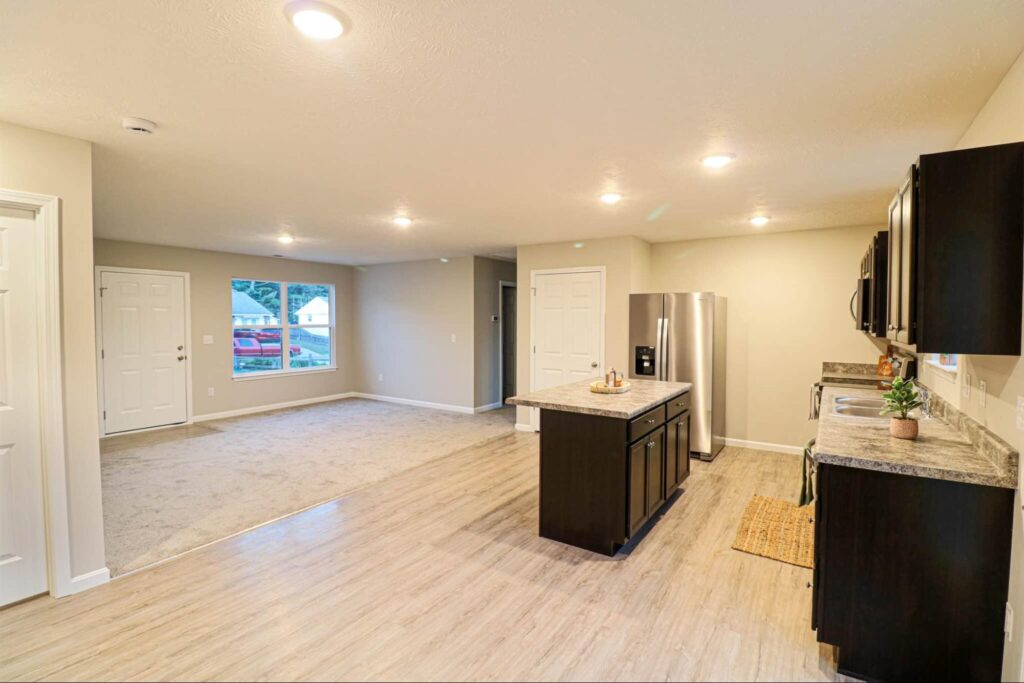
- Open-concept living areas that combine the kitchen, dining space, and main living area into one connected zone. Flow between spaces matters more than room count when square footage is limited.
- Flex rooms that can serve as a home office, guest room, playroom, or hobby space depending on the season. A room that adapts is an asset; a room that serves only one purpose is a liability in a smaller home.
- Smart storage built into the design (built-ins, deep closets, organized utility areas) that reduces visible clutter and makes the home feel intentional rather than crowded.
- Efficient kitchen layouts designed around how real households actually cook, with quality materials in a right-sized footprint rather than expansive square footage that’s rarely used.
None of these features require a large footprint. They require thoughtful planning, which is exactly what a well-engineered, standardized floor plan delivers. For buyers thinking through how layout structure affects daily life, our posts on open vs. traditional floor plans and embracing small house plans cover the design and lifestyle sides of that decision in more detail.
Why Southwestern Indiana Is a Smart Place to Build Smaller
National trends define the direction. Regional conditions determine what your budget can actually accomplish.
The Midwest outperformed the rest of the country in 2025. While national single-family starts declined for the year, combined Midwest housing starts grew 7.2%, the strongest regional performance in the country. Markets in Indiana, including the Evansville area and the broader tri-state region, benefited from that relative stability.
What This Means for a SW Indiana Buyer
For buyers in the Evansville area and surrounding communities, that combination of a growing Midwest market, lower land costs compared to coastal regions, and an active local builder creates real opportunity. A well-designed 1,200 to 1,600 sq ft home in Southwestern Indiana delivers more value per dollar than the same floor plan would in higher-cost markets.
For a closer look at what affordable new construction looks like on the ground here, our post on building an affordable home in Southern Indiana covers the real-world specifics without the industry-speak.
Value Built Homes Was Designed for Exactly This Moment
The national shift toward smaller, more efficient homes isn’t new to Value Built Homes. The company built its entire model around this philosophy before it became a trend.
Value Built Homes constructs standardized, cost-engineered site-built homes throughout Southwestern Indiana, with floor plans ranging from 933 to 2,514 sq ft. Most options fall squarely in the 1,000 to 2,000 sq ft range now driving the highest national sales volume. The standardized model delivers three concrete advantages for buyers:
- Predictable costs, because Value Built Homes builds proven plans with engineered material quantities, not open-ended custom designs.
- A faster timeline, typically five to seven months from start to move-in, with no scope creep from mid-build design changes.
- A simpler process, because buyers choose from finished plans rather than navigating a blank-slate design that expands in complexity and cost.
That efficiency translates to meaningful savings. Value Built Homes’ model can save most buyers between 20% and 30% compared to building new homes through other builders.
Value Built Homes also offers free construction financing, covering the interest on the construction loan during the build phase. For buyers already managing today’s rates, removing that upfront cost removes one of the biggest barriers to getting started.
Frequently Asked Questions About Small House Plans
Why are new homes getting smaller?
New homes are getting smaller because affordability pressure, shifted buyer preferences, and builder economics are all pointing in the same direction. Rising construction costs, higher land prices, and elevated mortgage rates have made cost efficiency the top priority for most buyers. At the same time, majorities of every active buyer generation now say they’d prefer a smaller, better-built home over a larger one with fewer amenities. Builders have responded by developing floor plans that prioritize quality and thoughtful design over raw square footage.
What square footage is right for a new home in 2026?
For most first-time buyers, a well-designed home between 1,200 and 1,800 sq ft offers the best balance of affordability, day-to-day function, and long-term flexibility. Homes in that range represent the highest-demand size band nationally. That said, the right size depends on your household: how many people live there, how you use your space, and what your budget can sustain without strain. A three-bedroom, two-bath plan at 1,400 sq ft may serve a family of four better than a 2,400 sq ft home that keeps finances tight for the next 30 years. Our practical guide to choosing a floor plan can help you work through that decision for your specific household.
Is a smaller home a good investment?
For most buyers in today’s market, yes. A home purchased within your budget is a stronger long-term position than a larger home that stretches finances thin. Smaller homes in the 1,200 to 1,800 sq ft range typically carry lower property taxes, utilities, and maintenance costs, and tend to have a broader pool of future buyers at resale. The financial risk of overbuilding on square footage is greater now than it’s been in over a decade.
Are there small house plans available in Southwestern Indiana?
Yes. Value Built Homes builds site-built homes throughout Southwestern Indiana and the tri-state area, with floor plans starting at 933 sq ft. Active subdivisions include locations in Evansville, Boonville, Princeton, Poseyville, Vincennes, and Gibson County, and buyers with their own land are welcome too. Contact the Value Built Homes team or browse available floor plans and pricing to see current options across the full size range.
How is a small site-built home different from a modular or manufactured home?
A site-built home is constructed entirely on your lot from the ground up, using traditional framing methods and materials. Value Built Homes builds exclusively site-built homes, not modular, prefabricated, or manufactured. Site-built homes qualify for conventional mortgage products, are assessed and financed the same as any traditional new construction, and are built to the same code standards as larger homes. The standardized floor plan model simply applies the same construction efficiencies used by high-volume builders to keep costs down, without changing how the home is built.
Ready to Explore Your Options?
The national move toward smaller, smarter floor plans reflects something buyers have known for a while: right-sized isn’t a compromise. It’s a strategy. A home that fits your life, your budget, and your long-term goals is a better investment than one that’s simply bigger.
Value Built Homes has been building affordable, site-built homes in Southwestern Indiana with exactly that philosophy. If you’re ready to see what’s possible, reach out to the Value Built Homes team to talk through what a right-sized build looks like for your family and your lot.