Figuring out where to live while building a house comes down to two questions: how long you’ll need temporary housing and what each option costs per month. The simplest starting points are staying in your current home until move-in or renting something nearby. And because a Value Built Homes build typically takes 5 to 7 months, that temporary stretch is shorter and cheaper than the full year most guides assume.
Key Takeaways
Here’s what matters most when choosing where to live during your build:
- Staying in your current home or renting nearby are the simplest starting points, and the right choice hinges on two numbers: the length of the build and the monthly cost of each option.
- The average single-family home completed in 2024 took 9.1 months from permit to completion, and contractor-built homes took about 12 months. A typical Value Built Homes build runs 5 to 7 months.
- Renting gives you full, private space at a predictable monthly cost. The average Evansville apartment rents for $1,041 per month, with 2-bedroom units at $1,099 and 3-bedroom units at $1,374.
- Extended-stay hotels average $118.71 per night nationally, or $58.45 in the economy tier, which works out to roughly $3,560 or $1,750 per month.
- Staying with family or friends costs the least in cash, but budget for storage: a 10×10 unit in Evansville runs $91 to $97 per month.
- A 12-month lease rarely makes sense for a 5 to 7 month build. Ask for a month-to-month or 6-month lease so you’re not paying for months you won’t use.
How Long Will You Need Temporary Housing?
Plan on needing temporary housing for the length of the build, plus about a month of buffer for closing and moving. National build times give you the baseline:
- 9.1 months: the average from permit to completion for a single-family home completed in 2024.
- About 12 months: the average for homes built by hired contractors, the closest comparison for most custom builds. Owner-built homes took the longest at 15.1 months.
- 9.4 months: the average for the East North Central division, the Census region that includes Indiana, which also posted the nation’s shortest permit-to-start wait at 0.9 months.
A Value Built Homes build changes that math. A typical build takes 5 to 7 months from breaking ground to move-in, a schedule you can follow in our guide to the six stages of home construction. Cutting the timeline nearly in half cuts the cost of every option below with it: fewer months of rent, fewer hotel nights, less time in a spare bedroom.
Timelines do vary from builder to builder, so ask for typical build times up front. It’s one of the most useful questions covered in this guide to choosing a home builder.
As one Value Built Homes homeowner put it: “After the initial ordering of my Value Built Homes home I was able to concentrate on moving and packing. The building process was managed and I was called when it was done and able to move right in with no problems.”
Where Can You Live While Your House Is Being Built?
You have six realistic options: stay in your current home, rent an apartment or house, book a short-term rental, use an extended-stay hotel, move in with family or friends, or live in a camper. The right one depends on your budget, your household, and the season your build runs through.
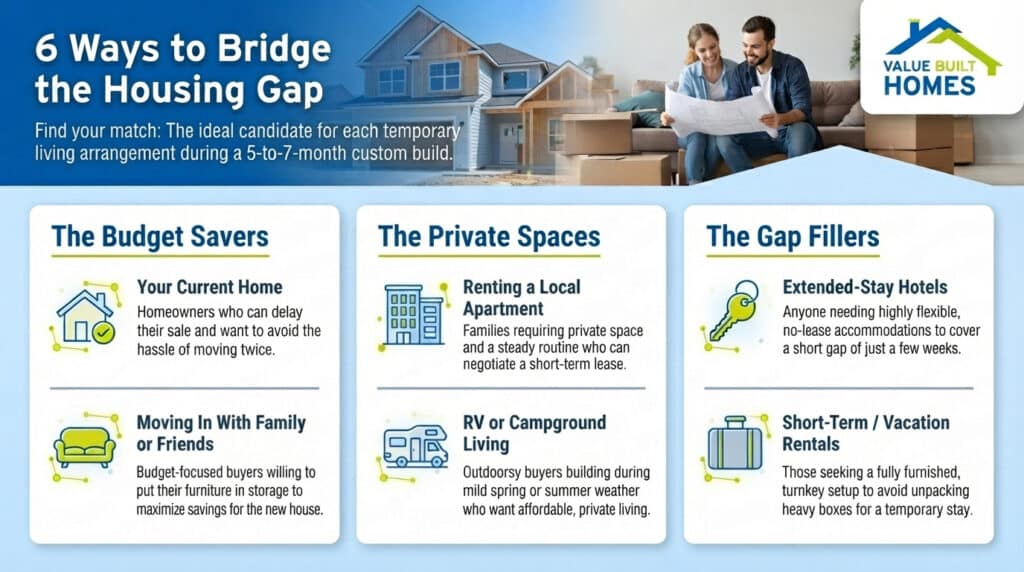
Stay in Your Current Home Until Move-In
If you own your current home and don’t need its equity to start the build, staying put is usually the cheapest and least disruptive option. You keep your routine, your kids stay in their school, and you move exactly once.
The trade-off is carrying two properties at once: upkeep on the current house plus the costs of the build. Value Built Homes removes the biggest overlap cost for most buyers by paying the construction loan interest during the build (more on that in the budgeting section below).
The other question is timing the sale. If you’re weighing whether to sell before construction starts or after you move in, read up on the trade-offs of selling your home before building before you decide.
Rent an Apartment or House Near the Build
Renting gives a household full, private space at a predictable monthly cost. The average apartment in Evansville rents for $1,041 per month, with 2-bedroom units at $1,099 and 3-bedroom units at $1,374.
Over a 5 to 7 month build, that’s roughly $5,500 to $7,700 for a 2-bedroom or $6,900 to $9,600 for a 3-bedroom (calculated from those monthly averages). The catch is the lease: most landlords default to 12 months. Ask about month-to-month or 6-month terms before you sign, even at a slightly higher rate.
Shared housing or a room in a co-living setup can trim the cost further, though inventory in Southern Indiana is thin. It’s worth a look for solo builders more than for families.

Book a Short-Term Rental or Vacation Home
Short-term rentals come furnished, with flexible dates and no long lease, which makes them a good bridge rather than a full-build solution. They typically cost more per month than a standard lease, so they fit a short gap best, like the stretch between a lease ending and your closing date.
If your stay lands outside peak travel season, ask hosts about monthly discounts for a multi-month booking.
Use an Extended-Stay Hotel
Extended-stay hotels bundle furniture, utilities, and housekeeping into one nightly rate with no lease at all. Nationally, extended-stay rates averaged $118.71 per night in the first quarter of 2026, with the economy tier at $58.45.
Multiplied out, that’s roughly $3,560 per month at the average rate or about $1,750 in the economy tier (calculated from the nightly rates; both are national benchmarks rather than Evansville prices). That flexibility is valuable for a few weeks. Across a full 5 to 7 month build, an apartment usually wins on cost.
Stay With Family or Friends
Moving in with family or friends is the cheapest option in cash, and for many buyers it’s how the savings for the new home get finished. The real line item is storage for your furniture and household goods.
In Evansville, a 10×10 storage unit runs $91 to $97 per month, and a 10×20 unit big enough for a full household runs $124 to $142. Over the build, that’s roughly $455 to $680 for a 10×10 (calculated from the monthly rates).
Protect the relationship as carefully as the budget: agree on an end date, contribute to groceries or utilities, and decide up front what happens if the schedule slips.

Live in a Camper or RV at a Campground
A camper on a nearby campground site offers privacy, flexibility, and a low monthly cost in mild weather. Campground rates in the Evansville area vary facility by facility, so call for monthly pricing rather than budgeting from a national figure.
Season is the deciding factor. Campers are hard to heat through an Indiana winter and expensive to cool in high summer, so this option fits a spring or summer build far better than one that runs through January. You’ll also still need storage for most of your household.
Temporary Housing Costs Compared for a 5 to 7 Month Build
Here’s how the main options stack up over a typical Value Built Homes build window, using verified local and national rates:
| Option | Typical cost near Evansville | Over a 5 to 7 month build | Best for / watch out for |
|---|---|---|---|
| Stay in your current home | Your existing housing payment (no new cost) | No new housing cost; the overlap risk is the construction loan, and Value Built Homes covers construction loan interest during the build | Best for owners not forced to sell first. Watch two-property upkeep. |
| Rent an apartment | $1,099 per month for 2 beds; $1,374 for 3 beds (RentCafe, July 2026) | About $5,500 to $7,700 (2 beds) or $6,900 to $9,600 (3 beds), calculated | Best for families needing full space. Watch 12-month lease terms; ask for month-to-month or a 6-month lease. |
| Extended-stay hotel | National average $118.71 per night; economy tier $58.45 (Highland Group Q1 2026 via Business Travel Executive) | Roughly $1,750 to $3,560 per month, calculated from nightly rates | Best for short gaps and no-lease flexibility. Watch the cost at full-build length. |
| Stay with family or friends | Low or negotiated; add storage: 10×10 unit $91 to $97 per month (RentCafe, July 2026) | Mostly the storage bill, roughly $455 to $680 for a 10×10, calculated | Best for maximum savings toward the new home. Watch boundaries and length of stay. |
| Camper or RV at a campground | Rates vary by facility; call for monthly pricing | Site fees plus the camper itself; heating and cooling limits make season the deciding factor | Best for flexible, private, low-cost living in mild months. Watch winter and storage needs. |
Budgeting for the Gap: Deposits, Storage, and the Double Move
Whichever option you choose, a few costs show up in the gap between homes. Plan for these up front:
- The double move: you’ll pay to move out and to move in. Get quotes for both legs early, and cull anything you don’t want to pay to move twice.
- Storage during the gap: if your temporary housing is smaller than your current home, add a storage unit to the budget. Evansville 10×10 units run $91 to $97 per month.
- Deposits and lease mismatch: renting means a security deposit plus first month’s rent up front, and a 12-month lease against a 5 to 7 month build means paying for empty months or paying to break it. A month-to-month or 6-month lease wins here, even at a higher rate.
- Construction loan interest: buyers who stay in a mortgaged home worry about paying a mortgage and construction loan interest at the same time. Through Free Construction Financing, Value Built Homes pays the interest on your construction loan while your home is being built, which takes that overlap cost off the table.
How to Plan Your Move Around the Build Schedule
A little sequencing keeps the temporary stretch from feeling chaotic. Work through these as the build gets scheduled:
- Time the lease to the schedule: don’t commit to temporary housing until you have a construction start date, and leave a month of buffer on the back end for closing and move-in.
- Plan for delays before they happen: month-to-month terms and a flexible end date with hosts are your insurance. These tips for handling home construction delays cover how to stay flexible if the schedule slips.
- Keep kids in their school district: filter your rental search by district lines so a temporary move doesn’t force a mid-year school change.
- Sort pets early: many rentals and most hotels restrict pets or charge extra deposits, so confirm the policy before signing anything.
- Don’t assume you must live near the lot: Value Built Homes clients follow the build in real time through Buildertrend, with photo and progress updates in the app, so choose temporary housing that fits your life rather than the commute to the job site.
- Handle the logistics twice: forward your mail, schedule utility connections and disconnections for both moves, and update addresses for schools, banks, and insurance.

Frequently Asked Questions About Where to Live While Building a House
How long do you need temporary housing when building a house?
For as long as the build runs, plus about a month of buffer for closing and moving. Nationally, single-family homes completed in 2024 averaged 9.1 months from permit to completion, and contractor-built homes averaged about 12 months. A typical Value Built Homes build takes 5 to 7 months, so buyers here usually need temporary housing for six to eight months, still well under the national averages.
Should you sign a 12-month lease while building a house?
Usually not for a 5 to 7 month build. A 12-month lease either leaves you paying for months you won’t use or paying penalties to break it. Ask for a month-to-month or 6-month lease with the option to hold over; many landlords will agree, especially outside peak rental season.
Is an extended-stay hotel cheaper than renting while building a house?
Usually not over a full build. At the national average of $118.71 per night, an extended-stay hotel runs roughly $3,560 per month (calculated), while the average Evansville apartment rents for $1,041 per month. Economy extended-stay brands at $58.45 per night close the gap but still land near $1,750 per month, calculated. Hotels win for short gaps, not long stays.
What happens if construction delays stretch past your planned stay?
You extend, which is why flexibility is worth paying for. Month-to-month leases, hosts with open-ended arrangements, and hotels with no lease at all absorb a delay far better than a fixed-term lease does. Build that possibility into the plan up front.

Start Planning Your Southern Indiana Build
The shorter the build, the easier the housing question gets, and a 5 to 7 month timeline keeps the temporary stretch manageable for most families. Ready to see what your forever home could look like? Browse Value Built Homes’ floor plans to find the right fit, or contact the Value Built Homes team with questions about building in Southern Indiana.