The sticker price on a new home is just the starting point. Your all-in monthly payment includes property taxes, insurance, utilities, maintenance reserves, and several costs that never show up on a listing sheet. For buyers building a new home in Southwest Indiana, the math gets even more layered because you’ll move through two distinct financial phases: a construction period with interest-only draws, followed by a permanent mortgage with a full escrow payment.
This checklist gives you a practical tool to capture every budget category and translate them into real monthly numbers. Work through it before your lender meeting and use it to compare builders with confidence. Whether you’re looking at Value Built Homes’ floor plans starting at $128,100 or evaluating other options in the tri-state area, knowing your true monthly cost before you sign anything is the single best thing you can do for your financial peace of mind.
Key Takeaways
Here’s what you need to know before diving into the full checklist:
- Your “all-in” monthly payment typically runs 30–50% higher than your base mortgage payment once you factor in taxes, insurance, utilities, and maintenance reserves.
- Building a home has two budget phases: a construction period (5–7 months with interest-only payments) and permanent ownership (full PITI plus ongoing costs). Plan for both.
- Indiana’s property tax cap of 1% on owner-occupied homes keeps tax bills relatively predictable, and a new 10% homestead credit (up to $300) takes effect in 2026.
- Builders who cover construction loan interest, like Value Built Homes’ Free Construction Financing program, can save you thousands during the build phase. Factor that into your comparison.
- Use the two-phase worksheet at the end of this post to run your own numbers and bring them to your builder and lender meetings.
Why the Sticker Price Isn’t Your Real Monthly Cost
Most homebuyers focus on the base price when comparing builders and floor plans. But the base price only tells you what the home costs to build. It doesn’t account for the recurring monthly expenses that define what you’ll actually pay each month after you move in.
According to a Zillow analysis of hidden homeownership costs, the average U.S. homeowner pays roughly $1,325 per month in costs beyond their mortgage payment. That’s nearly $16,000 per year in expenses that never appear on the listing price. In SW Indiana, some of these costs run lower than the national average (property taxes and insurance, for example), but they still add up to a significant monthly commitment.
The goal of this checklist is to help you calculate a single, honest number: your total monthly housing cost. That’s the number that determines whether you’ll be comfortable in your new home or stretched thin from day one.
Phase 1: The Construction Period (What You’ll Pay While Your Home Is Being Built)
When you build a new home, your costs during construction look very different from your permanent monthly payment. Understanding these temporary expenses helps you plan your cash flow for the 5–7 months before you move in.
Construction Loan Interest Payments
Most construction loans require interest-only payments on the funds that have been drawn (disbursed) so far. As your builder completes each phase of construction, more money is drawn from the loan, and your monthly interest payment increases. Early in the build, you might pay $200–$400 per month. By the final month, that could climb to $800–$1,200 depending on the loan amount and interest rate.
This is where builder programs can make a real difference. Value Built Homes’ Free Construction Financing program covers the interest on your construction loan during the build phase, which can save you several thousand dollars before you even move in.
Other Costs During Construction
In addition to loan interest, budget for these potential expenses during the build phase:
- Your current housing payment. If you’re renting or paying a mortgage on your current home, you’ll carry that cost alongside construction loan payments until your new home is finished.
- Builder’s risk or course-of-construction insurance. Some lenders require this during the build. Ask your lender whether this is included or billed separately.
- Site preparation costs. Depending on your lot, you may need to budget for grading, tree removal, or well/septic work that falls outside the base home package. These packages typically include foundation, septic, water, and electric, but it’s always worth confirming what’s covered in your specific contract.
- Permit and impact fees. These are typically one-time costs, but they affect your total cash outlay during the build.
Phase 2: Permanent Ownership (Your Ongoing Monthly Budget After Move-In)
Once construction is complete and your loan converts to a permanent mortgage (or you close on a new mortgage), your monthly budget shifts to a predictable, recurring structure. Here’s every category to account for.
Principal and Interest (P&I)
This is the core of your mortgage payment. The amount depends on your loan amount, interest rate, and term. For a $180,000 home with 10% down, a 30-year fixed mortgage at 6.75% would produce a P&I payment of roughly $1,050 per month. Use your lender’s specific numbers for your situation.
Property Taxes (Escrowed Monthly)
Indiana’s statewide effective property tax rate averages about 0.74%, according to SmartAsset’s Indiana property tax data. For owner-occupied homes, the state caps property taxes at 1% of assessed value. In Vanderburgh County (Evansville), the effective rate is roughly 0.74%. On a $180,000 home, that works out to approximately $1,332 per year, or about $111 per month escrowed into your mortgage payment.
Starting in 2026, Indiana homeowners will also benefit from a new 10% supplemental homestead credit (capped at $300 per year), which could reduce your annual tax bill further, according to the Association of Indiana Counties.
Homeowners Insurance (Escrowed Monthly)
Lenders require homeowners insurance, and it’s typically escrowed into your monthly mortgage payment. In Indiana, average annual premiums run between $1,200 and $1,800 for a new construction home, depending on coverage levels and the insurer. That’s roughly $100–$150 per month. New builds often qualify for lower premiums because the roof, electrical, and plumbing systems are all new.
Private Mortgage Insurance (PMI)
If your down payment is less than 20%, your lender will likely require PMI. This typically costs 0.5–1% of the loan amount per year. On a $162,000 loan (a $180,000 home with 10% down), PMI could add $68–$135 per month. Once you reach 20% equity, you can request PMI removal on conventional loans.
Utilities
New construction homes are generally more energy efficient than older homes, but utilities still represent a meaningful monthly cost. Budget for these categories in SW Indiana:
- Electricity: $120–$180/month (varies seasonally)
- Natural gas/propane: $50–$120/month (higher in winter)
- Water and sewer: $40–$70/month
- Trash pickup: $25–$40/month (varies by municipality)
- Internet: $50–$80/month
Total estimated utilities for a new construction home in the region: $285–$490 per month. Energy-efficient construction practices can help keep these costs toward the lower end of the range.
Maintenance and Repair Reserve
Even new homes need maintenance. The standard rule of thumb is to set aside 1–2% of your home’s value annually for upkeep. For a $180,000 home, that’s $1,800–$3,600 per year, or $150–$300 per month. New construction homes typically run closer to the lower end for the first several years, especially when backed by a structural warranty like Value Built Homes’ 2-10 Home Buyers Warranty.
As one Value Built Homes homeowner put it: “My Value Built Homes home is very energy efficient, low/no maintenance, and just perfect for my lifestyle.” That kind of low-maintenance experience is common with new construction, and it’s a real advantage when you’re budgeting for the long term. For a deeper look at what upkeep actually involves, check out Value Built Homes’ guide to new construction home maintenance.
HOA Fees (If Applicable)
Some Value Built Homes subdivisions may have homeowners association fees that cover shared amenities or common area maintenance. Check the lot details for your specific subdivision to determine whether HOA fees apply and what they cover.
Lawn Care and Seasonal Maintenance
If you’re moving from an apartment or a home without a yard, lawn care is a new line item. In SW Indiana, basic lawn mowing service runs $30–$60 per visit, or you can budget $50–$75 per month for DIY supplies and equipment upkeep. Seasonal costs like gutter cleaning, snow removal supplies, and HVAC filter changes add another $20–40 per month when averaged over the year.
Putting It All Together: Your All-In Monthly Payment for a $180,000 New Home
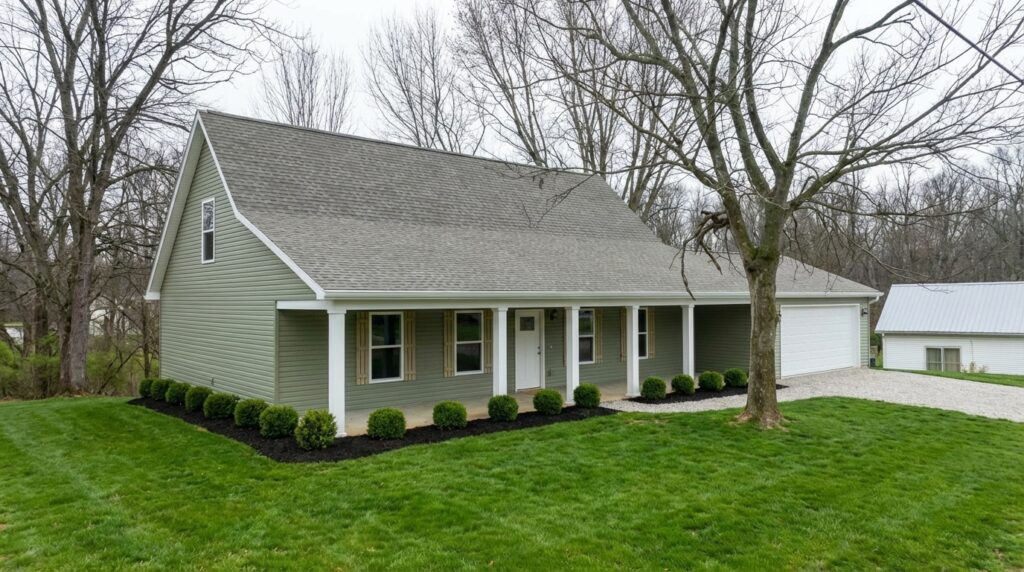
Here’s what a realistic all-in monthly payment might look like for a buyer building a $180,000 home in the Evansville area with 10% down on a 30-year fixed mortgage at 6.75%. These are estimates for illustration. Your actual numbers will vary based on your lender, location, and choices.
| Budget Category | Est. Monthly Cost |
| Principal & Interest | $1,050 |
| Property Taxes (escrowed) | $111 |
| Homeowners Insurance (escrowed) | $125 |
| PMI (10% down) | $100 |
| Utilities (electric, gas, water, sewer, trash, internet) | $375 |
| Maintenance Reserve (1.5%) | $225 |
| Lawn Care / Seasonal Maintenance | $65 |
| Estimated All-In Monthly Payment | $2,051 |
In this example, the base P&I payment is $1,050, but the true all-in monthly cost is roughly $2,051. That’s nearly double the mortgage payment alone. Knowing this number upfront prevents the budget shock that catches many first-time buyers off guard.
Your Two-Phase Budget Worksheet: Construction and Ownership
Use this worksheet to calculate your own numbers. Fill in estimates for each line item, then bring your totals to your builder and lender meetings to make sure nothing gets missed.
Phase 1: Construction Period (5–7 Months)
Track these costs for the months while your home is being built:
- Current rent or mortgage payment: $______/month
- Construction loan interest (average monthly draw payment): $______/month
- Builder’s risk insurance (if required): $______/month
- Storage unit (if downsizing before move-in): $______/month
- Total Phase 1 Monthly Cost: $______
Phase 2: Permanent Ownership (Ongoing Monthly Budget)
These are your recurring monthly costs after the home is complete and your permanent mortgage begins:
- Principal & interest: $______/month
- Property taxes (escrowed): $______/month
- Homeowners insurance (escrowed): $______/month
- PMI (if applicable): $______/month
- Utilities (electric, gas, water, sewer, trash, internet): $______/month
- Maintenance reserve: $______/month
- HOA fees (if applicable): $______/month
- Lawn care / seasonal maintenance: $______/month
- Total Phase 2 Monthly Cost: $______
SW Indiana Budget Tips That Can Lower Your All-In Payment
Living in Southwest Indiana comes with several advantages that can reduce your total monthly housing cost compared to national averages. Here are the most impactful ones to factor into your budget:
- Indiana’s property tax cap. Owner-occupied homes are capped at 1% of assessed value, which provides a hard ceiling on your tax bill regardless of rate fluctuations in your county.
- 2026 homestead credit. The new 10% supplemental homestead credit (up to $300/year) reduces your tax bill starting in 2026.
- Lower cost of living. Utility rates, insurance premiums, and contractor costs in the Evansville metro area generally run below national averages, which benefits every recurring line item in your budget.
- New construction = lower maintenance early on. When you build a new home with modern materials and systems, your maintenance costs in the first 5–10 years are significantly lower than they would be in a 20- or 30-year-old resale home.
Common Budget Mistakes to Avoid When Building a New Home
Even careful buyers miss budget items when they focus too narrowly on the mortgage payment. Watch out for these common gaps:
- Ignoring the construction-to-permanent transition. Your monthly costs will change significantly when your construction loan converts to a permanent mortgage. Plan for both phases, not just one.
- Forgetting escrow adjustments. Your first year’s escrow estimate may be based on incomplete data. In year two, your lender will adjust based on actual tax and insurance bills, which can raise or lower your payment by $50–$150 per month.
- Skipping the maintenance reserve. New homes need less maintenance, but they’re not maintenance-free. Setting aside even 1% of your home’s value annually ($150/month on a $180,000 home) prevents small problems from becoming expensive surprises.
- Not comparing builders on total cost. Two builders might quote similar base prices, but one might include site prep, driveways, and septic in their package while the other charges those as extras. Ask for a detailed breakdown of what’s included before you compare. Value Built Homes’ home packages include foundation, basement, garage, driveways, septic, water, electric, sidewalks, porches, and patios, so there are fewer surprise add-ons. Review the full list on the new home construction page.
Frequently Asked Questions About Budgeting for a New Home in SW Indiana
How much more than my mortgage will I actually pay each month?
Plan for your all-in monthly cost to be 30–50% higher than your base principal and interest payment. The exact amount depends on your property tax rate, insurance premiums, utility usage, and how much you set aside for maintenance. On a $180,000 new construction home in the Evansville area, a $1,050 P&I payment typically becomes roughly $2,000–$2,100 when you account for every recurring cost.
Do I have to pay a mortgage and construction loan at the same time?
If you currently rent or own a home, you will carry that payment alongside your construction loan interest during the build phase. Construction-to-permanent loans simplify this by rolling both phases into a single loan with one closing, which reduces overlap costs. Builders who offer free construction financing also help by covering your construction loan interest during the build.
What’s included in a Value Built Homes home package, and what costs extra?
Value Built Homes’ home packages include the home, foundation, basement, garage, driveways, septic systems, water, electric, sidewalks, porches, and patios. Costs that fall outside the package may include lot purchase (if buying separately), landscaping beyond basic grading, and any personal upgrades. Contact the team for a detailed breakdown specific to your chosen floor plan.
Are property taxes lower on new construction in Indiana?
Not necessarily lower, but they are predictable and capped. Indiana caps property taxes on owner-occupied homes at 1% of assessed value. New construction homes are assessed based on their completed value, so your tax bill will reflect the full home price from the start. The Homestead Standard Deduction (60% of assessed value, up to $48,000 in 2026) and the new 10% supplemental credit help reduce the net bill.
How can I lower my all-in monthly payment when building new?
The most effective strategies include choosing a builder whose package minimizes surprise costs, selecting an energy-efficient floor plan to reduce utility bills, making a larger down payment to eliminate PMI, and choosing a builder who offers free construction financing to save money during the build phase. Shopping for competitive insurance rates before closing can also reduce your escrowed amount.
Start Building Your Budget (and Your Home)
The best time to run these numbers is before you commit to a builder or a floor plan. Use the worksheet above to fill in your estimates, then bring those numbers to your first lender conversation. When you’re ready to explore what’s possible in Southwest Indiana, browse Value Built Homes’ floor plans or contact the Value Built Homes team to start a conversation about your budget and your options.