The biggest worry for most people building a new home is simple: will the price I sign today be the price I actually pay? When you weigh fixed price vs cost plus, you are weighing two different answers to that question. This guide explains what each pricing model means, why a “fixed” price can still move, and how a standardized, cost-engineered plan keeps your number set from contract to move-in.
Key Takeaways
- A fixed-price home contract is not automatically a locked number. It can still move through low allowances, change orders, undefined scope, and unforeseen site conditions.
- A cost-plus contract charges actual costs plus a builder fee, so the final total is unknown until the build ends and cost increases pass straight to you.
- A new for-sale home takes about 7.4 months from permit to completion, which is the window during which prices can shift.
- Residential building material prices were up about 5.1% year over year excluding energy as of August 2026, so cost exposure during a build is real, not theoretical.
- On a standardized, cost-engineered plan, the price is set before you sign, and the builder absorbs material and labor swings for the defined scope.
- Even a set plan has site-specific variables. A basement, a finished driveway, a septic system, or radon where code requires it are priced separately and quoted up front.
What “Fixed Price” and “Cost Plus” Mean When You Build a House
Fixed price and cost plus are the two main ways a builder can price your home, and the difference comes down to who absorbs rising costs. A fixed price locks one number for a defined scope, so the builder carries that risk. Cost plus passes actual costs through to you, so the total is not final until the build ends.
What is a cost-plus construction contract?
A cost-plus contract bills you for the actual cost of labor and materials, plus a set fee or percentage for the builder. You see where the money goes, but the final price stays open-ended, and if costs rise mid-build, that increase lands on you.
What is a fixed-price home building contract?
A fixed-price contract sets one agreed number for a defined scope, and in theory the builder carries the risk of rising costs. The catch is the word “defined.” A fixed price only holds if the scope, allowances, and selections behind it are complete and honest before you sign.
How Three Pricing Models Handle a Rising Market
When building costs rise mid-build, the pricing model decides who pays. On cost plus, the increase flows to you. On a true fixed price, the builder absorbs it for the defined scope. On a standardized, cost-engineered plan, the price is set before you sign and holds for that scope. Here is how the three compare.
| Cost-plus contract | Fixed price, custom build | Fixed price, standardized plan (Value Built Homes) | |
| How the price is set | Actual costs plus a builder fee. Final number is not known until the end. | A single agreed number for a defined scope, priced from custom plans. | The price is set by a proven, cost-engineered plan before you sign. |
| What can still move it | Any change in materials, labor, or scope flows straight to you. | Change orders, low allowances, undefined scope, unforeseen site conditions. | Buyer-chosen add-ons and site-specific items (septic by ground conditions, finished driveway, basement, long or unusual sewer runs, radon where code requires). |
| Who absorbs material and labor swings during the roughly 7.4-month build | The buyer. | The builder, if the scope is truly fixed. | The builder. The plan’s price holds for the defined scope. |
| Construction-loan interest during the build | Buyer pays interest on drawn funds during construction. | Buyer pays interest on drawn funds during construction. | “We pay the interest on your construction loan while your home is being built.” |
| Budget certainty for the buyer | Lowest. | Higher, if allowances and scope are honest. | Highest for a defined plan, with add-ons priced up front. |
Construction costs are about 64.4% of a new home’s price, so most of the bill is the part exposed to these swings.
Why a “Fixed” Price Can Still Change During Construction
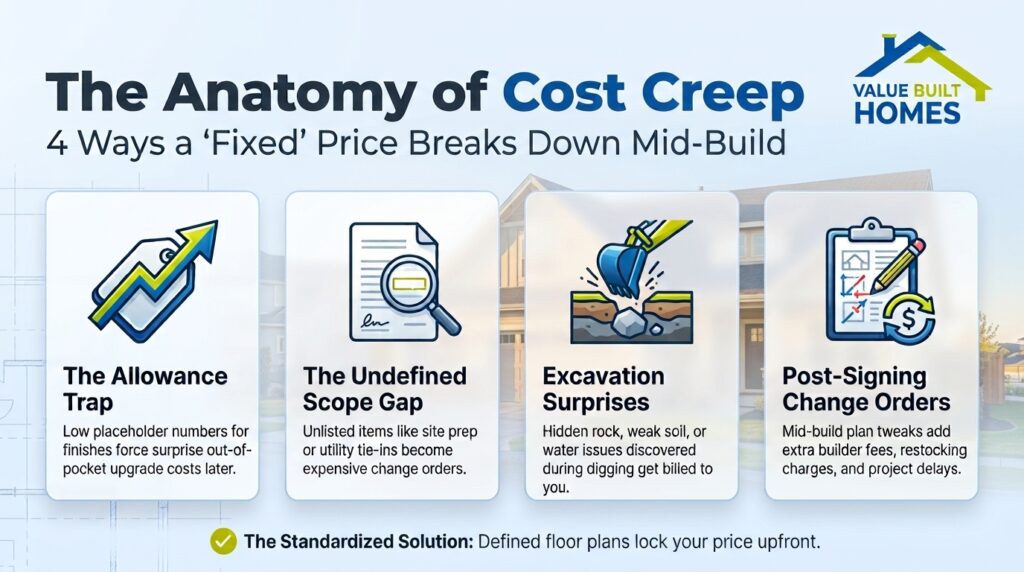
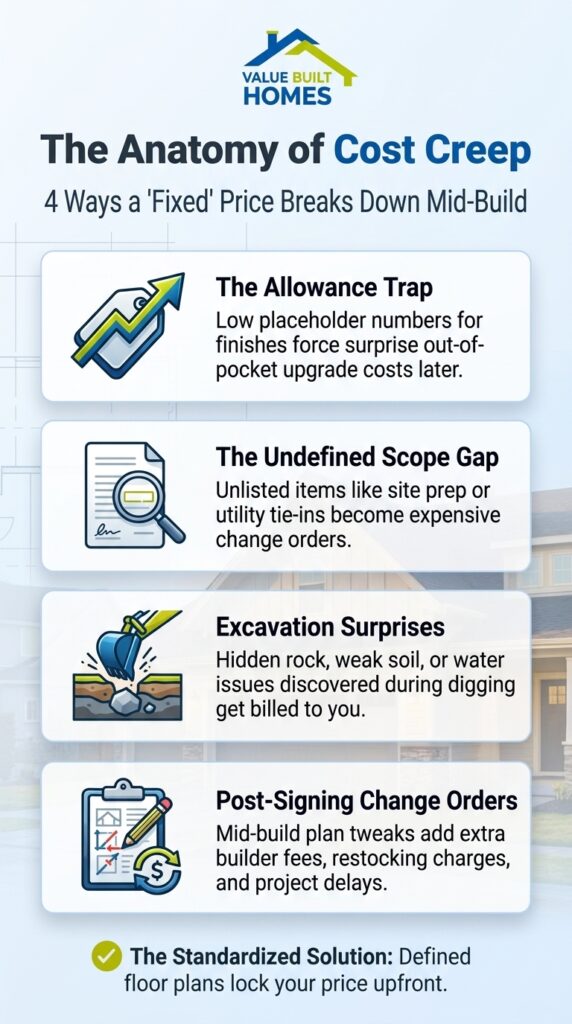
A fixed price can still change because “fixed” only applies to the scope written into the contract. Anything left vague, priced low, or discovered after digging begins can become an extra cost. Four things move a supposedly fixed price most often:
- Low allowances. An allowance is a placeholder amount for a category the builder has not finalized, like flooring or lighting. Set it low, and your real selections cost more, with the difference billed to you.
- Undefined scope. Work that is not written down is not priced. Site prep, utility connections, or finishes left off the contract turn into change orders later.
- Unforeseen site conditions. Rock, poor soil, or drainage problems found during excavation can add cost on any build.
- Change orders. Any change after signing, whether you request it or the builder must correct something, is a change order that adjusts the price.
These are real risks over a real timeline. A new for-sale home takes about 7.4 months from permit to completion, the stretch when prices can move. As of August 2026, residential building material prices were up about 5.1% year over year excluding energy, with softwood lumber roughly 13.0% higher than a year earlier. The National Association of Home Builders notes builders continue to contend with high construction costs and broader economic uncertainty. On an open-ended contract, those swings are yours to absorb.
How to Tell a Real Fixed Price From a Low Starting Number
The difference between a real fixed price and a low starting number is what stands behind it. A real fixed price is backed by a complete, itemized scope with no blank allowances. A low starting number leaves gaps that get repriced after you commit. Before you sign, ask for these in writing:
- An itemized scope that lists every included item, not a single lump sum.
- Firm prices, not “allowances,” for flooring, cabinets, fixtures, and finishes.
- A written list of what is not included, so the add-ons are clear up front.
- Who pays for unforeseen site conditions, and how those costs are handled.
- Whether the number is a price or an estimate. Ask for the exact word.
If a builder cannot answer these, the quoted number is a starting point, not a price.
The Third Option: A Fixed Price Set by a Standardized Plan
There is a third path the comparison guides rarely mention: a fixed price set by a standardized, cost-engineered plan. Instead of pricing a one-off custom design, the builder prices a plan it has built many times, so the number is known before you sign. Value Built Homes uses this model across Southern Indiana and the tri-state area.
With a standardized, cost-engineered building model, every material and finish is selected and priced in advance. There are no blank allowances to fill in later, because the plan is the specification. (See how standardized plans compare with custom plans.)
This is also why the model saves money. Value Built Homes’ standardized approach saves most buyers between 20% and 30% compared with building elsewhere. Plans start around $129,900, with current pricing on the floor plans page. One Value Built Homes homeowner shared that their stick-built home cost about the same as the modular option they had been weighing.
What Still Varies Even on a Standardized Plan
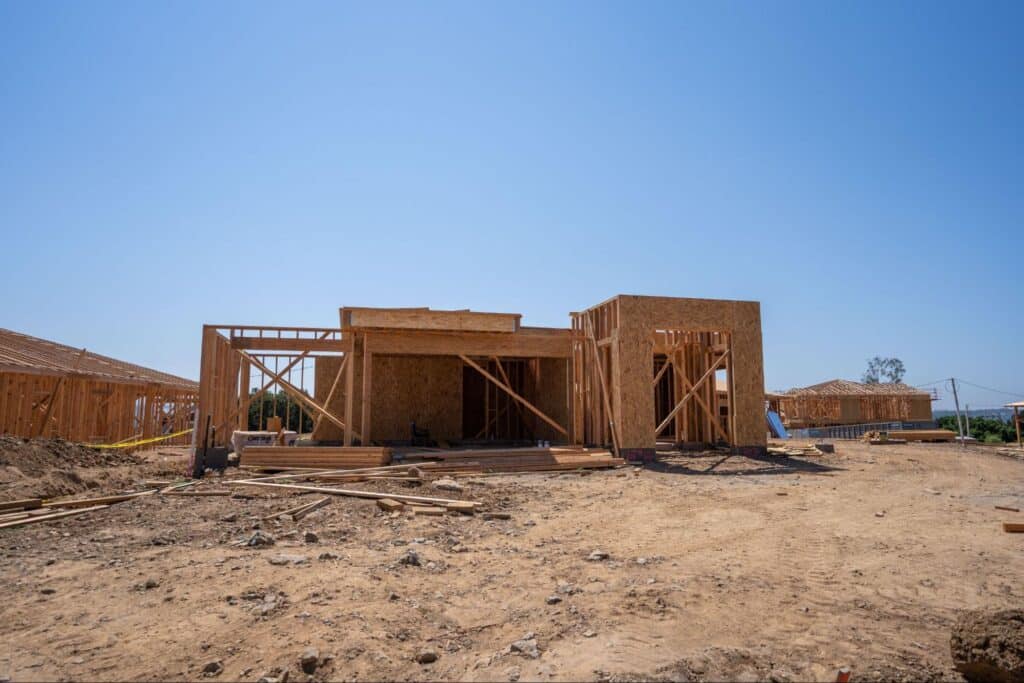
Even with the price set by the plan, some site-specific and lifestyle items are quoted separately, because they depend on your lot and your choices. Value Built Homes prices from standardized plans on one simple rule: if it is part of the standard plan, it is included; if it is not, it is a priced add-on.
Standard in the base quoted price: the site-built home built to standard specifications, the foundation, a standard sewer connection, water and electric, and a rock construction drive (which is not a finished driveway).
Plan-dependent, included only when the plan calls for it: a garage, a porch, or a patio, built into the plans designed for them.
Priced separately as add-ons:
- A basement, which is always optional and never automatic.
- A finished driveway, which is an upgrade from the rock construction drive.
- Sidewalks, including any walk connecting to a garage or front porch.
- A septic system, priced by home size and ground conditions on lots without a sewer connection.
- Long or unusual sewer connections on deep or oddly placed lots.
- Radon mitigation where local code requires it. Otherwise it is an optional add-on.
For a full breakdown, see what’s included in a new construction home versus a priced add-on. This is not a loophole. Every one of these items is priced up front, so there is no surprise scope waiting mid-build.
Who Pays the Construction-Loan Interest During the Build
One cost that moves during almost every build is construction-loan interest, and on most contracts the buyer pays it. A construction loan is a short-term loan disbursed in stages as work progresses, usually at higher rates than a mortgage, with interest-only payments during construction on the funds drawn so far.
Because interest accrues on the drawn balance over several months, it is a real line in your budget that grows as work progresses. Value Built Homes removes that line with Free Construction Financing: the builder pays the interest on your construction loan while your home is being built, one fewer moving cost between contract and move-in.
Which Pricing Model Fits a Budget-Conscious Buyer
A fixed price on a standardized plan fits buyers who want a number they can build a budget and a loan around, with fewer decisions and a shorter timeline. Cost-plus, or a fully custom fixed price, fits buyers who want a one-off design and will manage allowances, change orders, and an open-ended total. For a value-focused buyer in Southern Indiana who wants a forever home without budget surprises, price certainty usually wins, and it continues after move-in through a home buyers warranty that protects the home once you are living in it.
Frequently Asked Questions About Fixed Price vs. Cost Plus
Can the price change on a fixed-price home build?
Yes. A fixed price only covers the scope written into the contract. Low allowances, undefined scope, unforeseen site conditions, and change orders can all raise the final number. A price set by a complete, standardized plan is least likely to move.
What is a change order when building a house?
A change order is a written adjustment to your contract after you sign, whether you request it or the builder needs to make one. Each can add both cost and time. The fewer decisions left open after signing, the fewer change orders you are likely to see.
Does a fixed price include everything?
Not automatically. Even a genuine fixed price covers only what the contract defines. Items like a basement, a finished driveway, sidewalks, or a septic system are typically priced separately because they depend on your lot and your choices. Get every add-on quoted up front rather than discovering it later.
What happens if building material prices rise during construction?
On a cost-plus contract, rising material prices are passed to you. On a true fixed price, the builder absorbs them for the defined scope. Because material prices were up about 5.1% year over year excluding energy as of August 2026, confirm who carries that risk before you sign.
Build With a Price You Can Plan Around
Building a home should not mean guessing at the final number. If you want a clear price set before you sign, Value Built Homes can walk you through the plan and exactly what it includes. Contact the Value Built Homes team to turn a stressful decision into a straightforward one.