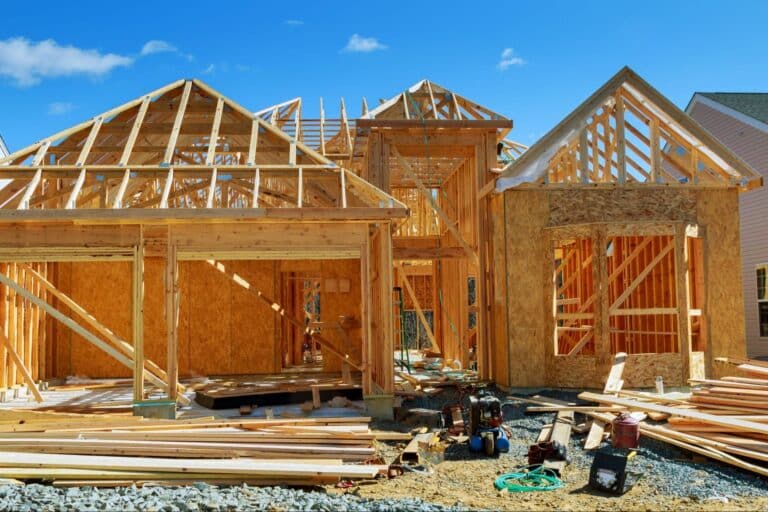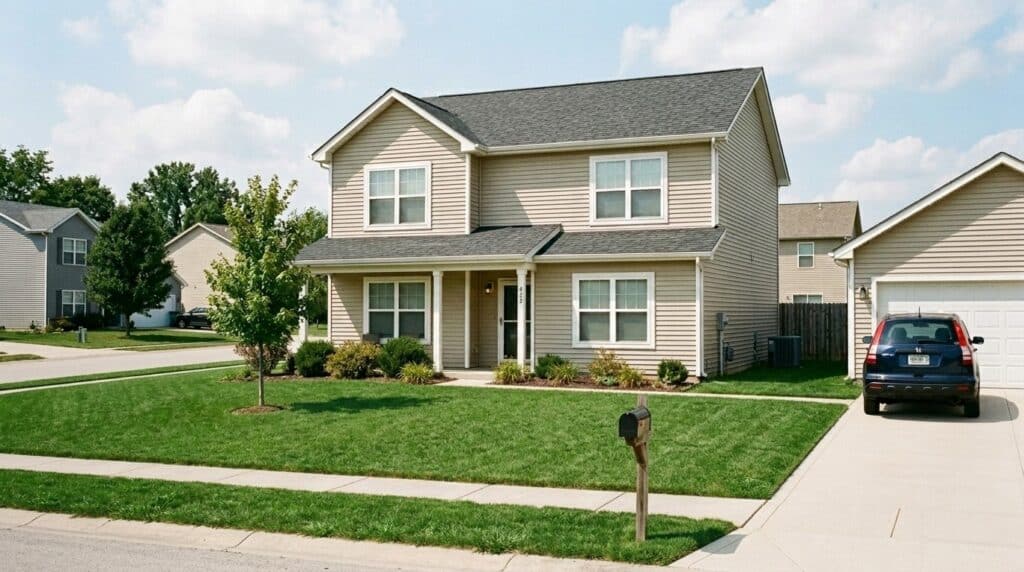
An energy-efficient home is built from the ground up to use less energy for heating, cooling, water heating, and daily living than a standard home. Knowing how to build an energy-efficient home comes down to five systems working together: the building envelope, windows and doors, design and orientation, heating and cooling, and energy-efficient appliances. Getting these right during construction is far easier, and usually less expensive, than retrofitting them later.
This guide is for people planning a new home build. That distinction matters, because designing efficiency into a home during construction is a different project than improving one that already exists. If you own your home today and want to lower its energy use, the better starting point is upgrading an existing home, where the work centers on sealing, added insulation, and equipment swaps. For a new build, you make those decisions before the walls go up, which is when efficiency is cheapest to achieve and easiest to get right.
The Five Systems of an Energy-Efficient Home
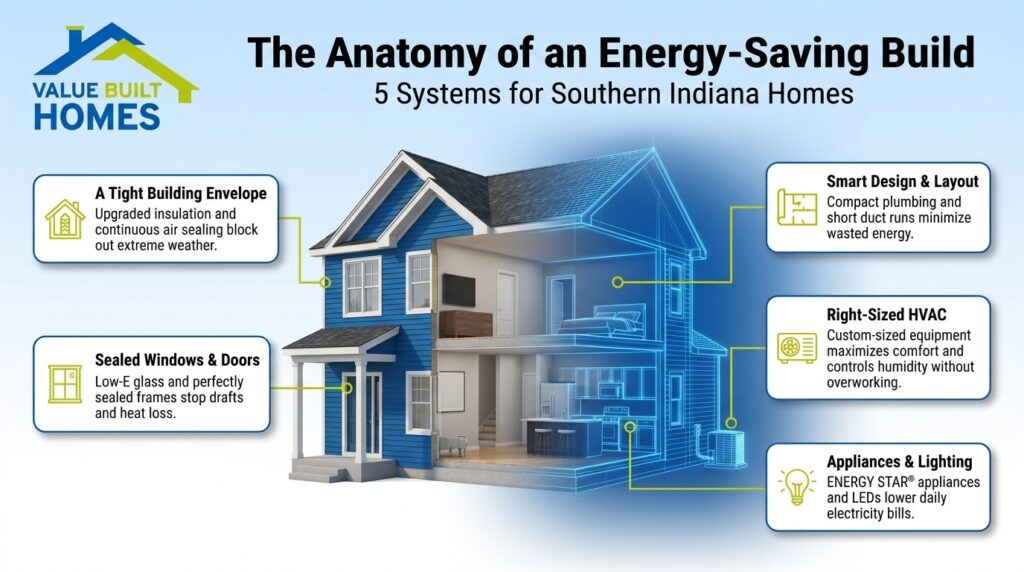
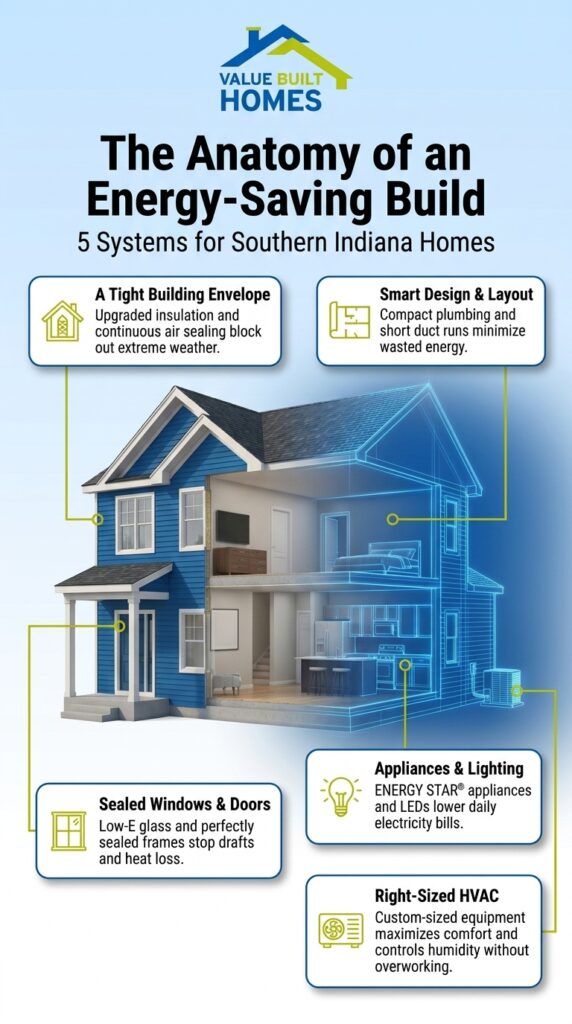
Energy use in a home is not controlled by any single feature. It comes from five systems working together: the building envelope, windows and doors, design and orientation, heating and cooling, and appliances and lighting.
A home’s efficiency depends on what the U.S. Department of Energy calls a whole-house systems approach, where the parts work together rather than in isolation. The table below shows how an energy-efficient build compares to the Indiana code minimum for Southern Indiana, which sits in IECC Climate Zone 4.
| System | Indiana Code Minimum (Climate Zone 4) | Energy-Efficient Build |
| Wall insulation | R-15 | R-15 or higher; continuous exterior insulation adds further R-value |
| Attic insulation | R-38 | R-49 (recommended for maximum efficiency in this climate) |
| Duct insulation | R-8 for ducts 3 inches or larger, R-6 for smaller ducts | Same code minimum, with sealed duct joints and ducts run inside conditioned space where possible |
| Air sealing | Visual inspection per code | Continuous house wrap, sealed penetrations, tested air leakage rate |
| Windows | Meets code U-factor | Low-emissivity coatings, properly installed and sealed |
| HVAC | Meets code | Right-sized to a Manual J load calculation, not oversized |
Code minimums reflect the Indiana Residential Code (2018 IECC adoption) for Climate Zone 4, which covers Southern Indiana.
A Tight Building Envelope: Insulation, Air Sealing, and Roof
The building envelope is the highest-leverage system in an energy-efficient home, and it is the hardest to fix after the fact. The envelope is everything separating conditioned indoor air from the outside: insulation, the air barrier, exterior sheathing, and the roof. Because most of it is buried inside walls and the attic, it has to be built correctly during framing. Retrofitting insulation or air sealing into a finished home is disruptive and costly, which is why a new build is the time to get it right.
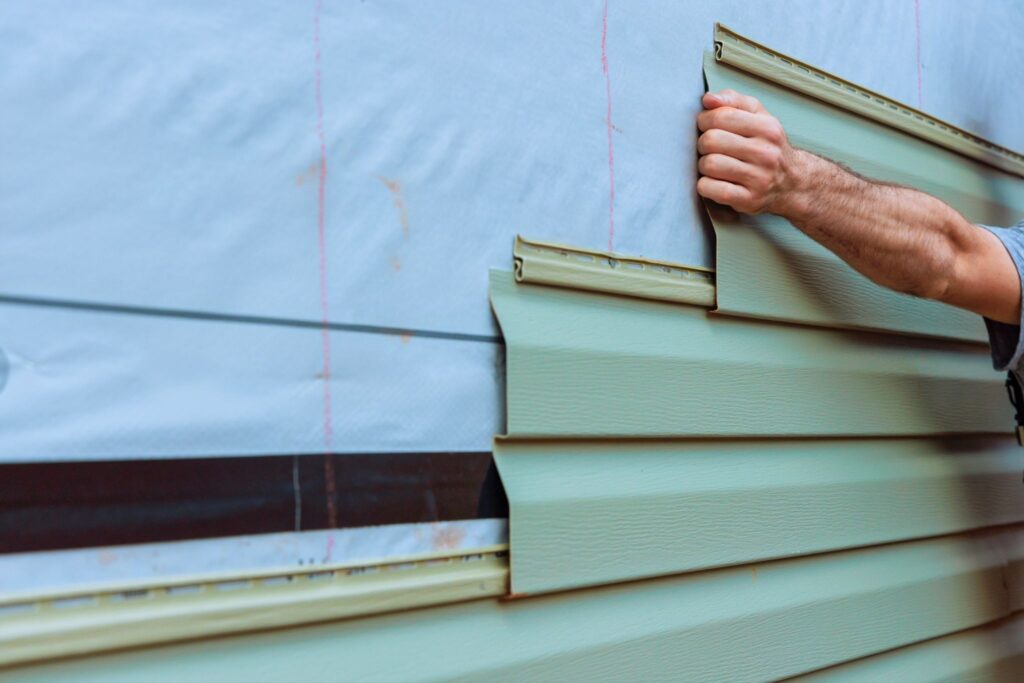
Insulation slows heat transfer, but it only performs if air is not leaking around it, so continuous air sealing matters as much as R-value. Value Built Homes uses Typar house wrap as a continuous air barrier behind the siding, which limits drafts so the insulation can do its job. A durable roof, finished with GAF shingles, protects the insulated attic beneath it.
Energy-Efficient Windows and Doors
Windows and doors are common weak points in a home’s envelope, because every opening is a place where heat can escape and air can leak. Specifying efficient units while the home is being built is far simpler than swapping them out years later. Two things determine how a window performs: the unit itself, and how well it is installed and sealed into the rough opening.
Even a high-quality window will leak if the frame is not sealed properly, so installation is as important as the product. Value Built Homes specifies Sun Windows with low-emissivity coatings, properly sealed and suited to Indiana’s humid summers and cold winters. Quality doors, weatherstripped and sealed at the threshold, complete the openings an efficient envelope depends on.
Smart Design and Orientation
Smart design lowers a home’s energy use before any equipment is installed. How a house sits on its lot, where its windows face, and how its rooms are arranged all affect how much heating and cooling it needs. Thoughtful window placement can bring in natural light and warmth in winter while limiting summer heat gain.
Floor plan design matters in ways buyers rarely think about. Compact plumbing runs mean less heat lost in hot water lines, and efficient ductwork layouts mean conditioned air reaches every room without long, leaky runs. Standardized, value-engineered floor plans bake these decisions in, so efficiency is designed into the layout rather than added on later. Good design is the least visible part of an efficient home and one of the most effective.
Heating, Cooling, and Water Heating
A right-sized heating and cooling system is one of the most overlooked parts of an efficient home. Bigger is not better. An oversized furnace or air conditioner short cycles, switching on and off rapidly, which wastes energy and leaves humidity behind in summer. An undersized system runs constantly and still struggles to keep up.
The fix is a Manual J load calculation, which sizes equipment to the actual home rather than a rule of thumb. Sealed ductwork matters too, since air that leaks out of ducts before it reaches a room is energy paid for and wasted. Water heating belongs to this system as well, and pairing an efficient unit with short, well-insulated hot water lines reduces standby losses. For a closer look at getting this right, see our guide to HVAC sizing for comfort in a new build.
Energy-Efficient Appliances and Lighting
Appliances and lighting are the daily-use layer of an efficient home. They will not make or break performance the way the envelope does, but they shape the energy bills a family sees every month. ENERGY STAR-rated appliances and LED lighting are the practical default, using less electricity for the same result.
Refrigerators, dishwashers, and clothes washers all run for years, so efficient models pay back steadily over the life of the home. Value Built Homes includes Whirlpool appliances in its homes. Choosing efficient lighting from the start also avoids the steady waste of older incandescent bulbs, which give off more heat than light.
What Climate Zone 4 Means for Building Efficiency in Southern Indiana
Southern Indiana sits in IECC Climate Zone 4, and that designation shapes what an energy-efficient home here actually needs. Climate Zone 4 means a home has to handle two opposite stresses well: hot, humid summers and cold winters.
Humid summers test both the cooling system and the envelope. When warm, moist air leaks into a home, the air conditioner has to work harder to remove heat and moisture, which is why air sealing and a right-sized system matter so much in this climate. Cold winters do the opposite, pushing heat out through any gap or under-insulated surface, which is where insulation levels and continuous air barriers earn their keep.
This is also why the code minimums for Southern Indiana differ from those in central and northern Indiana, which fall in the colder Climate Zone 5. The insulation and duct values in the table above are the Climate Zone 4 figures that apply here. Building to those minimums meets code. Building above them, with higher attic insulation and tested air sealing, is what separates a merely compliant home from an efficient one.
What ENERGY STAR Certification Means for Long-Term Savings
ENERGY STAR certification is a national benchmark for new homes that perform better than standard construction. ENERGY STAR certified homes and apartments are designed and constructed to be more efficient, exceeding minimum energy code requirements by at least 10 percent. That margin comes from the same systems covered above: a tighter envelope, better windows, right-sized equipment, and verified performance.
The program is well established. There were 190,000 ENERGY STAR certified homes and apartments built in 2023, 12 percent of all new homes built in America that year, with more than 2.7 million certified to date. Those figures show the standard is verifiable, not a marketing label.
It is worth being clear about what certification is and is not. A home can be highly energy-efficient without carrying the ENERGY STAR label, because the label requires a specific third-party verification and inspection process. Value Built Homes builds with energy-efficient materials and practices but does not certify its homes through ENERGY STAR. The efficiency comes from how the home is built, not from a certificate.
For homeowners, the practical payoff is operating cost. A home that beats code by a meaningful margin typically costs less to heat and cool, year after year.
Why a Local Builder Who Designs Efficiency In Matters
A builder who designs efficiency into the home from the start gives buyers an advantage that is hard to add later. Efficiency is not a single upgrade. It is the result of dozens of decisions made during design and framing, and a builder who treats it as the default rather than an add-on produces a more consistent result.
Value Built Homes builds in Southern Indiana and designs efficiency into its standardized floor plans. Because the plans are refined and repeated rather than reinvented for every project, the envelope details, window specifications, and system layouts that drive efficiency are worked out in advance and built the same way every time. That consistency is part of why the homes perform.
One Value Built Homes homeowner described their home as very energy efficient and low maintenance, and just right for their lifestyle. That result is the point of designing efficiency in from the beginning rather than chasing it with upgrades afterward.
Frequently Asked Questions About Building an Energy-Efficient Home
What energy-efficient features should a new home have?
The most important features fall into five systems: a tight building envelope with good insulation and air sealing, energy-efficient windows and doors, a smart floor plan and orientation, a right-sized heating and cooling system, and ENERGY STAR-rated appliances. No single feature makes a home efficient. They work together, and the envelope and the heating and cooling system tend to have the largest effect on comfort and energy use.
Is it cheaper to build an energy-efficient home or upgrade an existing one?
Building efficiency in during new construction is usually less expensive than retrofitting an existing home later. While a home is being built, insulation, air sealing, efficient windows, and properly sized systems can be installed before the walls and finishes are in place. Adding those same improvements to a finished home means opening up walls, ceilings, or mechanical systems, which costs more and disrupts more.
Do energy-efficient homes have to be ENERGY STAR certified?
No. A home can be highly energy-efficient without carrying the ENERGY STAR label. ENERGY STAR certification requires a specific third-party verification and inspection process, but the efficiency itself comes from how the home is designed and built. Many efficient homes are never formally certified, and the absence of a label does not mean a home performs poorly.
How much can an energy-efficient home save on utility bills?
Exact savings depend on the home’s size, its systems, local energy rates, and how the household uses energy, so no single figure applies to every home. As a verified benchmark, ENERGY STAR certified homes are designed to exceed minimum energy code by at least 10 percent, and a home that beats code by a meaningful margin typically costs less to heat and cool. The savings continue for as long as you own the home.
How long does it take to build an energy-efficient home in Indiana?
Building an energy-efficient home in Indiana generally takes about the same time as building a comparable standard home, because efficiency comes from the design and the materials rather than from a slower process. The construction timeline depends mostly on the floor plan, site conditions, and weather. Designing efficiency in from the start does not add time the way major retrofits would to an existing home.
Start Planning an Energy-Efficient Home in Southern Indiana
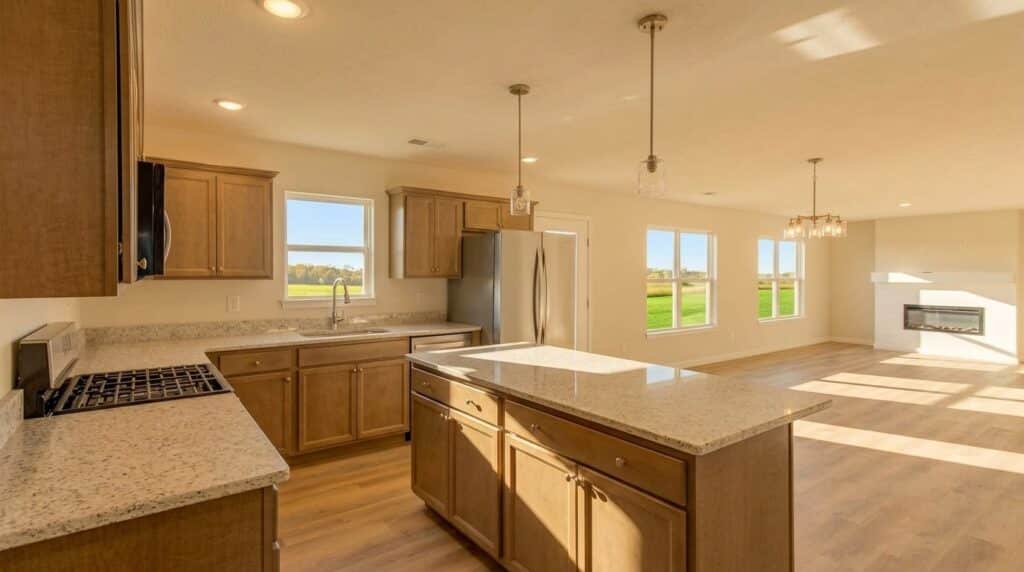
An energy-efficient home starts with decisions made long before move-in day, and the right time to make them is during planning and design. Explore Value Built Homes floor plans to see how efficiency is designed into each layout, or contact the Value Built Homes team to talk through building in Southern Indiana. Building it in from the start is the most reliable way to get a comfortable home that costs less to run.